Which Cannabis Genetics Are Ideal for LST? 8 Exciting Strains Compared

8 Genetics for LST: Which Ones Are Really Suitable for Low Stress Training?
Real Killer Skunk, Kushblast Kush, Cap Junky, or perhaps a Haze? Not every plant can be shaped in the same way. We present 8 interesting genetics for Low Stress Training and explain what really matters.
Low Stress Training is one of the most popular methods for growers who want to develop shorter, wider, and more controlled plants. Our complete Cannabis Training Guide explains the fundamentals and how LST differs from topping, FIM, and ScrOG.
But this is exactly where a question begins that many LST guides barely answer:
Which genetics are particularly well suited to LST?
A compact, heavily branched plant responds differently from a tall Haze with long internodes. Some plants are very easy to spread apart, while others benefit from much smaller and slower adjustments.
We have therefore selected eight interesting genetics whose growth patterns can make them especially appealing for Low Stress Training.
What Makes a Good LST Genetic?
Before looking at individual strains, one point is especially important:
There is no genetic for which LST works automatically.
The individual plant is always what matters most.
Even so, certain traits can make training considerably easier.
Flexible Side Branches
Young, still-pliable side branches are easier to guide outward without creating unnecessary mechanical stress. The article on cannabis anatomy and plant health explains how nodes, shoots, and side branches are structured.
Good Branching
The more vigorous side branches a plant develops, the more options there are for distributing its structure evenly across the available area.
Strong Stretch
At first, this may sound like a disadvantage, but it can be very useful for LST.
Genetics with strong vertical growth can be controlled more effectively when they are guided sideways early. This can make a major difference where vertical space is limited. The Cannabis PPFD and DLI Guide helps with planning the lighting.
Enough Space Between Shoots
Very densely growing plants can be harder to open up. A little more space between individual branches makes positioning easier.
With that in mind, let us look at our candidates.
1. Real Killer Skunk - strong branching as a foundation
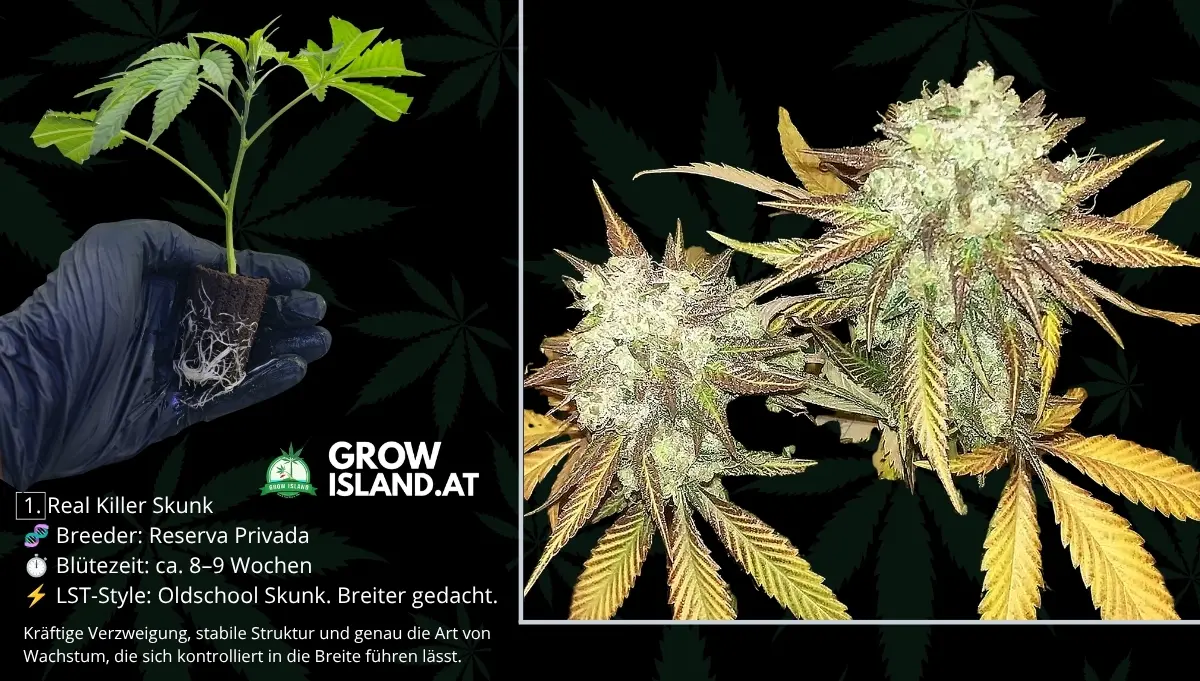
Real Killer Skunk is interesting for growers who want to train a vigorous plant with pronounced lateral development.
Instead of allowing one dominant main stem to continue growing upward, the stronger side branches can gradually be guided outward.
This creates a wider plant structure in which several shoots can develop at a similar height.
Why is it interesting for LST?
- strong side branches
- stable plant structure
- good branching
- interesting for building a wider canopy
LST factor: ★★★★★
Anyone looking for a classic, well-branched plant for structured training should definitely keep Real Killer Skunk in mind.
2. Kushblast Kush - compact, vigorous, and easy to control
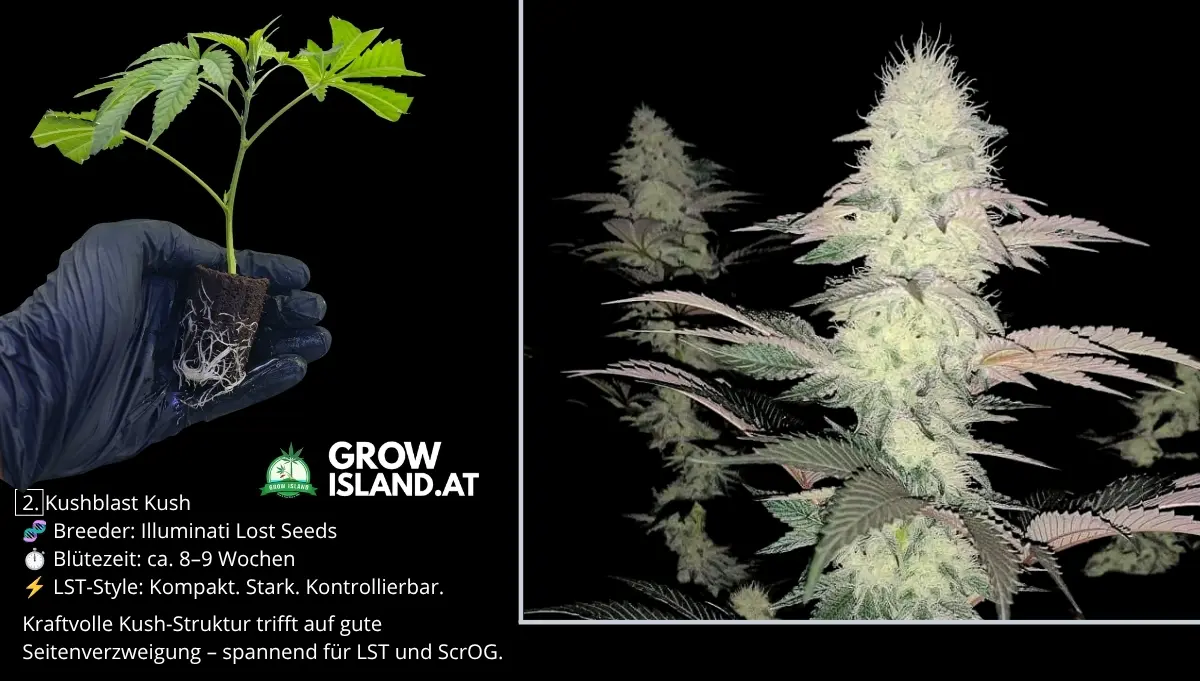
Not every LST plant has to grow strongly upward.
Kushblast Kush shows why more compact genetics can also be interesting.
With a vigorous and branching growth pattern, training is less about controlling extreme stretch. Instead, individual side branches can be opened deliberately and distributed across a larger area.
This type of growth can be particularly useful in smaller cultivation spaces.
Why is it interesting for LST?
- compact growth
- good lateral branching
- controllable plant structure
- also interesting in combination with ScrOG
LST factor: ★★★★★
If you prefer your plants to stay short and wide rather than tall, Kushblast Kush is one of the most interesting candidates in this selection.
3. Akathcuki Jutsu - planning LST directly from seed
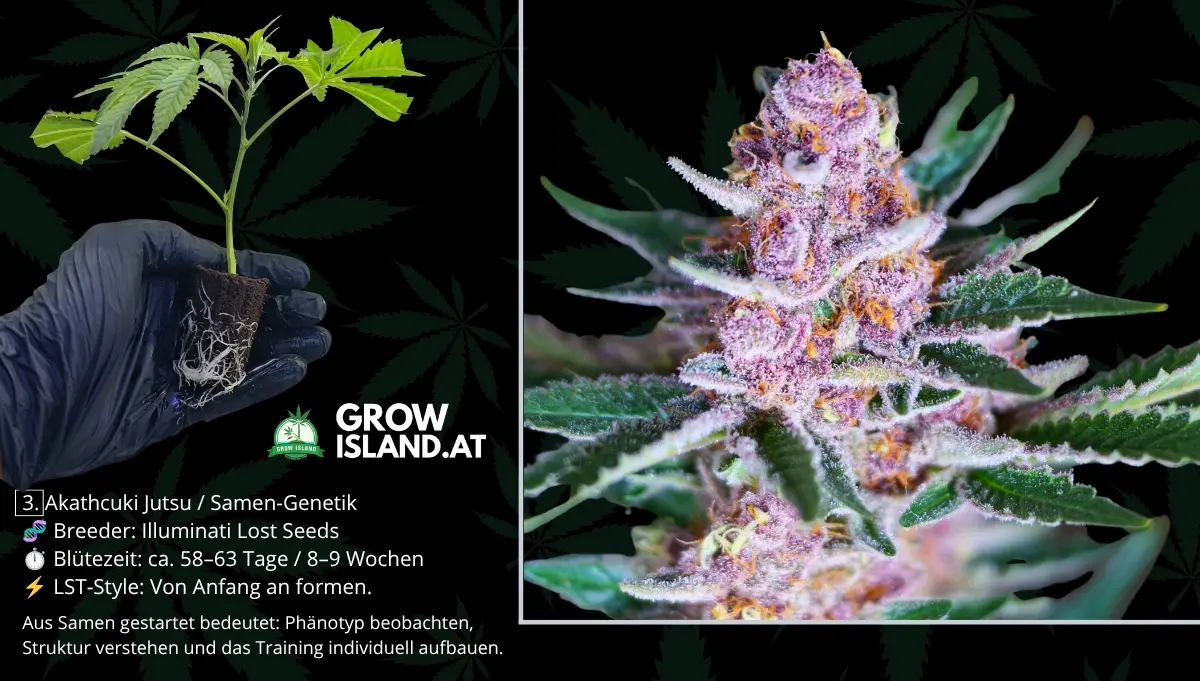
Special note: Akathcuki Jutsu is a seed genetic in this list
Akathcuki Jutsu from Illuminati Lost Seeds differs from several other candidates in this selection:
Here, training begins with a plant grown from seed.
This opens up an interesting advantage.
You can observe the structure from the very beginning and adapt the training to the actual phenotype.
Does the plant develop long side branches?
Does it remain more compact?
Which shoots take the lead most quickly?
Instead of following a rigid formula, LST can be adjusted step by step to the individual plant.
Why is it interesting for LST?
- the structure can be planned early
- individual adaptation to the phenotype
- training can be developed gradually
- interesting for growers who want to shape their plants themselves from the start
LST factor: ★★★★☆
Important: In this selection, Akathcuki Jutsu is a seed genetic, not a cannabis clone .
4. Dante's Inferno #8 - deliberately distributing vigorous shoots
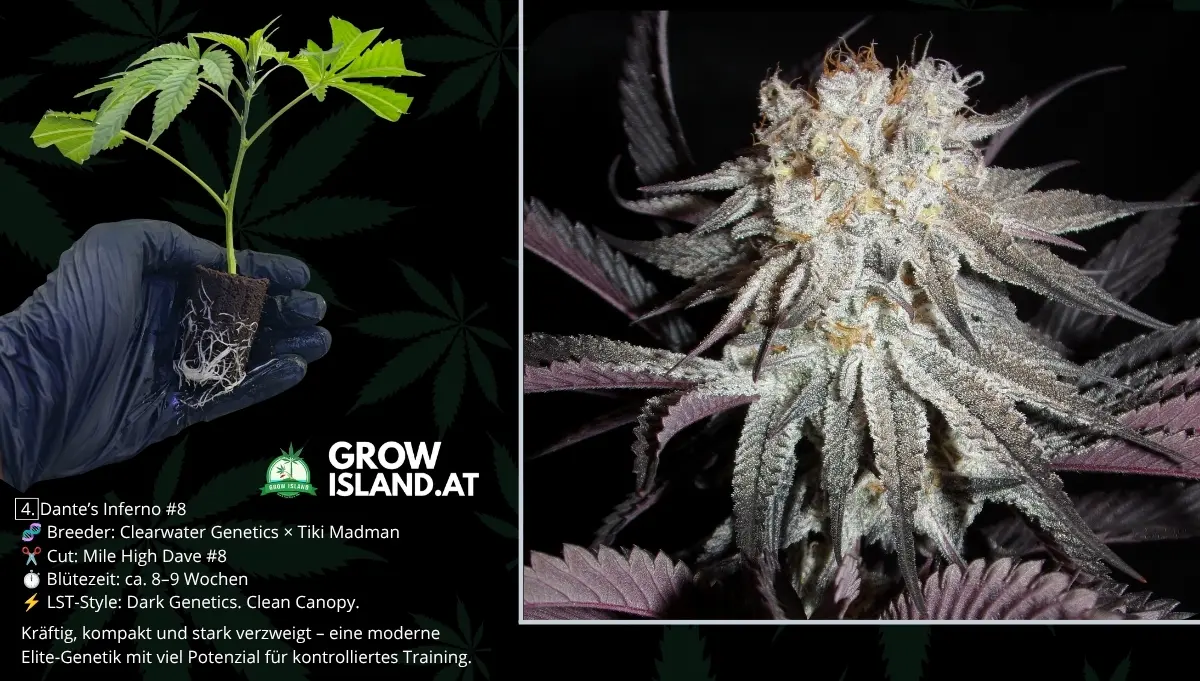
Dante's Inferno #8 is especially interesting when several vigorous, dominant shoots emerge during vegetative development.
These are precisely the shoots that can be spread apart gradually with LST.
The goal is not to bend the plant as dramatically as possible.
It is much more important to position dominant areas so that no single top permanently controls the entire plant structure.
Why is it interesting for LST?
- vigorous shoot development
- interesting for structured canopy management
- dominant shoots can be distributed deliberately
- a good foundation for a wider plant structure
LST factor: ★★★★☆
With Dante's Inferno #8 in particular, several small adjustments are preferable to one extreme bend.
5. Cannalope Haze - when stretch becomes an advantage
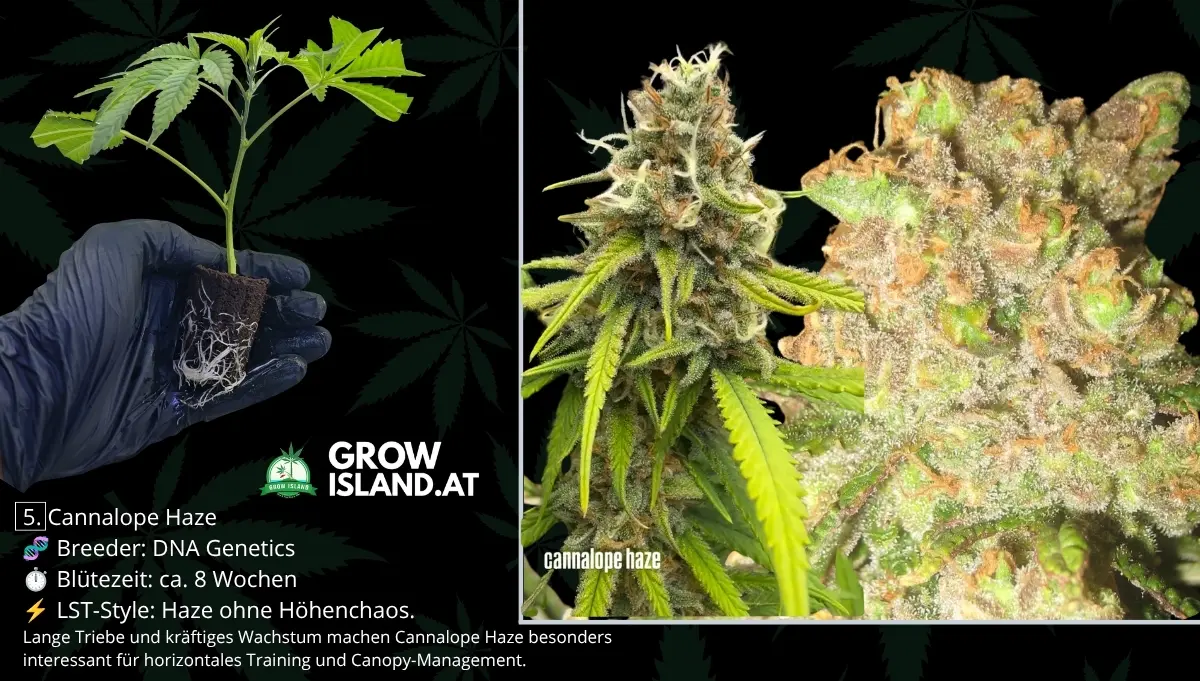
Haze-oriented genetics are an especially interesting subject in Low Stress Training.
Why?
Because the very trait that can quickly become a problem in small grow spaces can also be a strength for LST:
long branches and pronounced vertical growth.
With Cannalope Haze, longer shoots can be guided sideways at an early stage. This helps control the height while making better horizontal use of the available area.
Why is it interesting for LST?
- longer branches
- potentially pronounced stretch
- well suited to horizontal training
- interesting where grow-tent height is limited
LST factor: ★★★★★
With Haze genetics in particular, it can be wise to act before the plant has already grown too tall. The article How far should an LED grow light be from cannabis? helps coordinate plant height and light distance.
Plan early and guide slowly.
That is often the better strategy here.
6. Cap Junky - opening vigorous growth in a controlled way
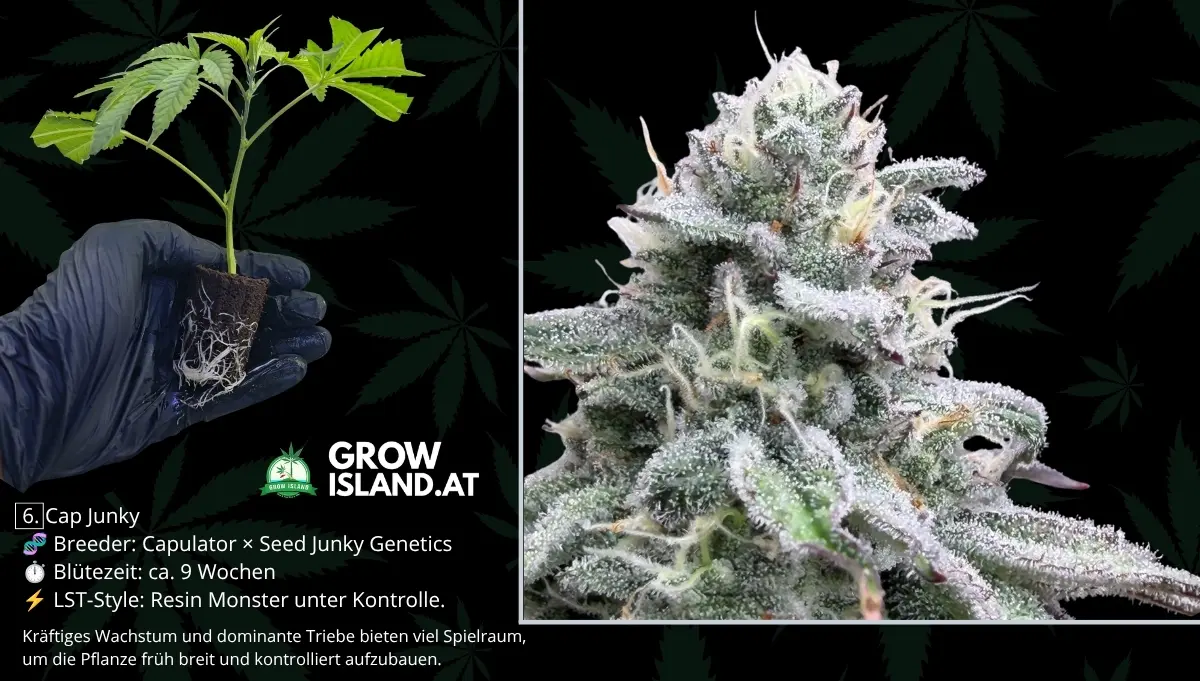
Cap Junky is one of the modern genetics whose vigorous plant structure creates interesting training opportunities.
On healthy plants, stronger side branches can gradually be guided outward.
This creates more space between individual shoots and can help build a wider plant structure.
Why is it interesting for LST?
- vigorous growth
- good shaping possibilities
- dominant shoots can be controlled
- suitable for a wider canopy
LST factor: ★★★★☆
Cap Junky is particularly interesting for growers who do not simply let a plant grow, but deliberately help shape its later structure.
7. Colorado Nightshifter - less height, more area
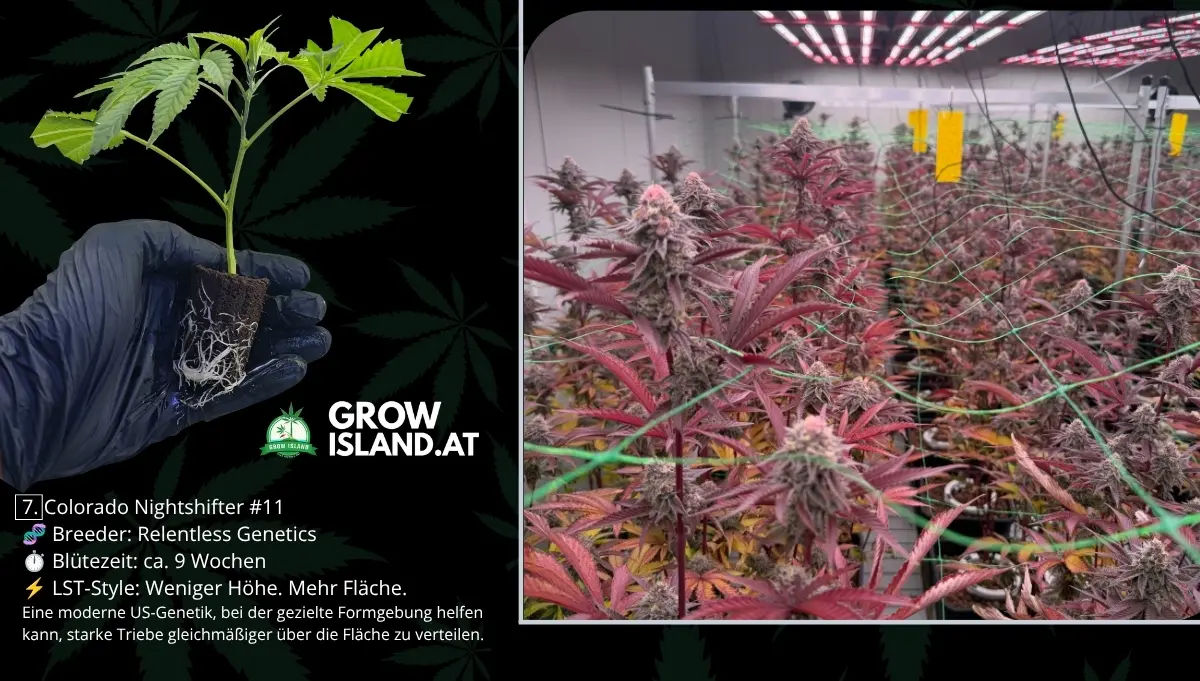
With Colorado Nightshifter, LST is primarily about shaping the plant.
Gradually guiding stronger shoots sideways opens up the plant structure.
This can be particularly interesting when several branches grow close together and you deliberately want to create more space between them.
Why is it interesting for LST?
- good shaping possibilities
- a wider plant structure is possible
- better distribution of individual shoots
- interesting for controlled growth
LST factor: ★★★★☆
Colorado Nightshifter demonstrates that LST does not have to be used only for height control.
Sometimes the objective is simply to create a better plant structure .
8. Super Buff Cherry #26 - toward an even canopy
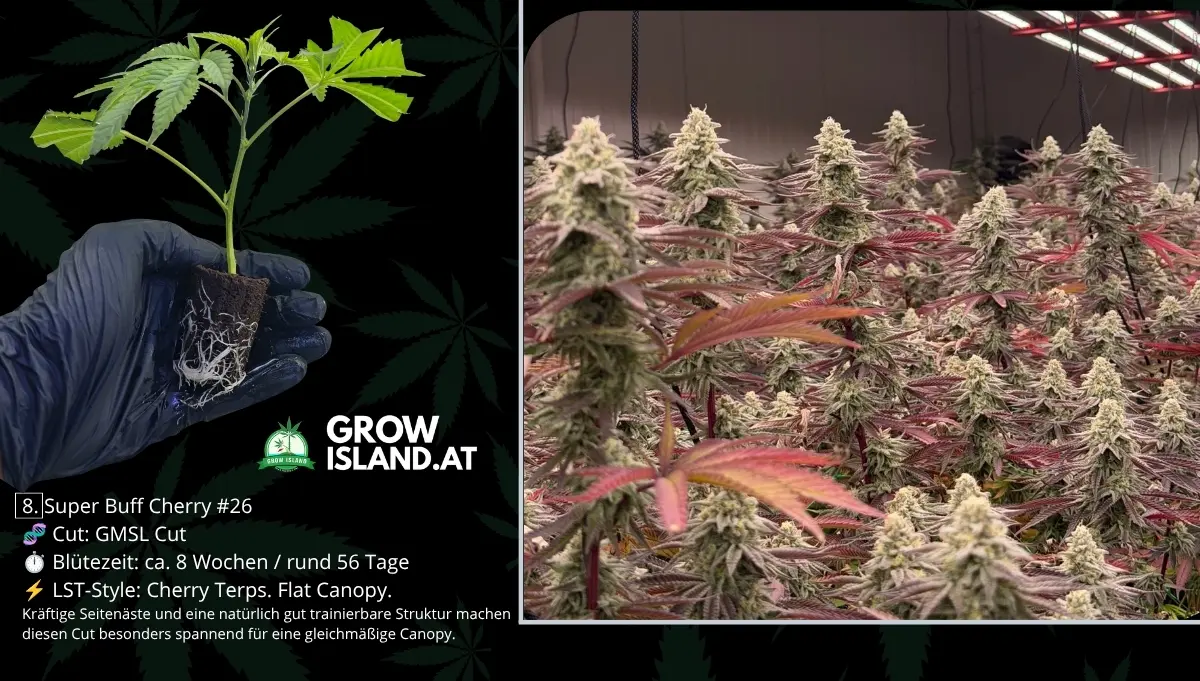
Super Buff Cherry #26 is especially well matched to a training goal pursued by many indoor growers:
several main shoots at roughly the same height.
Instead of allowing one shoot to grow far above the rest, dominant areas can be guided outward carefully.
This gives the side branches below an opportunity to catch up.
Why is it interesting for LST?
- interesting for a wide canopy
- several branches can be brought to a similar height
- a good foundation for an even plant structure
- well suited to systematic canopy management
LST factor: ★★★★★
Anyone aiming for the most even possible surface beneath the grow light should take a closer look at Super Buff Cherry #26.
Which of the 8 Genetics Fits Your LST Style?
There is no single perfect choice.
The right genetic depends on what you want to achieve with the training.
Do you want to control stretch?
Then genetics with longer branches are especially interesting.
Our candidate:
Cannalope Haze
Do you want to make a compact plant wider?
Then vigorous plants with strong branching can be interesting.
Our candidates:
Kushblast Kush
Real Killer Skunk
Do you want to build the plant yourself from the beginning?
Then a seed genetic is an interesting choice.
Our candidate:
Akathcuki Jutsu - Illuminati Lost Seeds
Do you want the most even possible canopy?
Then genetics whose stronger side branches can be distributed deliberately are particularly interesting.
Our candidates:
Super Buff Cherry #26
Cap Junky
Dante's Inferno #8
Colorado Nightshifter
Clone or Seed - Which Is Better for LST?
Both have their advantages.
LST with cannabis clones
With a clone, part of the genetic starting point is already known.
This becomes particularly useful when several clones of the same cut are used. Plant structures and training responses can then be compared more easily. The article Cannabis clone or seed? explains the differences between the two starting formats in more detail.
LST with seeds
With seeds, the individual phenotype requires closer observation.
That means:
Do not begin by following a rigid training plan immediately.
First observe how this particular plant actually grows , then adapt the LST accordingly.
That is exactly why Akathcuki Jutsu is marked separately in our list as a seed genetic.
The Biggest Mistake: Buying a Strain and Starting LST Immediately
Even the most theoretically suitable LST genetic should not be bent aggressively immediately after arrival or transplanting.
Before the first training session, the plant should:
- look healthy
- be growing actively
- be firmly rooted
- show no clear symptoms of stress
- have sufficiently flexible young shoots
This is especially important with newly arrived cannabis clones. The guide Cannabis Clones from Grow Island - Strength from the Start explains what matters during the initial phase.
Let the plant acclimatize first. Train it afterward.
A genetically suitable plant offers little advantage if it is trained at the wrong time. If visible problems appear, first use the Cannabis Stress Guide to assess them.
LST Is Not a One-Time Action
Many beginners make a simple mistake:
They tie the main stem down once and then consider the training finished.
But the plant keeps growing.
New side branches turn upward.
Other shoots assume dominance.
The stems become thicker.
You should therefore inspect the plant structure regularly.
Pay particular attention to:
- new dominant shoots
- ties that have become too tight
- thickening stems
- uneven heights
- areas inside the plant that have become too dense
The goal is not a perfectly symmetrical plant.
The goal is a healthy, manageable, and sensibly structured plant . If inner areas become too dense, the risk of an unfavorable microclimate increases. The guide How to identify and prevent mold on cannabis provides more detail.
LST or ScrOG - or Both?
These two methods are often combined.
LST is first used to shape the individual branches.
A ScrOG net can later help distribute them across a larger area.
A simple way to think about it is:
LST shapes the plant.
ScrOG organizes the area.
Genetics with longer or vigorously growing side branches can be especially interesting for this combination. The complete guide to LST, topping, and ScrOG explains how the two methods can be combined in practice.
Does LST Automatically Mean a Higher Yield?
No.
This is one of the most important points.
Low Stress Training does not suddenly create more light, more energy, or more root space.
The potential advantage comes from allowing a better-structured plant to use the available resources more efficiently.
A flatter canopy can, for example, help several shoots remain within a similar light range.
But that does not mean:
LST automatically equals a higher yield.
The decisive factors still include:
- genetics
- light
- root health
- climate
- nutrition
- plant condition
- available area
- the grower's experience
Training is a tool, not a substitute for stable conditions. The VPD chart for vegetative growth and flowering provides guidance for climate management. If yellow leaves, spots, or burned tips appear, the article on cannabis nutrient deficiencies can help with diagnosis.
Grower Tip: Pay Less Attention to the Strain Name and More to the Plant
A strain description can provide useful clues.
The actual plant is more important, however.
Pay particular attention to:
Internodal spacing:
Longer distances can make it easier to distribute the branches.
Side-branch angle:
Branches that grow outward are often easier to position than very upright ones.
Flexibility:
Young, flexible shoots are far better suited to gentle adjustments.
Recovery:
A plant that quickly resumes growth after small changes is a better training candidate than one that is already stressed.
Stretch:
Strong vertical growth can be a good reason to begin LST early.
Conclusion: The Best LST Genetic Is the One Whose Growth You Understand
Real Killer Skunk, Kushblast Kush, Cannalope Haze, Cap Junky, Colorado Nightshifter, Dante's Inferno #8, and Super Buff Cherry #26 bring different growth characteristics that can make them interesting for Low Stress Training.
Akathcuki Jutsu completes the selection as a seed genetic from Illuminati Lost Seeds and demonstrates a different approach: training is adapted to the individual phenotype from the very beginning.
But regardless of which genetic you choose:
The strain name does not determine whether LST will be successful.
What matters is observing how your plant actually grows.
Long branches are guided.
Dominant tops are controlled.
Side branches are given space.
And through many small adjustments, a more even plant structure gradually develops.
Do you want to learn LST properly?
In our detailed Cannabis Plant Training Guide , we cover not only Low Stress Training but also topping, FIM, mainlining, supercropping, ScrOG, and SOG, including their advantages and disadvantages and which technique suits which growth pattern.
Read the complete Plant Training Guide
Are you looking for the right genetic?
Explore our current cannabis clones, pre-grown cannabis plants, and Illuminati Lost Seeds genetics and find the growth pattern that suits your next project.
Get 15% Extra Off Cannabis Clones
Click the promotional image, sign up through the linked form, and receive your personal 15% voucher code directly by email.

Valid until 30 September 2026. Not valid on already reduced items. The voucher code will be sent to the email address provided after successful registration.
Note: The characteristics described are intended as guidance. Even plants of the same genetic can grow differently and respond differently to training depending on phenotype, stage of development, and environmental conditions.
Grow smarter. Grow better. - Grow Island














Comments