PPFD & DLI – Complete Lighting Guide

Author: Bartholomew Alen
Too little or too much light? Optimal PPFD and DLI values, LED distance and the most common lighting mistakes explained clearly.
Light is the engine of cannabis cultivation, but wattage and perceived brightness reveal very little about how many useful photons actually reach the leaves. Two LED fixtures with the same power draw can create completely different light distributions. The same lamp may cause stress at 30 centimetres and leave weak edge zones at 70 centimetres.
PPFD describes the photon density arriving on a surface at a given moment. DLI adds that intensity across the entire photoperiod. Only the two values together answer the practical question: is the plant receiving the right amount of light per second and per day?
This guide provides target ranges, conversion charts, LED distances, measuring methods and a systematic diagnosis of insufficient light and light stress. The numbers are practical starting points for healthy plants without supplemental CO₂. Genetics, climate, irrigation, nutrition and acclimation always influence the final result. For a deeper understanding of plant responses, see our English guide to cannabis anatomy and plant health .
Contents
- PAR, PPFD and DLI explained
- Why light quantity matters
- PPFD versus DLI
- Optimal PPFD by stage
- Optimal DLI
- PPFD-to-DLI chart
- LED distance by wattage
- Signs of insufficient light
- Signs of excessive light
- How to measure PPFD
- CO₂ and high PPFD
- Common mistakes
- Frequently asked questions
1. What Are PAR, PPFD and DLI?
PAR: the photosynthetically active range
PAR stands for Photosynthetically Active Radiation. Traditionally, it covers wavelengths from 400 to 700 nanometres. PAR is not a measurement by itself; it is the defined range in which photons are especially effective at driving photosynthesis. Modern research also examines photons outside this classic boundary, but 400-700 nm remains the standard for most PAR meters and PPFD maps.
Lumens and lux describe light according to human vision. Plants respond differently. A fixture may look extremely bright while delivering an inefficient or uneven supply of photosynthetically useful photons. For horticultural lighting, PPFD, spectrum, efficacy and distribution are more informative than lumens alone.
PPFD: how many photons are arriving now?
PPFD means Photosynthetic Photon Flux Density. It tells us how many micromoles of PAR photons reach one square metre every second. Its unit is µmol/m²/s. A reading of 600 PPFD means that 600 micromoles of photosynthetically active photons reach each square metre every second.
PPFD is a local measurement. The centre beneath a fixture may receive 900 while the corners receive only 450. A single impressive centre reading does not prove good coverage. Average canopy-level PPFD and uniformity between centre and edges matter more.
DLI: the daily light total
DLI means Daily Light Integral. It describes the total quantity of PAR photons reaching one square metre during a full day. Its unit is mol/m²/day. DLI combines intensity and time, making different lighting schedules comparable.
Formula: DLI = PPFD × light hours × 3,600 ÷ 1,000,000.
Example: 500 PPFD for 18 hours equals 32.4 mol/m²/day. The same 500 PPFD for 12 hours equals only 21.6 mol/m²/day. Instantaneous intensity is unchanged, but the daily photon dose is one third lower.

LED recommendation for compact areas: HortiLight Litha S 150W
A 150-watt fixture is easy to control on a smaller footprint. Start clones at a generous distance or with strong dimming, then measure at leaf height.
View product2. Why Are PPFD and DLI So Important?
Photosynthesis and growth
During photosynthesis, plants convert light energy, carbon dioxide and water into energy-rich carbohydrates. More usable light can increase carbon uptake and biomass while water, nutrients, temperature and CO₂ remain adequate. Too little light causes stretched, weak growth and limited leaf area.
A controlled indoor study examined cannabis under average canopy intensities ranging from approximately 120 to 1,800 PPFD. Dry flower yield increased with light intensity across the tested range. This does not mean that a home grow should target 1,800 PPFD. Such levels require fully coordinated climate control, irrigation, root health and professional monitoring.
Yield, flower structure and uniformity
Average PPFD across the whole canopy matters more than a spectacular peak in the centre. Uniform distribution produces similarly developed tops and fewer shaded zones. Training, canopy height and defoliation determine how deeply light penetrates.
Terpenes, resin and quality
Light affects metabolism and morphology as well as mass. Studies comparing 600, 800 and 1,000 PPFD reported greater flower mass and a higher total yield of selected specialised metabolites in one medical cultivar. This does not establish a universal rule that maximum light always creates the best aroma. Genetics, temperature, harvest timing and drying remain decisive.
3. PPFD vs DLI: What Is the Difference?
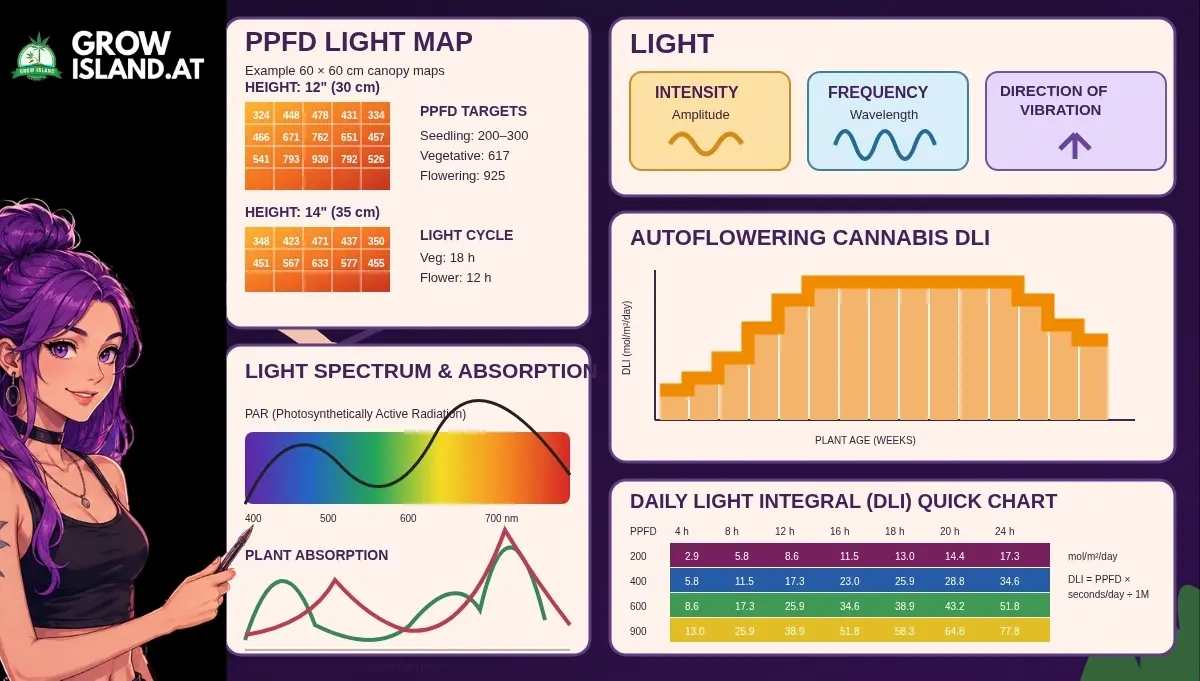
PPFD is like the flow rate from a tap; DLI is the total amount collected by the end of the day. A strong flow for a short period can deliver the same total as a weaker flow over longer hours. The combinations are not biologically identical because excessive instantaneous intensity may cause stress and the dark period has important functions.
| Feature | PPFD | DLI |
|---|---|---|
| Meaning | Instantaneous photon density | Daily photon total |
| Unit | µmol/m²/s | mol/m²/day |
| Depends on | Output, distance, optics, measurement point | PPFD and photoperiod |
| Main use | Check peaks and distribution | Compare lighting schedules |
4. Optimal PPFD Values for Cannabis
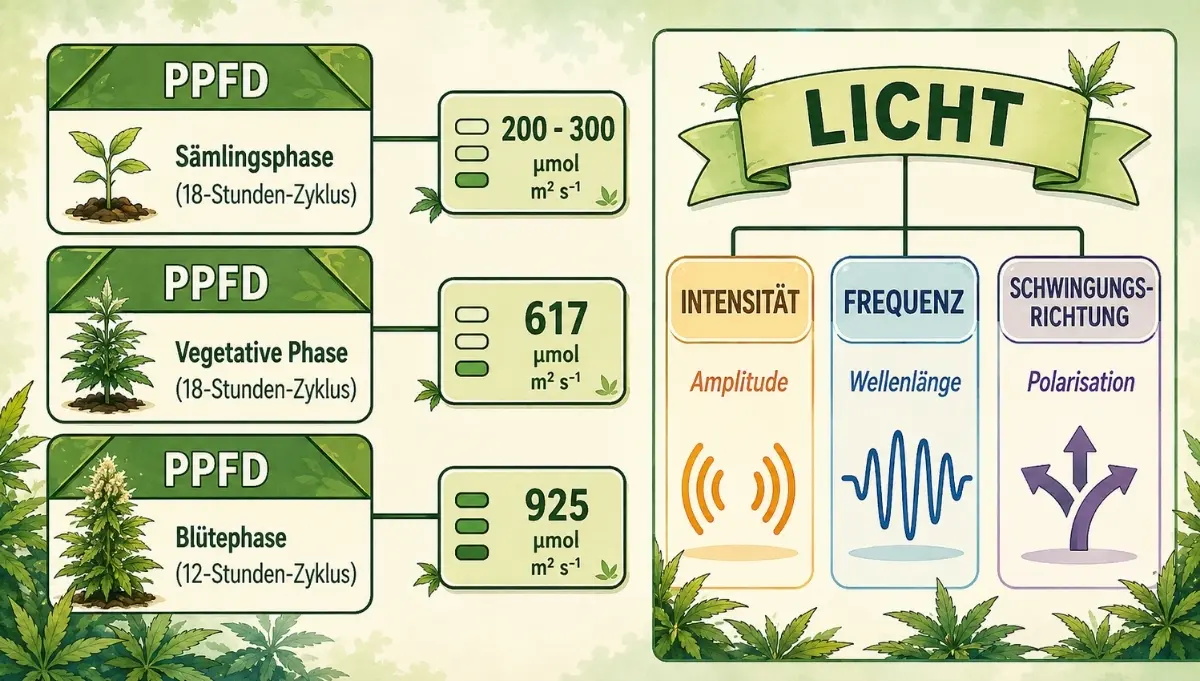
These are conservative starting ranges without supplemental CO₂. Measure at the height of the top leaves in several locations and acclimate plants over several days.
| Stage | Suggested starting PPFD | Goal |
|---|---|---|
| Clones | 100-200 | Rooting without high transpiration pressure |
| Seedlings | 150-250 | Compact, safe establishment |
| Vegetative | 300-600 | Strong structure and branching |
| Pre-flower | 600-800 | Controlled transition |
| Flowering | 700-1,000 | High productivity in a stable climate |
Clones: 100-200 PPFD
Unrooted and freshly rooted clones cannot replace water as efficiently as established plants. Excess light increases transpiration while the root system cannot keep up. Start near the lower end and increase only after new roots and active growth appear.
Seedlings: 150-250 PPFD
Seedlings need enough light to avoid stretching, but not flowering intensity. A stable 180-220 PPFD often works better than large daily changes. Observe stem strength, leaf angle and internode spacing. See the full English cannabis seedling guide .
Vegetative growth: 300-600 PPFD
Intensity can rise as leaf area increases. About 300-400 PPFD suits early growth and 450-600 suits vigorous, established plants. The upper end provides no advantage when temperature, root volume or nutrition is limiting. Use our diagnosis for slow-growing cannabis plants when development stalls.
Pre-flower: 600-800 PPFD
Demand does not jump overnight after changing the light schedule. Increase intensity gradually during the transition and check lamp distance frequently as the canopy stretches.
Flowering: 700-1,000 PPFD
A healthy canopy can often use 700-1,000 PPFD without supplemental CO₂. The average matters more than the peak. If the centre receives 1,050 and the edge only 450, greater distance or a wider fixture may be more productive than more power.

LED recommendation for medium areas: Lumatek Attis 300W Pro
The 300-watt class can cover vegetative growth and flowering on a compact footprint. Use dimming and a measurement grid so clones never receive the same intensity as a mature flowering canopy.
View product5. Optimal DLI Values
There is no single perfect DLI for every genotype. Practical starting ranges are approximately 6-13 mol/m²/day for clones, 10-18 for seedlings, 20-35 during vegetative growth and 30-43 during flowering without supplemental CO₂.
| Stage | Starting DLI range | Typical schedule |
|---|---|---|
| Clones | 6-13 mol/m²/day | 18 hours |
| Seedlings | 10-18 mol/m²/day | 18 hours |
| Vegetative | 20-35 mol/m²/day | 18 hours |
| Flowering | 30-43 mol/m²/day | 12 hours |
6. PPFD-to-DLI Conversion Chart
Values are calculated with the DLI formula and rounded to one decimal place. The 24-hour column is a mathematical comparison, not a general recommendation.
| PPFD | DLI at 12 h | DLI at 18 h | DLI at 20 h | DLI at 24 h |
|---|---|---|---|---|
| 100 | 4.3 | 6.5 | 7.2 | 8.6 |
| 150 | 6.5 | 9.7 | 10.8 | 13.0 |
| 200 | 8.6 | 13.0 | 14.4 | 17.3 |
| 250 | 10.8 | 16.2 | 18.0 | 21.6 |
| 300 | 13.0 | 19.4 | 21.6 | 25.9 |
| 400 | 17.3 | 25.9 | 28.8 | 34.6 |
| 500 | 21.6 | 32.4 | 36.0 | 43.2 |
| 600 | 25.9 | 38.9 | 43.2 | 51.8 |
| 700 | 30.2 | 45.4 | 50.4 | 60.5 |
| 800 | 34.6 | 51.8 | 57.6 | 69.1 |
| 900 | 38.9 | 58.3 | 64.8 | 77.8 |
| 1,000 | 43.2 | 64.8 | 72.0 | 86.4 |
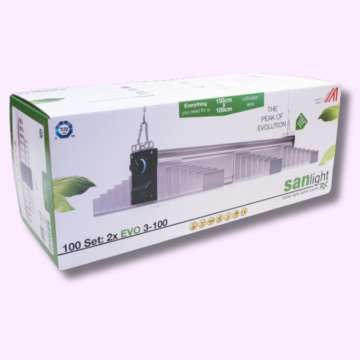
LED recommendation for 100 × 100 cm: SANlight EVO 400W set
A matched set simplifies planning, but real PPFD still needs to be checked at several points because wall reflection, canopy shape and hanging position change the result.
View product7. LED Distance by Wattage
Distance alone does not determine PPFD. Optics, beam angle, dimming, reflective walls and footprint all matter. Use this chart only as a cautious starting point and set final height using the manufacturer map, your own measurements and plant response.
| LED power | Clones | Vegetative | Flowering |
|---|---|---|---|
| 100 W | 50-70 cm | 35-50 cm | 25-35 cm |
| 150 W | 55-75 cm | 40-55 cm | 30-40 cm |
| 240 W | 65-85 cm | 45-65 cm | 35-50 cm |
| 300 W | 70-90 cm | 50-70 cm | 40-55 cm |
| 465 W | 80-110 cm | 60-85 cm | 45-65 cm |
| 600 W | 90-120 cm | 70-95 cm | 50-75 cm |
| 720 W | 100-130 cm or strong dimming | 75-105 cm | 55-80 cm |
Important: exact distance always depends on the fixture, optics and manufacturer PPFD map. Read the verified English guide to LED grow light distance for cannabis .

LED recommendation: Lumen King Eco Line 400W
At 400 watts, real distribution matters more than a universal distance. Compare centre, edge and average readings; correct hotspots with distance or dimming first.
View product8. How to Recognise Insufficient Light
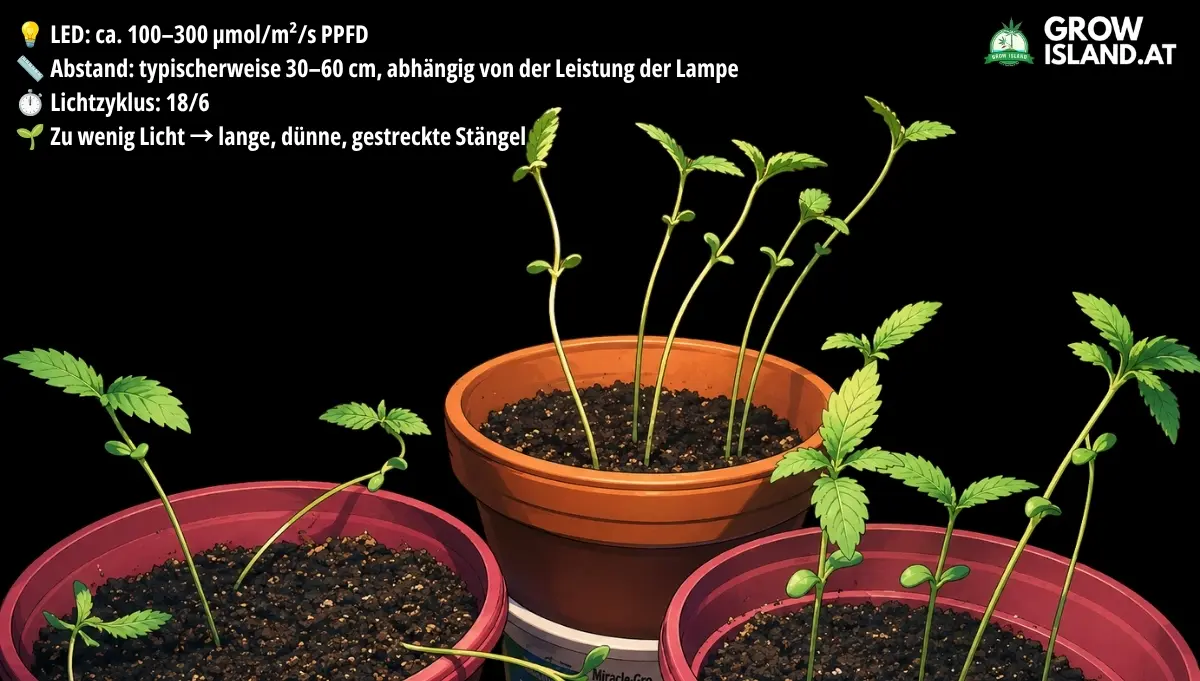
Stretch and long internodes
The classic sign is excessive elongation: a long thin stem, wider gaps between nodes and growth leaning toward the light. Seedlings may fall over. Long internodes can also be genetic, so compare new and old growth and several plants of the same genotype.
Small leaves and slow development
With prolonged light shortage, leaf area remains small, side branches stay weak and the canopy closes slowly. Pale colour alone does not prove a lighting problem; pH, EC, roots and nutrients may create similar symptoms.
Loose flowers and reduced yield
Weak edge and lower zones often form small, airy flowers. Measure a grid over the complete area. A flat canopy and uniform coverage are often more effective than simply increasing wattage.
9. How to Recognise Excessive Light
Photobleaching
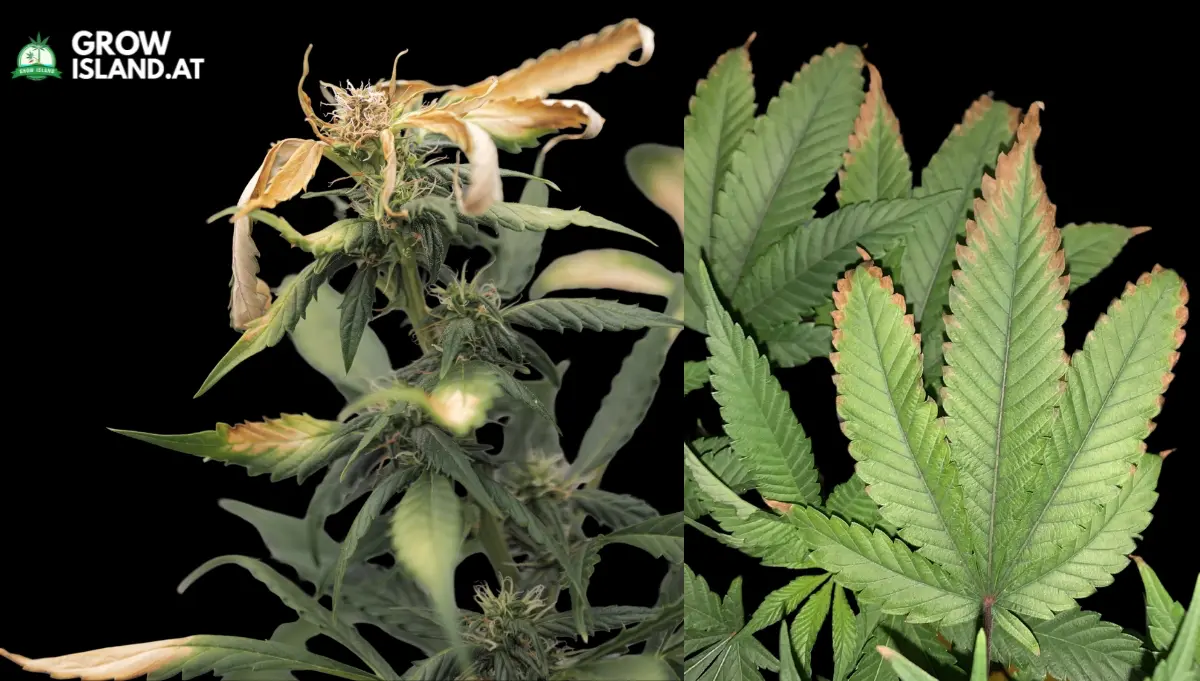
Strong paling of the upper leaves or flower tips directly beneath the brightest zone is typical. Unlike a mobile nutrient deficiency, it begins at the top and follows the light pattern. Bleached tissue may not return to green.
Light burn and taco leaves
Under light and heat stress, leaf edges may curl upward, feel dry and stand at a steep angle. Measure leaf-surface temperature as well as PPFD. Cool room air does not guarantee that a leaf directly beneath an intense LED is comfortable.
Foxtailing
New tower-like calyx growth may be caused by intense light or heat, but some genotypes form it naturally. Stress is more likely when it appears only in the brightest top zones and is accompanied by bleaching or curled leaves. See why cannabis buds foxtail and how to respond .
What should you do?
Reduce dimming or increase distance in one controlled step. Do not change light, fertiliser and irrigation simultaneously. Check new growth after 24-72 hours.
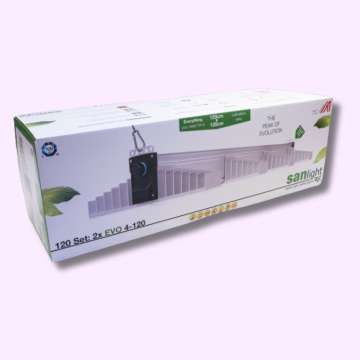
LED recommendation for 120 × 120 cm: SANlight EVO 530W set
Measure the centre and all four corners. The goal is a uniform grid, not the highest possible single reading.
View product10. How to Measure PPFD Correctly
PAR meter
A calibrated quantum or PAR meter is the most reliable practical solution. Keep the sensor level at canopy height, avoid casting a shadow, measure at least nine points on a small area and record average, minimum and maximum.
Smartphone application
A supported, calibrated application can provide an estimate. Sensor, diffuser, operating system and spectrum influence accuracy. For decisions near 900-1,000 PPFD, use a true PAR meter.
Manufacturer PPFD map
A useful map states the footprint, hanging height and dimming level. Check whether it was measured inside a reflective tent or in open space and confirm the values in your own setup.
Measurement grid
Measure after every major height or power adjustment and again after the plants grow 10-20 centimetres. The fixture may remain stationary while the canopy moves closer every day.
11. CO₂ and PPFD Above 1,000
Supplemental CO₂ can support photosynthesis at high intensity only when temperature, humidity, irrigation, root volume and nutrition are also optimised. Values above 1,000 PPFD are not a sensible first step for a normal home setup. Incorrect CO₂ concentrations may endanger people and animals.
High PPFD increases water use and may alter nutrient demand. Raising only light and CO₂ while ignoring climate and roots creates stress rather than yield. A stable 700-1,000 PPFD without supplemental CO₂ is more manageable for many controlled home systems.

LED recommendation for large areas: Lumen King 720W
A 720-watt fixture belongs in a sufficiently large, climate-controlled area. Strong dimming or generous distance is required for clones and early growth; PPFD measurement is essential.
View product12. Common Mistakes
Hanging the LED too close
Short distance often creates hotspots and poor uniformity. A slightly greater distance may improve the average even while the maximum falls.
Comparing only watts
Watts describe electrical input, not photon density at the leaf. Compare PPF, efficacy, PPFD map and suitable footprint.
Using only lux or lumens
Lux is weighted for human vision. It can roughly compare fixtures with the same spectrum but cannot replace a suitable PPFD measurement.
Measuring only the centre
A single centre value hides weak corners. A uniform 750 average can outperform 1,100 in the centre and 350 at the edge.
Not recalculating DLI
Changing from 18/6 to 12/12 immediately reduces the daily total. Recalculate after every photoperiod change.
Confusing other stress with light stress
Drooping or discoloured leaves may result from irrigation, pH, roots or nutrition. Diagnose the whole system before increasing or reducing light.
13. Frequently Asked Questions
How much PPFD do clones need?
Usually 100-200 PPFD. Start unrooted clones near 100 and increase well-rooted plants gradually toward 200.
How much PPFD do seedlings need?
About 150-250 PPFD. Stretch suggests too little; paling at the top may indicate too much.
Is 1,000 PPFD too much?
It can work for healthy, acclimated flowering plants, but it is demanding without stable climate and irrigation.
Which is better: more watts or more PPFD?
Neither alone. You need suitable average PPFD across the whole area at good electrical efficacy.
Can a phone measure PPFD?
Approximately, with a supported and calibrated app. A PAR meter remains more reliable for high intensities and accurate maps.
Is DLI more important than PPFD?
No. DLI shows the daily total and PPFD shows instantaneous intensity. A good DLI can still be produced with a stressful PPFD peak.
How high should my LED hang?
High enough to deliver the target PPFD evenly at canopy level. Use the manufacturer map, measurements and plant response.
How does DLI change between 18/6 and 12/12?
At the same PPFD, 18 hours supplies exactly 50% more DLI than 12 hours. At 600 PPFD the values are 38.9 and 25.9 mol/m²/day.
Do I need CO₂ at high PPFD?
Not necessarily up to about 1,000 PPFD when fresh air and climate are adequate. Far above that, controlled CO₂ becomes more relevant and more safety-critical.
Should cannabis receive 24 hours of light?
It is not generally necessary. Photoperiod plants need a sufficiently long dark period to flower; 18/6 is proven and energy-efficient for vegetative growth.
Where should PPFD be measured?
At current canopy height, in the centre, edges and corners, with a level sensor and no shading.
Why is PPFD lower at the edges?
Fewer photons overlap from different angles. Greater distance, wider fixtures and reflective walls can improve uniformity.
Can high PPFD cause nutrient deficiency?
It can accelerate growth and water use enough to reveal an existing supply problem. Light does not automatically cause a specific deficiency, but it raises system demand.
Is foxtailing always light stress?
No. Some genotypes produce it naturally. Stress is more likely when only the highest, brightest sites are affected.
Can two weaker LEDs replace one powerful fixture?
Yes. Correctly positioned fixtures may improve distribution. Total PPFD, overlap, efficacy and safe electrical installation remain decisive.
How can PPFD be increased safely?
In small steps over several days. Observe new leaves, water use, temperature and leaf angle rather than switching directly to maximum output.
Conclusion
PPFD shows how intensely the canopy is illuminated right now. DLI shows how many photons arrive over the whole day. Typical starting ranges are 100-200 PPFD for clones, 150-250 for seedlings, 300-600 for vegetative growth and 700-1,000 for flowering without supplemental CO₂. These figures are starting points, not rigid laws.
The best strategy combines an even PPFD map, suitable DLI, gradual acclimation and a stable climate. Measure several points, recalculate after every schedule change and assess the whole plant.
Scientific Background
- Study: cannabis yield, potency and leaf photosynthesis under increasing light intensity
- Study: high light intensity and the yield of specialised plant metabolites
- Study: interactions between vegetative and flowering-stage lighting
Legal and Electrical Safety Notice
Follow the laws that apply at your location. Electrical grow lighting must be installed correctly, protected from water and adequately cooled. Do not overload outlets or power strips. This article provides general horticultural information and does not replace the fixture manufacturer's instructions or inspection by a qualified electrician.











Comments