Cannabis Training – The Complete Guide to LST, Topping & ScrOG
Cannabis Training Guide: LST, Topping, FIM, Mainlining, Supercropping, ScrOG and SOG
Author: Bartholomew Alen
If a cannabis plant is simply allowed to grow straight upward, it will usually develop one dominant top with weaker side branches below it. Training deliberately changes this architecture by distributing light, space and growth across several shoots. This guide explains LST, topping, FIM, mainlining, supercropping, ScrOG and SOG, outlines the limits of every method and helps you choose a technique that suits the genetics, available space and your level of experience.
The most important principle
Training is not a competition to make as many cuts as possible. A healthy, actively growing plant and an even canopy are more important than a spectacular shape.
Why do professional growers bend their plants?
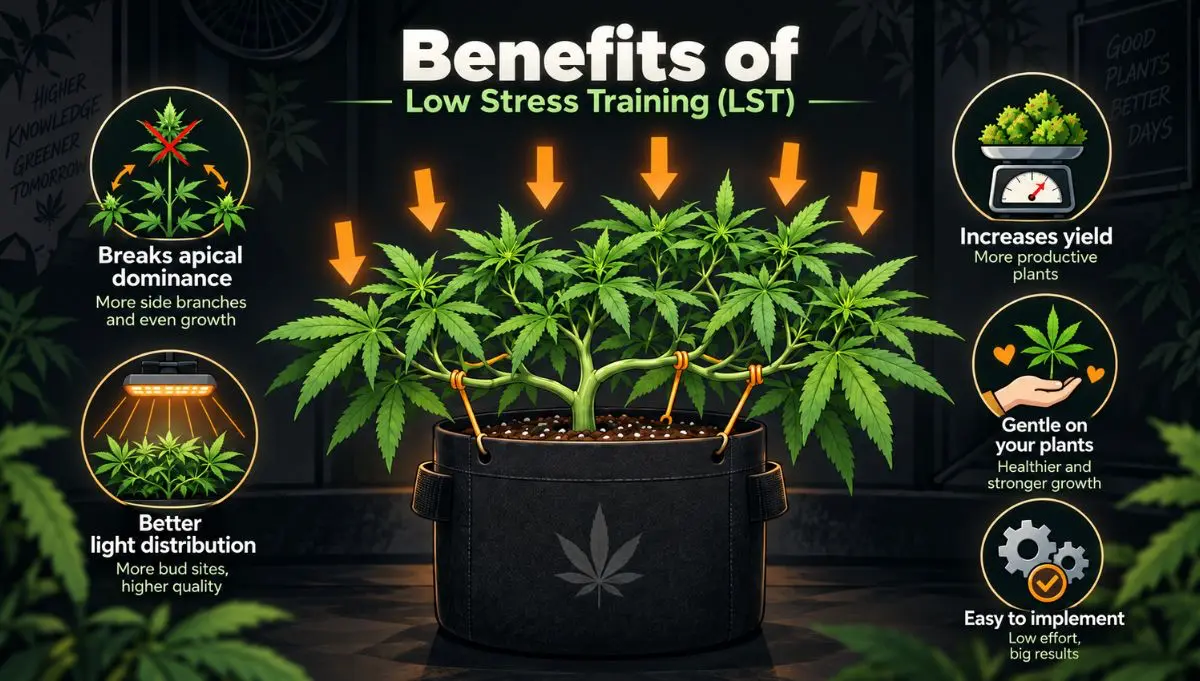
The answer is light distribution. A lamp illuminates the uppermost level most intensely. If a plant grows in a pyramid shape, the main top sits close to the lamp while the lower flower sites receive far fewer photons. When the main shoot is carefully guided sideways, formerly subordinate branches can rise. The result is a flatter canopy with several tops at a similar height.
Greg Green describes training in The Cannabis Grow Bible as a practical form of plant shaping: the main shoot is tied down, natural height is reduced and horizontal growth is encouraged. This is particularly useful in low rooms and beneath a ScrOG net.
Scientific studies confirm the underlying mechanism: plant architecture influences light penetration, the microclimate and the uniformity of flower development. This does not mean, however, that every intervention automatically increases yield.
Before you begin training
Lighting and climate should already be stable. Use the internal guide to PPFD, DLI and LED distance for cannabis when planning the light, and consult the VPD chart for vegetative growth and flowering to maintain stable growing conditions.
What is LST?
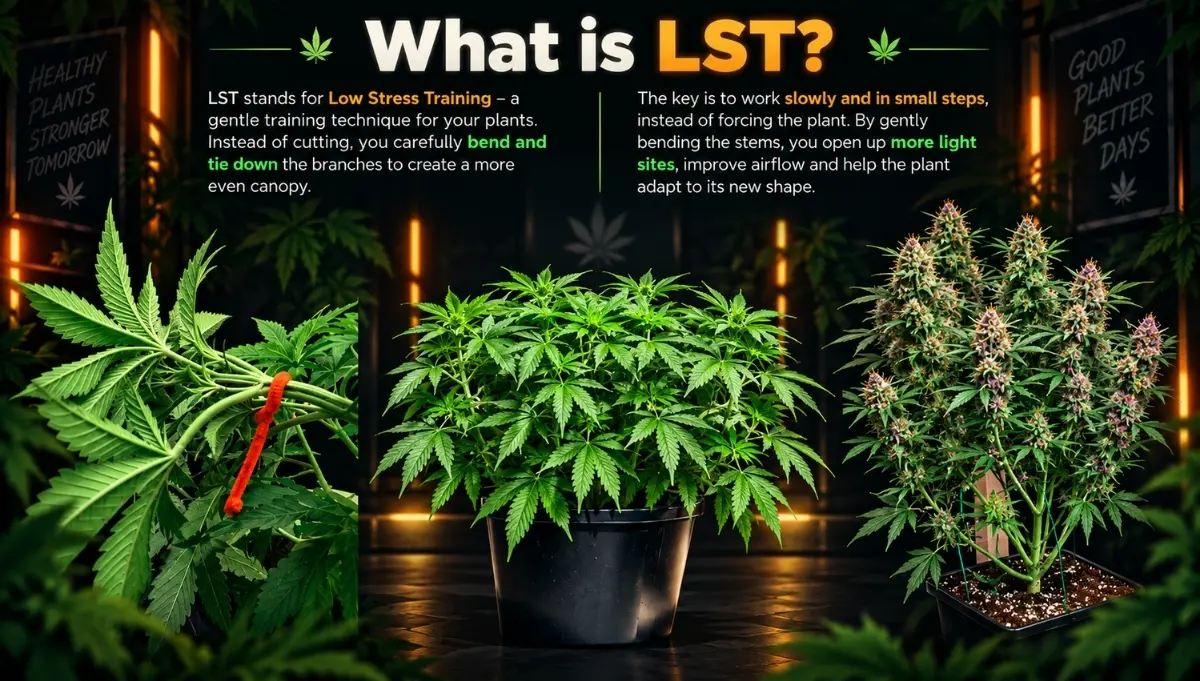
LST stands for Low Stress Training. Instead of removing the shoot, the grower gradually bends it and secures it to the rim of the pot or to a support with a soft plant tie.
The top should not be forced into one sharp bend. Small corrections made in several stages are safer. Young stems respond particularly well because they are flexible and quickly reorient themselves.
Begin only after the plant has become securely established and developed several pairs of true leaves. Stabilize the base of the stem with a counter-tie so the root ball does not move while the shoot is being pulled. Bend the main shoot sideways, fasten it loosely and check regularly that the tie is not cutting into the stem.
LST in five steps
- Select only a healthy, actively growing plant.
- Secure the base of the stem against the direction of pull.
- Slowly lean the upper shoot sideways.
- Fasten it with a soft tie, leaving space between the tie and stem.
- Readjust every one or two days instead of making one extreme bend.
Apical dominance explained simply
Apical dominance is the tendency of the uppermost shoot tip to grow more strongly than the lateral buds. Plant hormones and sugar signals work together in this process. As long as the top clearly dominates, many side shoots remain weaker.
When the top is lowered or removed, this signalling network changes and the lateral shoots gain a better opportunity to grow.
LST weakens spatial dominance without removing tissue. Topping interrupts it by removing the apical meristem. Both methods can create a flatter canopy, but they differ considerably in stress, recovery time and the risk of mistakes.
Grower tip
You can learn more about shoots, nodes and flower sites in Cannabis Anatomy and Plant Health.
Topping: advantages, disadvantages and the right time
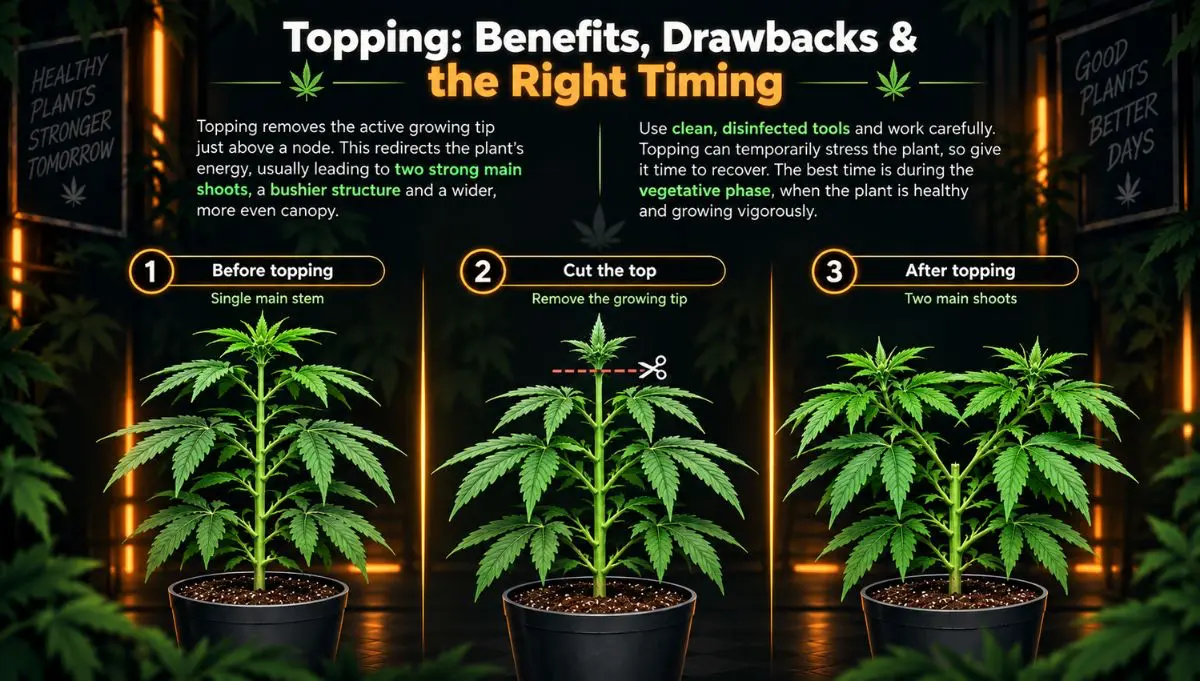
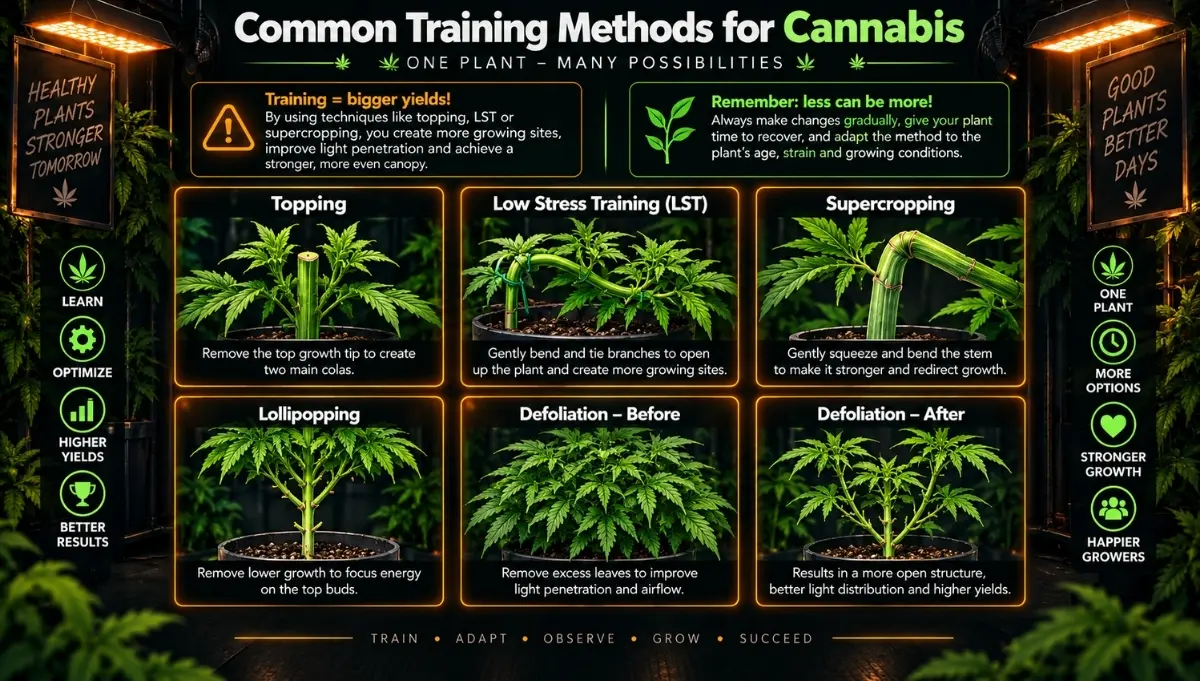
During topping, the active growing tip is cleanly removed above a node. The axillary buds below it will normally develop into two stronger leading shoots. This makes the plant shorter and wider.
A clean cut made with a disinfected tool causes less tissue damage than tearing or crushing.
The advantage is predictable branching. The disadvantage is the necessary recovery period: the plant must close a wound and reorganize the distribution of its growth.
A late or repeated cut can extend the vegetative stage. In short production cycles, this loss of time can cancel out the theoretical benefit.
Do not top automatically
Wait for vigorous growth, a stable root zone and enough time before flowering. If the plant is wilting or affected by pests, root problems, a nutrient deficiency or severe environmental stress, correct the cause first. The Cannabis Stress Guide can help you assess the situation.
Does topping really increase yield?
This question cannot be answered responsibly with a blanket yes. Topping does not create additional energy. The cut gives the plant neither more light nor more root space.
Instead, the intervention changes how the available resources are distributed among shoots and flower sites. A benefit appears only when the altered canopy uses the growing area more effectively, brings more flowers into a productive light zone and leaves the plant enough time to recover.
An untopped comparison plant may produce the same amount or even more. It loses no growing days and concentrates much of its development in the central cola.
In a tall room with good side lighting, this natural form can be efficient. In a low tent beneath a flat LED, however, the same architecture may become problematic: the top reaches the intensity limit early while lower areas receive too little light.
The better question for measuring success
Not: Does the topped plant have more colas?
Instead: Does it produce more usable flower mass of comparable quality in the same total time, over the same area and with the same electrical power?
What the controlled Medusa F1 trial found
A trial published in 2026 by CRIC Labs and Royal Queen Seeds compared 48 Medusa F1 autoflowering plants. Twenty-four were topped early and 24 were left untopped.
Lighting, plant density, substrate, irrigation and nutrient supply were standardized. After 75 days, the topped plants were about ten centimetres shorter on average. Their canopies were more compact, the central flower was slightly shorter and growth was distributed more strongly across the side shoots.
Scroll sideways to view the table
| Measurement | Topped | Untopped | Practical meaning |
|---|---|---|---|
| Average height | 74 cm | 84 cm | Topping improved height control. |
| Yield per plant | 255 g | 270 g | The numerical difference was not statistically significant. |
| Main-cola length | 19 cm | 21 cm | Biomass was distributed more strongly across lateral flowers. |
| Sugar-leaf proportion | About 2 percentage points higher | Lower | Potentially more trimming work. |
The topped plants averaged 255 grams, while the control plants averaged 270 grams. At the same time, a moderate increase in cannabinoid concentration was observed in the topped plants.
The decisive point is that no statistically significant difference was found in total yield or overall harvest quality. The trial therefore does not support the claim that topping autoflowers automatically produces a higher yield.
Instead, it shows that a vigorous F1 autoflower can tolerate an early cut under highly stable conditions and develop a lower, more even canopy.
An important limitation of the trial
The study examined only one F1 autoflowering genotype under controlled conditions at 1,000 µmol/m²/s PPFD, with 18 hours of light, rockwool, a pH of 5.8 and a high nutrient concentration. These results cannot be transferred unchanged to every autoflower, soil, lamp or level of growing experience.
Yield per plant is not the same as yield per unit of time
A common mistake is to compare only the final weight of an individual plant. If a topped photoperiod plant must remain in the vegetative stage for an additional seven to fourteen days, it generates extra lighting, climate-control and labour costs.
A fair comparison should therefore document at least five measurements:
- Dry mass per plant
- Dry mass per square metre
- Total cultivation time
- Energy consumption
- Proportion of marketable flowers
Only this combination reveals whether the method is genuinely more efficient in your own system.
When should you not top?
During flowering
Heavy cutting during flowering is usually a poor trade-off. The plant is already investing in flower formation. Restructuring it late costs time, removes active leaf area and may delay maturity.
Light maintenance is different from removing the dominant top. Greg Green explicitly warns against using topping as a late correction.
When plants are weak or stressed
Yellow leaves, slow growth, drooping shoots or unstable roots are stop signs. Check irrigation, climate, pH and nutrient supply first.
The article Slow-Growing Cannabis Plants explains common causes; for water-related problems, consult the guide to proper cannabis watering.
With unknown genetics and no test
Different genotypes respond differently. Some produce vigorous, symmetrical lateral shoots after the cut, while others recover slowly or merely divide the same biomass among smaller tops.
Green mentions Blueberry as an example of a genotype that can respond well, but he emphasizes the influence of the variety. During a run, test only some comparable plants and record the timing, number of cuts and recovery.
When too little time remains
The calendar is just as important as the number of nodes. A plant with six nodes may look technically ready to cut but still be unsuitable if flowering is about to begin.
Commercial guides often suggest a recovery period of seven to fourteen days. This range is not a promise: temperature, root health, genetics and the severity of the cut determine when growth actually accelerates again.
Common mistake
Do not plan exclusively according to a fixed calendar. What matters is whether the plant is once again producing vigorous, healthy new growth.
FIM or topping?
FIM is the incomplete removal of the young growing tip. Instead of cleanly cutting away the entire apical meristem, only a large portion of the fresh tip tissue is removed.
Depending on the cut and the plant's response, several new shoots may develop. That same variability is also the disadvantage: FIM is less predictable than a clean top.
Scroll sideways to view the table
| Method | Intervention | Predictability | Suitable for |
|---|---|---|---|
| LST | Bending and tying | High with regular maintenance | Beginners, low spaces |
| Topping | Completely removing the top | Usually easy to plan | Healthy photoperiod plants |
| FIM | Partially removing the top | Medium to low | Experienced growers with time and space |
| Mainlining | Several cuts plus tying | High, but time-consuming | Long vegetative stages |
Mainlining and manifolding
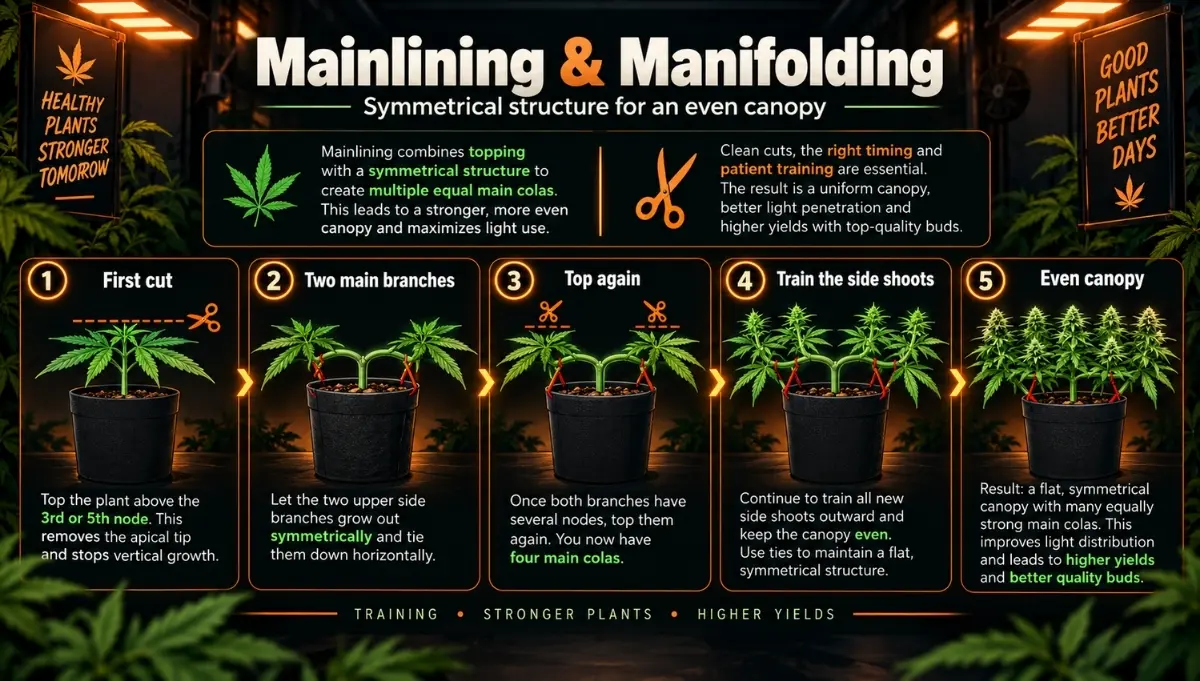
Mainlining combines repeated topping with symmetrical tying. The goal is a central hub from which several equivalent main arms extend.
After every planned cut, the number of leading shoots theoretically doubles. The system looks tidy and makes an even canopy easier to achieve, but it requires time, consistent maintenance and a plant that tolerates cutting well.
The method does not suit every schedule. If flowering must begin quickly, several recovery periods may provide no net benefit.
The available window is also narrow with autoflowering plants because the onset of flowering cannot be postponed at will. Scientific literature on mainlining explains the hormonal and structural principles while also pointing to the lack of standardized protocols across genotypes.
Supercropping: controlled pinching and bending
During supercropping, a still-flexible shoot is carefully rolled between the fingers to soften it and is then bent without intentionally tearing the outer skin.
The technique can bring excessively tall shoots down to canopy height. It is considerably more invasive than LST and requires experience. Too much pressure may sever vascular tissue or cause an open break.
If a branch breaks accidentally, align it immediately and secure it with plant tape or a splint. Greg Green explains that many breaks can heal when they are stabilized properly.
Cleanliness and mechanical stability are more important than home remedies. Honey appears in older growing guides but is not a standardized sterile wound treatment.
Stop rule
If the outer skin is open across a large area, the branch is almost completely severed or the plant is already stressed, stop all further training. Stabilize the damage and monitor the leaves above the injured area for continued water supply.
ScrOG: Screen of Green
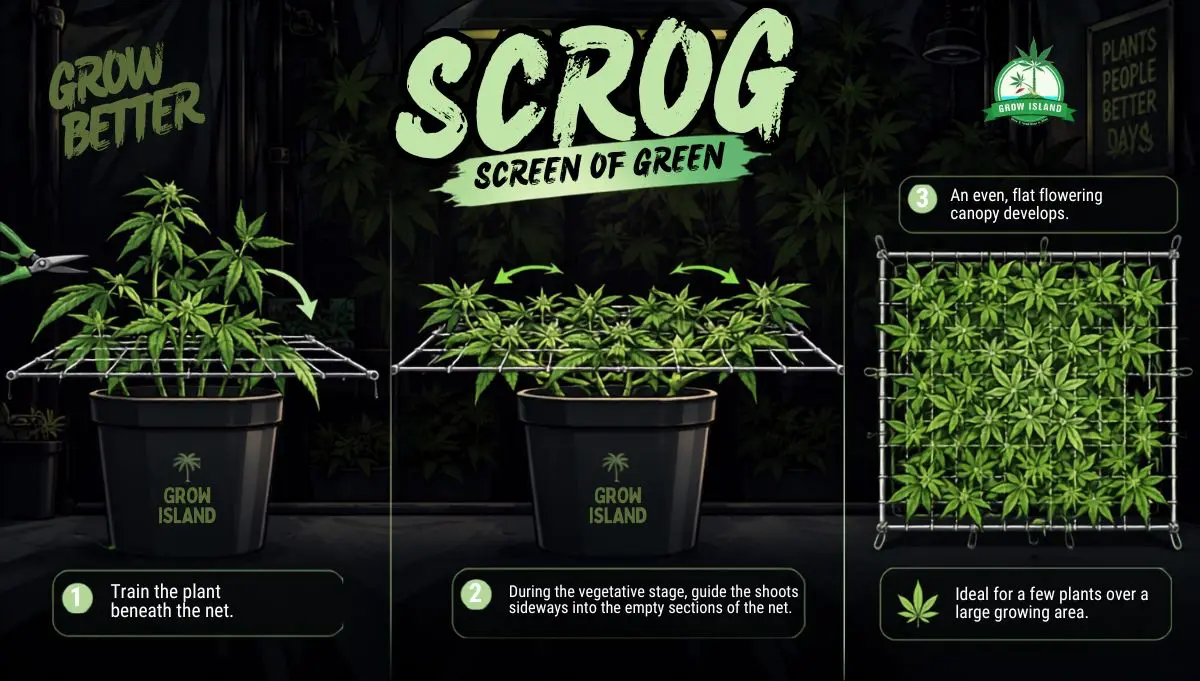
In a ScrOG, a net is installed above the plants. During the vegetative stage, growing shoots are not simply allowed to pass upward through it; instead, they are guided sideways into empty squares.
The net is therefore a guidance system, not merely a support frame. The method combines LST with area planning and is particularly suitable for a small number of plants spread across a broad growing area.
Do not completely fill the net before initiating flowering. Many genotypes stretch considerably afterwards. The amount of empty space that should remain depends on the expected stretch.
A sativa-dominant plant often needs more reserve than a compact indica. For background on the basic growth forms, see the comparison of Indica, Sativa and Ruderalis.
SOG: Sea of Green
SOG follows the opposite strategy: many smaller, uniform plants with a short vegetative stage and little individual shaping.
The aim is a closed, uniform surface of dominant main shoots. Clones are attractive for this purpose because genetically uniform starting material can grow more consistently. Plant density, air movement and legal plant-count limits must nevertheless be considered.
More plants do not automatically mean a higher yield per unit of area. Research shows that density and architecture work together. Overcrowded stands may reduce uniformity and create a poorer microclimate.
Grower tip
Before selecting cuttings, read Cannabis Clones from Grow Island.
Topping autoflowers: an exception, not a standard rule
The traditional recommendation is not to top autoflowers because their vegetative window often lasts only a few weeks. This cautious approach remains sensible for beginners.
The Medusa F1 trial nevertheless shows that the question is more nuanced: under optimal conditions, a vigorous, uniform F1 autoflower can tolerate an early top without a statistically significant reduction in final yield.
This does not mean that every autoflower should be topped.
Four factors determine the decision
- The plant must be visibly vigorous at the time of cutting.
- It must not yet be clearly transitioning into flowering.
- The genetics should display strong and uniform juvenile development.
- There must be a specific structural benefit, such as a strict height limit.
Grower tip
Practical autoflower rule: Do not top simply because it appears in a schedule. Consider it only when the plant is exceptionally vigorous, the window is still open and height control offers a real advantage. If in doubt, use gentle bending.
How to conduct a useful comparison
Grow reports are valuable only when the other influencing factors remain as constant as possible. Two plants raised from different seeds are not a clean comparison because different phenotypes can strongly affect growth and yield.
Genetically identical cuttings or a highly uniform F1 population are better options. Place the test and control plants in comparable positions, or rotate them according to a fixed plan.
A comparison in seven steps
- Select at least two groups that are as similar as possible.
- Use identical pot sizes, substrate volumes and irrigation.
- Measure PPFD at every position and document the daily light integral.
- Record height, canopy width and node count immediately before cutting.
- Document the number of days until vigorous growth resumes.
- Weigh only fully dried flowers trimmed to the same standard.
- Compare yield per unit of area and per total day, not merely per plant.
A photograph taken from the same position every week is often more informative than a memory at harvest. Record the working time as well: mainlining can create an even canopy, but it requires considerably more tying and supervision than a naturally growing plant.
Recommended plants and cuttings for training
The following recommendations are starting points rather than guarantees of a specific response. Begin with gentle training and document internodal spacing, lateral-shoot vigour and recovery time.

Hazelightyear seed-grown plant
A Haze-dominant genotype is an interesting candidate for LST or ScrOG when long shoots and pronounced stretch need to be distributed across the available area.

Real Killer Skunk cannabis cutting
A cutting provides genetically uniform starting material. This makes comparative trials easier when one plant is trained only with LST and a second is topped.

Studio 54 pre-grown cannabis plant
The established bushy structure provides several points for gentle tying. Before every intervention, check that the plant has fully recovered from transport and transplanting.

Kushblast Kush cannabis cutting
With more compact genetics, early and careful LST can help bring the side shoots to the same level. Strong interventions should wait until visible acclimatization has taken place.
More varieties and current availability can be found in the Cannabis plants and cuttings category. Guidance for the first days after delivery is available in the Grow Island Blog.
Which method suits which genetics?
Long, flexible shoots
LST and ScrOG use the length of the shoots without removing unnecessary tissue. Leave reserve space for the stretch.
Compact, heavily branched plants
Gently spreading the side branches may be sufficient. Too many cuts quickly make an already dense canopy difficult to manage.
Photoperiod plants
They provide more recovery time because the transition to flowering can be controlled. This makes topping and mainlining easier to schedule.
Autoflowering plants
The short, genetically determined window favours gentle LST. Topping is defensible only on highly vigorous plants and with sufficient experience.
The labels indica and sativa offer only a broad expectation. The actual phenotype, internodal spacing and lateral-shoot growth are more valuable for choosing a method.
Observe the real plant rather than relying only on the variety description. For colour-related or genetic characteristics, see Why Cannabis Turns Purple.
Four traits matter more than the label
Internodal spacing: Long gaps make distribution across a net easier but may indicate pronounced stretch. Very short gaps produce compact plants in which too many main shoots can quickly create a dense, humid centre.
Lateral-shoot angle: Flexible branches emerging horizontally are easier to shape with LST. Steep, upright and brittle shoots require slower corrections.
Recovery speed: Rapid new growth after gentle bending is a better positive signal than a general promise attached to a strain. If the plant remains stalled for a long time after transplanting, do not follow with HST.
Stretch: A strongly stretching genotype may fill a ScrOG net that was only half full before the flowering transition. A compact genotype may need more time or fewer empty squares.
A decision path for beginners
- Is the plant healthy and active? If not, do not train it.
- Is vegetative time limited? Choose gentle LST instead of repeated cuts.
- Is vertical space limited? Plan LST or ScrOG early.
- Are several identical cuttings available? Set up a controlled comparison.
- Are the genetics unknown? Begin with a small bend and document the response.
- Is flowering about to begin? Do not start structural mainlining.
Grower tip
For a first run, properly executed LST is usually enough. Once you understand the stretch, water use and response of your genetics, a comparison with topping becomes worthwhile.
Common cannabis-training mistakes
Doing too much at once
Topping, heavy defoliation, transplanting and introducing a new lighting schedule on the same day make the cause of later problems impossible to identify. Change one major factor and allow time for observation.
Ties that are too tight
Stems thicken. Wire or thin string can cut into them and interfere with sap flow. Use broad, soft ties and inspect every fastening regularly.
Training without a lighting plan
A flat canopy is useful only when the area is illuminated evenly. Insufficient distance can cause light stress despite a good plant shape. Guidance on symptoms is available in LED Distance for Cannabis.
Excessive defoliation
Leaves are photosynthetic surfaces. Do not remove healthy fan leaves indiscriminately. Scientific evidence shows that architectural manipulation can locally improve light and uniformity, but severe cutting costs active meristems and leaf area.
Read the separate guide to cannabis defoliation.
Ignoring mould risk
A dense, flat canopy can block air movement. Monitor humidity below the canopy and between flowers. The guide to identifying and preventing mould explains the warning signs.
The most common misconception
More training does not automatically produce a better plant. Every intervention needs a specific reason and should match the genetics, developmental stage and available time.
Checklist after every intervention
- Is the root ball firm and unmoved?
- Are the ties soft, loose and free from sharp edges?
- Do the leaves above the bend remain supplied and upright?
- Is the cut surface clean, dry and mechanically stable?
- Does the canopy remain even beneath the lamp?
- Is there sufficient air movement between the shoots?
- Was the intervention documented with a date?
During the next 24 to 72 hours, pay particular attention to new growth. Old mechanical damage will not disappear, but new shoots should look vigorous.
If yellow leaves, spots or burnt tips appear at the same time, avoid making a hasty fertilizer correction. First use the diagnostic guidance in Nutrient-Related Problems.
Conclusion
LST is the best starting point for most beginners because it is reversible, gradual and easy to observe. Topping creates predictable branching but requires a healthy plant and sufficient recovery time.
FIM is more variable, mainlining particularly structured, supercropping demanding, ScrOG area-oriented and SOG density-oriented. No method replaces a stable climate, suitable lighting, healthy roots or a realistic assessment of the genetics.
A professional approach does not involve using every technique simultaneously. Choose a clear objective, change little, document the response and compare only plants that began in a similar condition.
The key points
- LST is the lowest-risk introduction to plant training.
- Topping is primarily a tool for height and canopy control.
- More main shoots do not automatically mean a higher yield.
- Mainlining requires sufficient vegetative time.
- Supercropping demands experience and careful execution.
- ScrOG optimizes the use of a horizontal area.
- SOG relies on many small, uniform plants.
- The plant's actual response matters more than the variety label.
Sources and technical basis
Greg Green: The Cannabis Grow Bible, Chapter 11, especially Plant Care, Training, Pruning and Light Bending. Used for the practical principles of bending, tying, height control, cutting time, genotype-dependent responses and stabilizing damaged branches.
Danziger and Bernstein, 2021: Shape Matters: Plant Architecture Affects Chemical Uniformity in Large-Size Medical Cannabis Plants. Used for statements about plant architecture, light penetration, pruning, defoliation and spatial uniformity.
Plants, 2022: Impact of Harvest Time and Pruning Technique on Total CBD Concentration and Yield of Medicinal Cannabis. Used for the relationship between apical cutting, plant height and lateral-shoot development.
Agronomy, 2022: Cannabis sativa L.: Crop Management and Abiotic Factors That Affect Phytocannabinoid Production. Used as an overview of topping, FIM and other cultivation factors.
Current scientific review: The curious origins of a high-stress training technique mainlining. Used for mainlining, apical dominance, hormonal signalling pathways and the limits of current research.
Legal notice
This article is intended exclusively for general botanical, scientific and educational information. The legal framework governing the cultivation, possession and propagation of cannabis differs between countries and regions.
Always check the regulations that apply where you live and comply with all relevant legal requirements.
Author
Bartholomew Alen
The Grow Island Blog aims to provide clear, technically grounded and practical content about plant biology, grow technology and modern cultivation methods.









Comments