Cannabis Lunar Calendar 2026–2027 – The Connection Between the Moon and Cultivation
For thousands of years, the Moon has been one of humanity’s most important celestial companions. Ancient civilizations already observed that lunar cycles might be connected to the rhythms of nature, changing seasons, animal behavior and plant growth. For generations, farmers and gardeners have used methods that time sowing, transplanting, pruning and even harvesting according to the current phase of the Moon.
Followers of biodynamic agriculture, organic gardening and so-called moon gardening still pay close attention to the Moon’s movements today. More and more hobby and professional growers are exploring these traditional methods to create a more harmonious connection with nature and help their plants reach their full potential.
Growing Cannabis in Harmony with the Moon
Working with a lunar calendar is also gaining attention in cannabis cultivation. Many growers report that certain tasks—such as germinating seeds , transplanting young plants, propagating cannabis clones or even harvesting—may produce better results when performed during a suitable lunar phase.
Although modern science cannot currently confirm all of these observations conclusively, the method is based on centuries of practical experience. Moon gardening is still actively practiced in many parts of the world and is regarded as a valuable complement to modern cultivation methods.
The lunar cycle repeats approximately every 29.5 days. During this period, the Moon passes through several phases, each traditionally associated with different tasks in moon gardening. The practice is based on the observation that plant growth, water uptake and vitality may vary during different periods.
What Will You Learn in This Guide?
This guide explains the different lunar phases, the traditional effects attributed to them in cannabis development and how you can work with the rhythm of the Moon during the 2026–2027 growing season.
Whether you grow cannabis outdoors or indoors, a lunar calendar can be an interesting tool for observing your plants more consciously and planning the different tasks in your grow more effectively.
Why Does the Moon Matter in Moon Gardening?
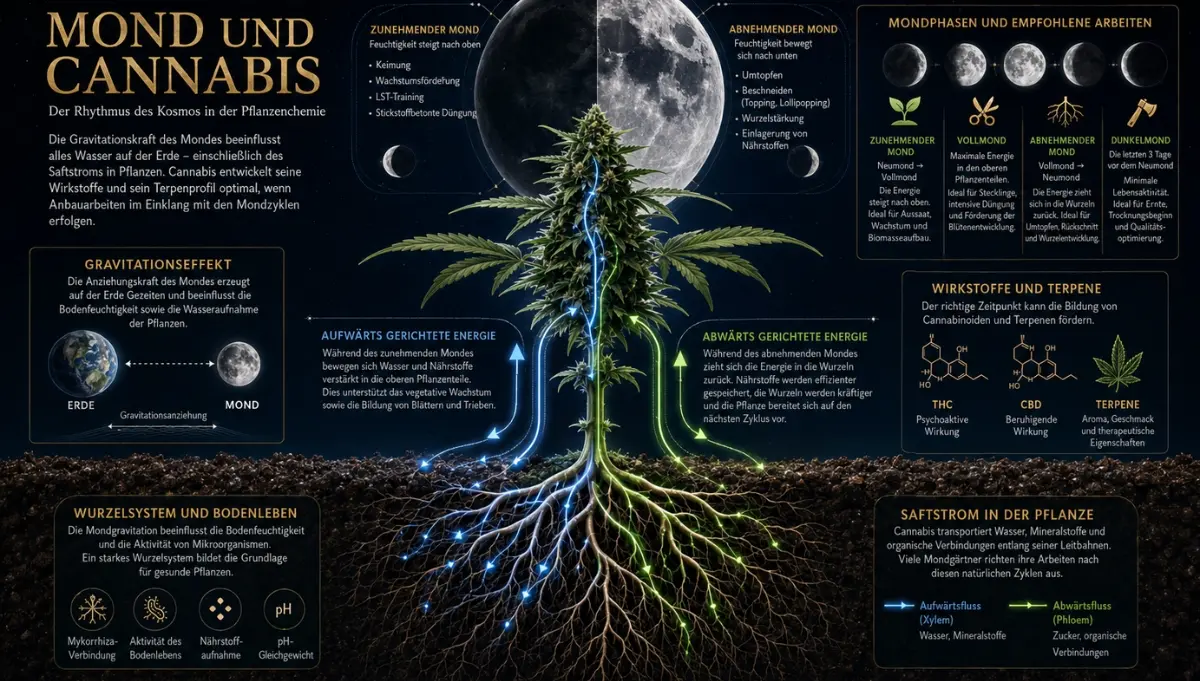
The Moon’s gravitational pull influences many natural processes on Earth. The best-known example is the ocean tides, which are caused by the Moon’s attraction.
Supporters of moon gardening believe that the same force—although on a much smaller scale—could affect soil moisture, plant water uptake and the internal flow of sap.
According to traditional moon-gardening teachings, more energy moves into the above-ground parts of a plant during the waxing Moon. Leaves, stems and new shoots are believed to grow especially actively at this time. Many gardeners therefore consider this period ideal for germination, sowing, seedling development and gentle plant care.
The full Moon is regarded as the peak of the lunar cycle. Tradition holds that plant vitality and activity may be especially high during this phase. Many growers use the days around the full Moon for taking cuttings, feeding or performing tasks intended to encourage a strong growth response.
As the Moon wanes, traditional practice increasingly shifts the focus toward the root zone. The plant’s energy is believed to concentrate more strongly below ground. This period is therefore often used for transplanting, strengthening roots, improving soil or carrying out more substantial pruning.
The period around the new Moon is regarded by many moon gardeners as a natural resting phase. Plant activity is thought to be lower, so growers often focus on preparing the substrate, planning the next cycle or carefully observing their plants instead of making major interventions.
Important note: Following lunar phases never replaces essential factors such as high-quality genetics, sufficient lighting, balanced nutrition, a suitable substrate or proper watering management . However, many growers see the lunar calendar as a useful supplement for planning cultivation tasks more consciously and bringing natural rhythms into their grow.
In the following sections, we examine the lunar phases of 2026–2027 in detail and show which cannabis cultivation tasks are traditionally recommended during each phase.
The Four Main Phases of the Moon and Their Meaning in Gardening
Moon gardening is based on centuries-old observations and traditions. According to this practice, the different lunar phases may influence plant growth, development and vitality. Although science has not yet provided conclusive evidence of direct effects on cultivated plants, many gardeners and cannabis growers around the world still organize their work according to the lunar calendar.
The system is built around the Moon’s four main phases. Each is associated with a different stage in a plant’s life cycle and is traditionally linked to specific gardening tasks.
Waxing Moon
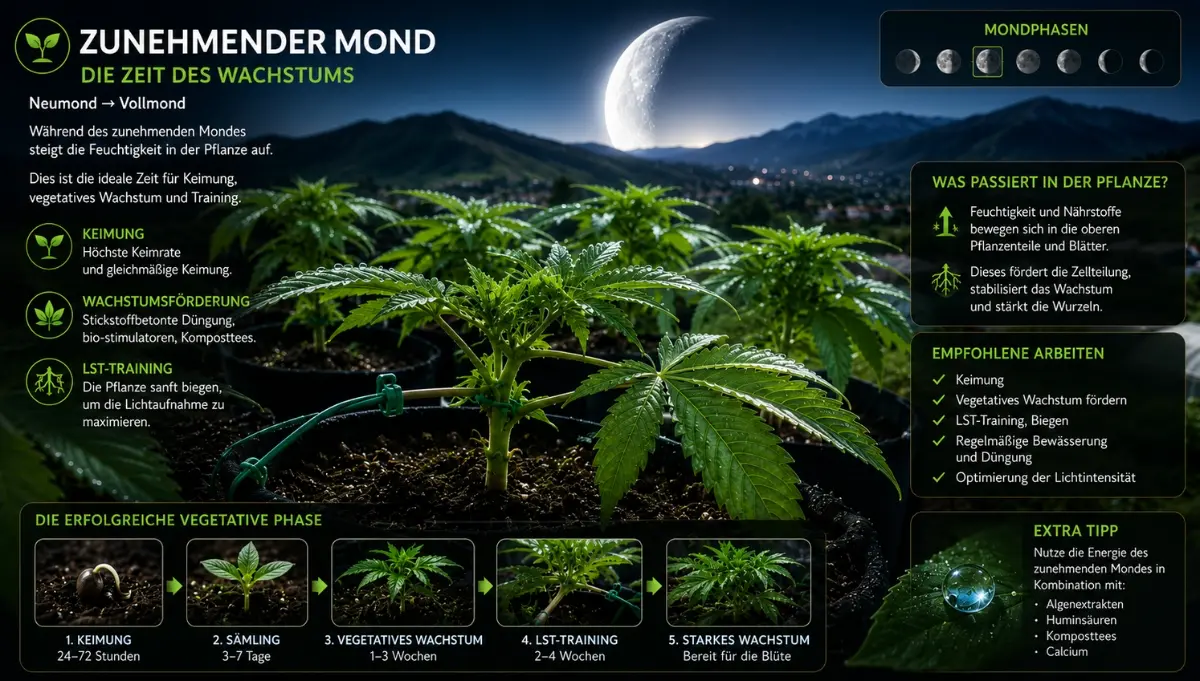
After the new Moon, the illuminated part of the Moon grows larger night by night until the full Moon is reached. This period is known as the waxing Moon.
According to tradition, plant energy is concentrated more strongly in the above-ground parts during this phase. Many growers therefore see it as one of the most active growth periods in the entire cycle.
The waxing Moon is associated with stronger vegetative development, faster germination and more vigorous growth of shoots and leaves. Tasks that support the upper parts of the plant are therefore often performed at this time.
Recommended Tasks During the Waxing Moon
- Germinating cannabis seeds
- Raising seedlings
- LST and other gentle training techniques
- Vegetative feeding
- Foliar feeding
- Applying biostimulants
- Supporting growth during the vegetative stage
Commonly Used Preparations
- Nitrogen-rich fertilizers
- Seaweed extracts
- Humic acids
- Compost teas
- Nettle tea and other plant extracts
These preparations are traditionally used to support vegetative growth and are considered especially suitable for the waxing-Moon phase by many moon gardeners. For a more structured approach, see our guide to feeding schedules for your grow .
Full Moon
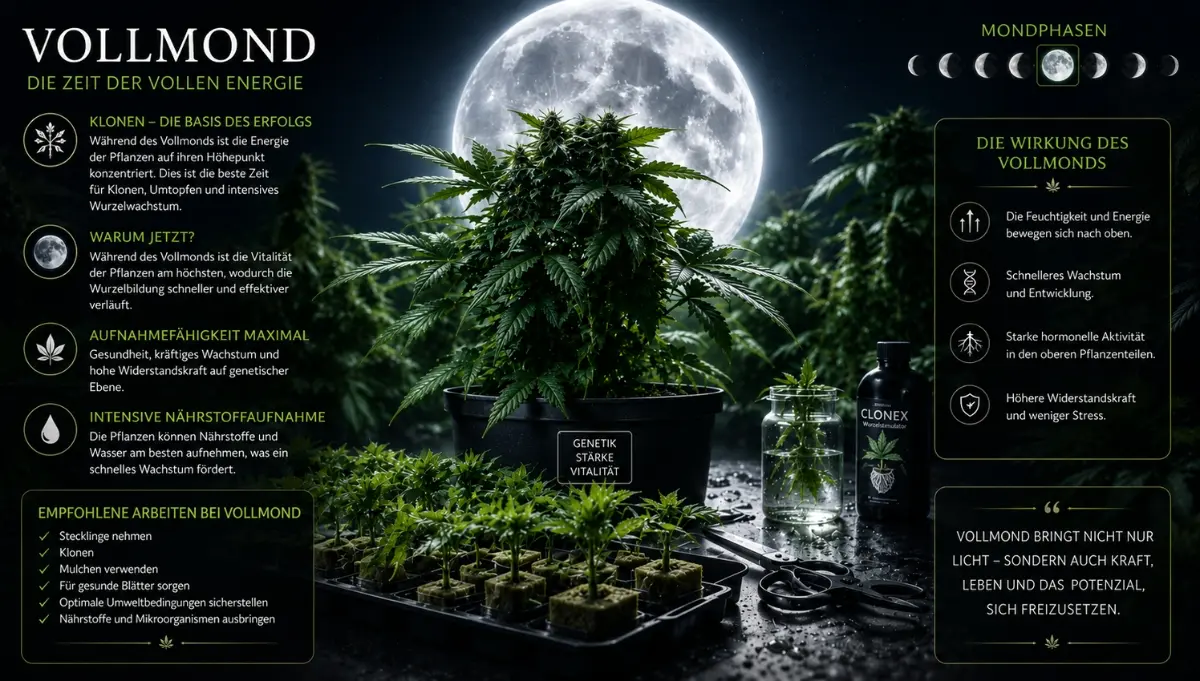
The full Moon is the brightest and best-known phase of the entire lunar cycle. During this time, the fully illuminated lunar disc appears in the night sky and reaches its most visible state. This phase is often given special significance in biodynamic agriculture and traditional moon gardening.
Many growers and gardeners believe that plant vitality, metabolic activity and overall energy may be especially pronounced during the full Moon. For this reason, numerous followers of moon gardening regard these days as an important period for different care and growth-related tasks.
According to tradition, plants respond especially actively to external influences during this phase. Many growers therefore use the days around the full Moon to observe their plants closely, document their development and prepare important tasks for the next vegetative or flowering stage.
Recommended Tasks During the Full Moon
- Taking cuttings and producing clones
- Caring for mother plants
- Applying rooting products
- Supporting soil life
- Using microbial products
- Applying mycorrhizal fungi
- Checking plant health
- Preparing for the next vegetative or flowering stage
Many growers also use the full Moon as an opportunity to inspect their plants thoroughly for pests, diseases, nutrient-related problems or other irregularities. Close observation of plant development is one of the most important elements of traditional moon gardening.
The connection between the full Moon and successful propagation from cuttings is not currently supported by scientific studies. Different moon-gardening systems take different positions: some consider the full Moon ideal for cloning, while others prefer the waxing Moon for plant propagation.
Waning Moon
After the full Moon, the waning phase begins and continues until the next new Moon. During this period, the visible illuminated part of the Moon becomes smaller night by night.
According to traditional moon-gardening teachings, plant energy increasingly concentrates in the root zone and underground structures during this phase. The waning Moon is therefore often associated with work involving the soil, root system and overall soil biology.
Many gardeners and cannabis growers use this period to establish the foundation for healthy growth. The focus is less on above-ground development and more on building a stable, efficient root system.
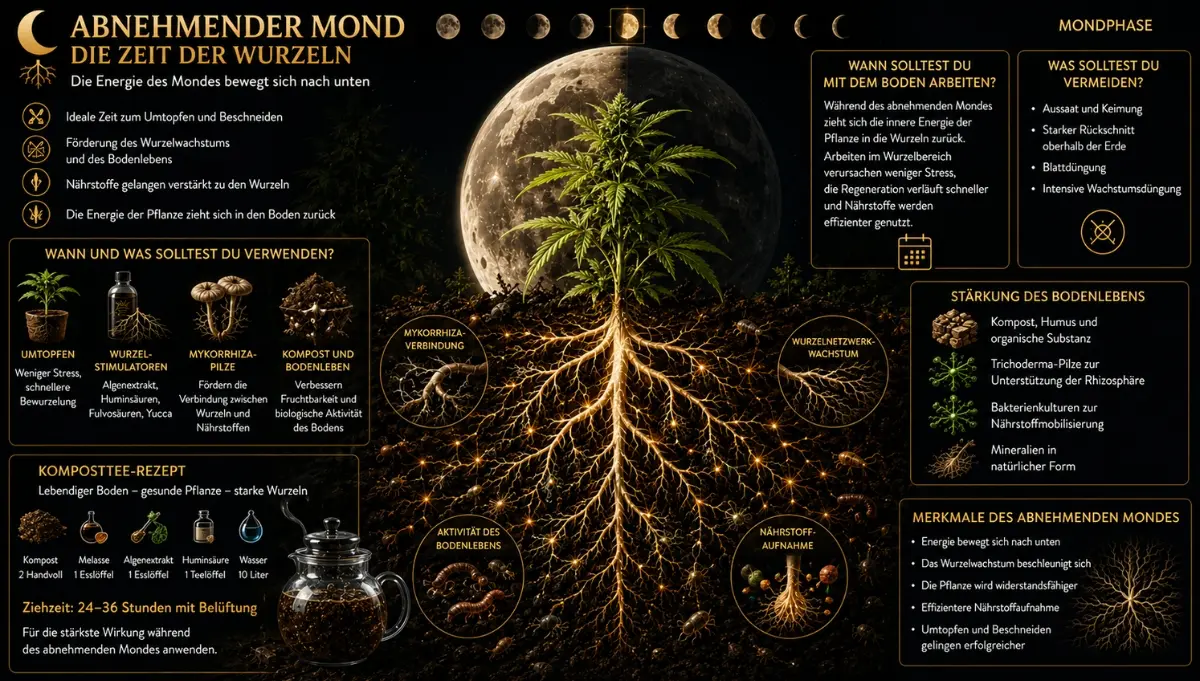
Recommended Tasks During the Waning Moon
- Transplanting plants
- Improving soil structure
- Applying compost
- Using root stimulants
- Applying mycorrhizal products
- Using Trichoderma products
- Supporting soil life
- Incorporating organic material
Commonly Used Products and Additives
- Compost
- Humus
- Trichoderma fungi
- Mycorrhizal products
- Fulvic acids
- Yucca extract
Many experienced growers report that this phase can be particularly well suited to stimulating biological activity in the soil and supporting the development of a strong root system. A healthy root zone ultimately provides the foundation for a vigorous, productive cannabis plant.
New Moon and Dark Moon
The new Moon marks the part of the lunar cycle when the Moon is almost invisible in the night sky. The term “dark Moon” is often used for the days immediately before and after the new Moon.
Moon gardening often regards this phase as a period of transition and rest. Many gardeners consider it a suitable time to avoid major interventions and instead carry out organizational, preparatory and technical work.
During these days, the emphasis is less on active plant care and more on planning the next steps and optimizing the growing environment.
Recommended Tasks During the New Moon
- Creating a cultivation plan
- Cleaning and disinfecting tools
- Maintaining the grow tent
- Checking ventilation and filtration systems
- Preparing substrate mixes
- Selecting and sorting seeds
- Planning the next growing cycle
- Documenting and analyzing previous grows
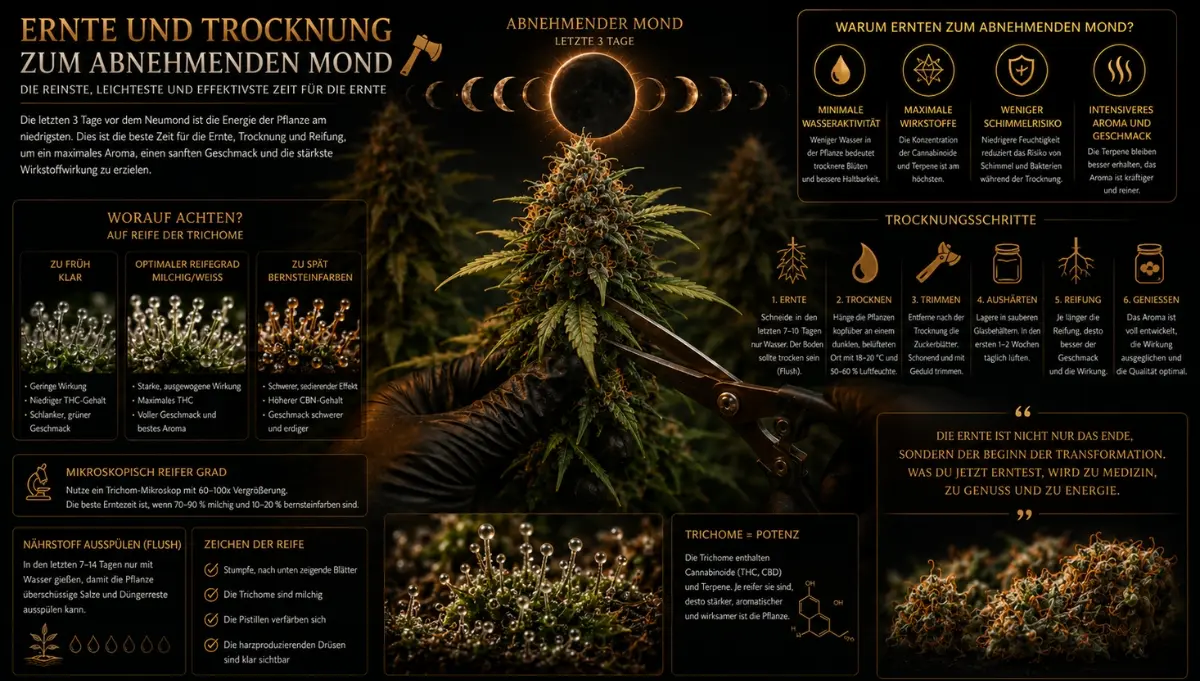
Some moon-gardening systems also recommend harvesting around the new Moon, while other traditions prefer the full Moon. These recommendations come mainly from biodynamic and historical observations and should not be treated as scientifically confirmed cultivation rules.
Different schools of moon gardening vary considerably in their recommendations. Many of the methods described here are based on centuries of experience and tradition rather than clearly demonstrated scientific relationships.
The Central Idea Behind Moon Gardening
The central principle of moon gardening is to become more aware of natural cycles and to observe plant development attentively. For many gardeners, the lunar calendar is not only a planning tool but also a philosophy that encourages a deeper understanding of natural processes.
Using lunar phases as a reference can help growers organize cultivation tasks more systematically and work with their plants more regularly. At the same time, it reminds us that successful cultivation always depends on many factors—including high-quality genetics, a healthy root system, optimal environmental conditions, balanced nutrition and continuous observation of plant development.
Whether you actively follow the lunar calendar or simply regard it as an interesting supplement, moon gardening remains a fascinating element of nature-conscious cannabis cultivation for many growers.
Genetics and Clones for Your Growing Calendar
Healthy genetics remain far more important than lunar timing. The following feminized seeds and rooted plants are available through the English Grow Island shop. Choose according to your environment, experience and local regulations.
Feminized Cannabis Seeds
 AlienZ / Fem / Green House Seeds
  Wonder Pie / Fem / Green House Seeds
  Velvet Moon / Fem / Green House Seeds
  Mango Haze (AUH2) / Fem / Green House Seeds
  White Widow / Fem / Green House Seeds
  Ztrawberry / Fem / Green House Seeds
  Jack Herer / Fem / Green House Seeds
  Shishka Lemonade / Fem / Green House Seeds
 Hemp Plants and Clones
 Dantes Inferno 8 (Milehighdave Cut) Hemp Plant
  Wedding Cake BX1 Hemp Plant
  Big Bud Hemp Plant
  Super Silver Haze Hemp Plant
  Indoor Mix of Pre-Grown Hemp Plants – 3 pcs
  Amnesia Core Cut Hemp Plant
  AK 47 Hemp Plant
  Outdoor Mix Hemp Plant
 Availability and legal requirements can vary. Always follow the regulations that apply in your location.
The Meaning of Zodiac Signs in Moon Gardening
Moon gardening is a centuries-old observation system that considers not only the phases of the Moon but also its passage through the zodiac signs. According to tradition, the Moon’s position may influence different aspects of plant development, including sap flow, root activity, leaf growth and the formation of flowers and fruit.
For this reason, many gardeners and growers schedule sowing, transplanting, watering and even harvesting according to the Moon’s current position in the zodiac. Although modern scientific research has not yet confirmed these connections conclusively, they continue to play an important role in biodynamic agriculture and traditional gardening.
The twelve zodiac signs are divided among four elements: fire, water, air and earth. Each element is traditionally associated with specific plant parts and gardening tasks.
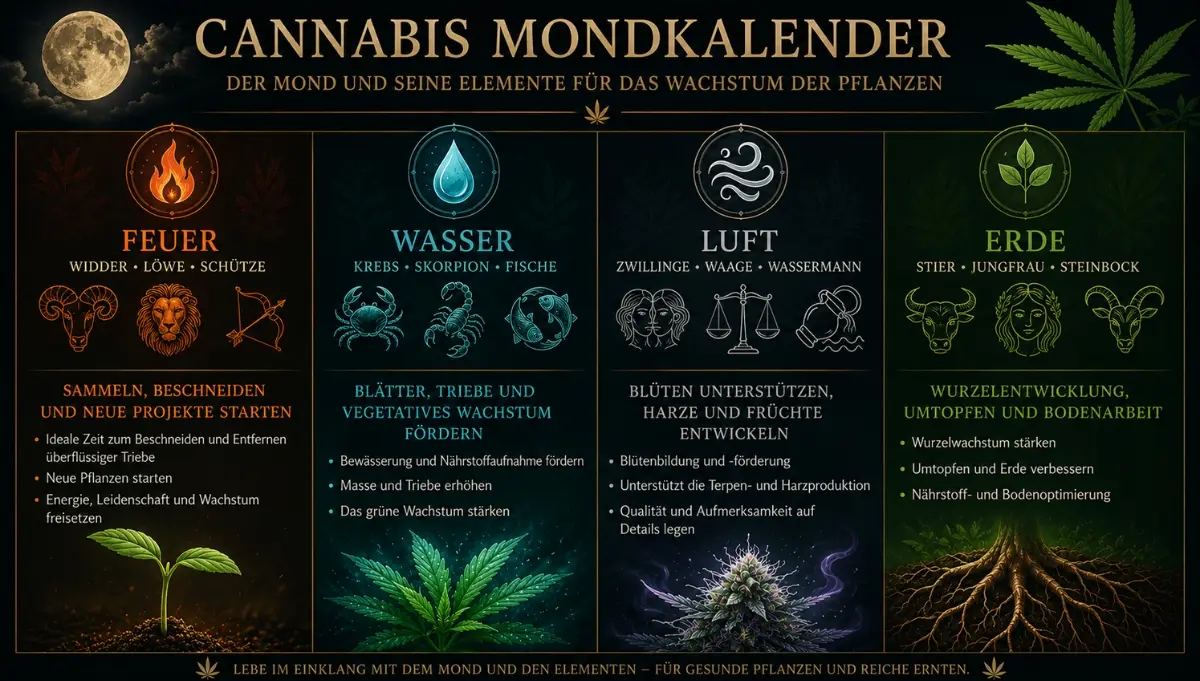
Fire Signs – Aries, Leo and Sagittarius
Fire signs symbolize activity, energy and growth. Traditional moon gardening considers these days especially favorable for sowing, germination and starting new projects.
Many growers use these lunar positions to germinate cannabis seeds, raise new seedlings or begin an entirely new growing cycle. Folk tradition holds that plants started at this time may begin especially vigorously and develop dynamic early growth.
Associated Tasks
- Sowing seeds
- Germinating cannabis seeds
- Raising seedlings
- Starting new grow projects
Water Signs – Cancer, Scorpio and Pisces
Water signs are traditionally associated with moisture, nutrient transport and vegetative growth. According to tradition, plants may use water and nutrients especially efficiently during these days.
Many gardeners therefore schedule watering, feeding and foliar treatments for water-sign days. This phase is often used to encourage the development of leaves, shoots and the plant’s entire above-ground mass.
For many growers, these days can be an important part of planning during the vegetative stage of cannabis plants.
Associated Tasks
- Watering
- Supplying nutrients
- Foliar feeding
- Encouraging leaf and shoot growth
Air Signs – Gemini, Libra and Aquarius
Air signs are traditionally associated with flowers, fragrances and the upper parts of the plant. Followers of moon gardening believe that these days may support flower formation, resin production and the development of aromas and terpenes.
When cannabis plants are flowering, many growers use these periods for measures intended to improve flower quality. Traditional lunar calendars often associate air signs in particular with the development of complex terpene profiles and intense aromas.
Associated Tasks
- Supporting the flowering stage
- Encouraging terpene development
- Supporting resin production
- Improving flower quality
Earth Signs – Taurus, Virgo and Capricorn
The earth element traditionally represents stability, roots and all soil-related processes. Moon gardening considers these days especially suitable for work in the root zone and for maintaining and improving the substrate.
Many growers use earth-sign days for transplanting, soil improvement or applying biological soil amendments. Because a healthy root system is the foundation of a vigorous and productive plant, these days are given considerable importance in many lunar calendars.
Associated Tasks
- Transplanting
- Improving the soil
- Applying compost and organic material
- Caring for roots
- Preparing substrates
Important note: Moon gardening and the use of zodiac signs in horticulture are based mainly on traditional observations and long-term experience. Many gardeners report positive results, but growth and yield are also influenced by many other factors—including genetics, climate, soil quality, watering, nutrition and overall plant care. Lunar and zodiac cycles should therefore be treated as a complementary method, not as a scientifically proven rule of cultivation.
When Is the Best Time to Harvest?
One of the most debated questions in moon gardening concerns the ideal time to harvest. Some growers rely exclusively on the plant’s maturity, while others also consider the current lunar phase.
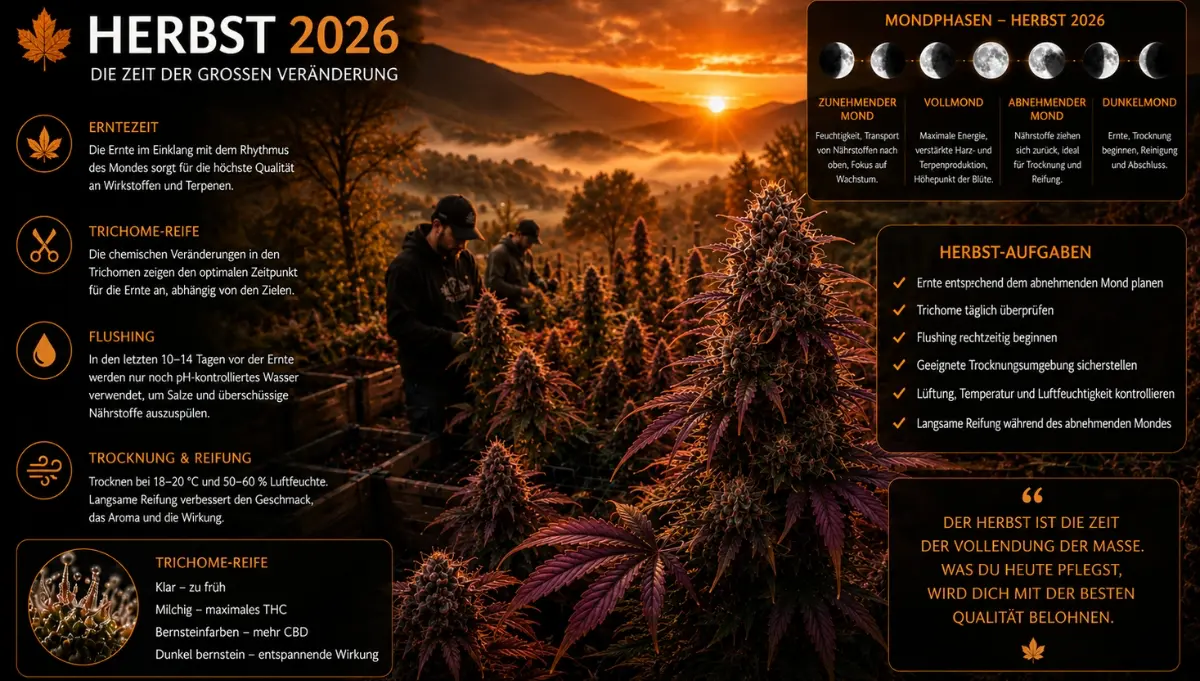
Different biodynamic and traditional systems offer different recommendations. As a result, there is still no universally accepted method followed by all moon gardeners.
Supporters of moon gardening believe that lunar phases may influence a plant’s water balance, sap flow and the concentration of certain compounds and aromas. Scientific evidence remains limited, but many growers continue to consider these ideas when planning a harvest.
Harvesting During the Full Moon
Harvesting around the full Moon is one of the best-known approaches in moon gardening. Supporters believe that the plant’s biological processes may be especially active at this time and that certain aromatic compounds and resins may be more concentrated in the flowers.
Possible Benefits According to Traditional Moon Gardening
- A more intense terpene profile
- Stronger flavors and aromas
- Greater resin production
- Especially vigorous flowers
- A richer sensory experience
Many growers prefer this method particularly for premium flowers where aroma, flavor and resin production are the main priorities.
Harvesting During the Waning Moon
Harvesting during the waning Moon is also widespread among followers of moon gardening. Traditional practice holds that the plant’s moisture content may be slightly lower during this phase as energy becomes more concentrated in the root zone.
Possible Benefits According to Tradition
- Lower moisture content in the flowers
- A more balanced drying process
- Reduced risk of mold
- More even ripening
- Easier post-harvest processing
Growers in regions with high humidity often favor this time because they report a more manageable drying process. Our guide to identifying, preventing and treating mold on cannabis offers additional practical advice.
Harvesting During the Dark Moon
The final days before the new Moon are called the dark Moon in many traditional lunar calendars. During this phase, the Moon is barely visible—or not visible at all—in the night sky.
Some growers consider this the optimal harvest period in the entire lunar cycle.
Possible Benefits According to Traditional Moon Gardening
- More concentrated plant compounds
- Faster and easier drying
- A cleaner final product
- Longer storage life
- Favorable maturation characteristics
It is important to emphasize that these assumptions are based mainly on traditional observations and growers’ experience and are not currently regarded as scientifically established facts.
What Does Practical Experience Say?
Most experienced cannabis growers agree that the plant’s actual maturity is far more important than the current lunar phase when determining the ideal harvest time. The most reliable indicator is to inspect the trichomes with a magnifying glass or microscope.
Trichomes are tiny resin glands that produce a large proportion of the cannabinoids and terpenes. Their appearance and color provide valuable clues about when a cannabis plant has reached the desired effect profile.
Using Trichomes as a Guide
- Clear trichomes: The plant is not yet fully mature. Harvesting at this stage would generally be too early.
- Milky or cloudy trichomes: The THC level often peaks at this stage. Many growers regard this as the ideal time for an energetic and balanced effect.
- Amber trichomes: As the proportion of amber trichomes increases, the effect is often described as more physical, relaxing and calming.
Many experienced growers prefer a mixture of mostly milky and some amber trichomes. However, the ideal harvest time depends heavily on the genetics and the desired effect profile.
Regardless of the chosen lunar phase, checking the trichomes remains the most precise method for determining the actual maturity of a cannabis plant. It provides much more reliable information than calendar dates or general flowering times supplied by the breeder.
The Importance of Drying
After harvest, one of the most important steps in the entire cultivation process begins: drying. Many experienced growers believe that correct drying and curing influence the quality of the final product far more than the exact harvest date or lunar phase.
Drying too quickly can destroy valuable terpenes and damage the aroma. Drying too slowly, on the other hand, increases the risk of mold and unwanted microorganisms. A stable environment is therefore essential.
Recommended Drying Conditions
- Temperature: 18–20 °C
- Relative humidity: 55–60%
- Light: Complete darkness or minimal light exposure
- Air movement: Gentle, indirect air circulation
- Drying time: Approximately 10–14 days
Slow, controlled drying helps preserve aroma, flavor and the cannabinoid profile as effectively as possible. Many quality problems do not arise during cultivation but are caused by mistakes in the drying process.
The Role of Curing
Drying is followed by curing—the controlled maturation of the flowers. During this phase, natural biological processes can further improve aroma, flavor and smoke quality.
Certain plant compounds slowly break down during curing while the terpene profile continues to develop and become more balanced. Many premium flowers reach their full potential only after several weeks or even months of curing.
Recommended Curing Times
- Minimum: 3 weeks
- Recommended: 6–8 weeks
- For the highest quality: 3–6 months
Many high-quality cannabis flowers develop their full aroma only after several months of storage under optimal conditions. Patience is therefore often one of the most important factors on the path to an exceptional final product.
Conclusion
Growing cannabis according to a lunar calendar is a fascinating system based on centuries of observation and traditional experience. Although modern science has not yet conclusively confirmed all the proposed connections between lunar phases and plant development, moon gardening remains a valuable planning aid for many growers.
At the same time, the fundamental success factors in cannabis cultivation remain unchanged. High-quality genetics, a healthy substrate, optimal environmental conditions, balanced nutrition, proper watering and regular trichome checks have a far greater influence on the quality of the final product than the lunar phase.
The Moon is no substitute for sound cultivation practices. For growers who want to align their work more consciously with natural rhythms, however, a lunar calendar can be an interesting, inspiring and tradition-rich addition throughout the growing cycle.
Ultimately, the lunar calendar remains a guide. The most important task for a successful grower is still to observe the plants attentively and understand their individual needs at every stage of their life cycle.
Cannabis Lunar Calendar 2026–2027
June 15, 2026 – June 15, 2027
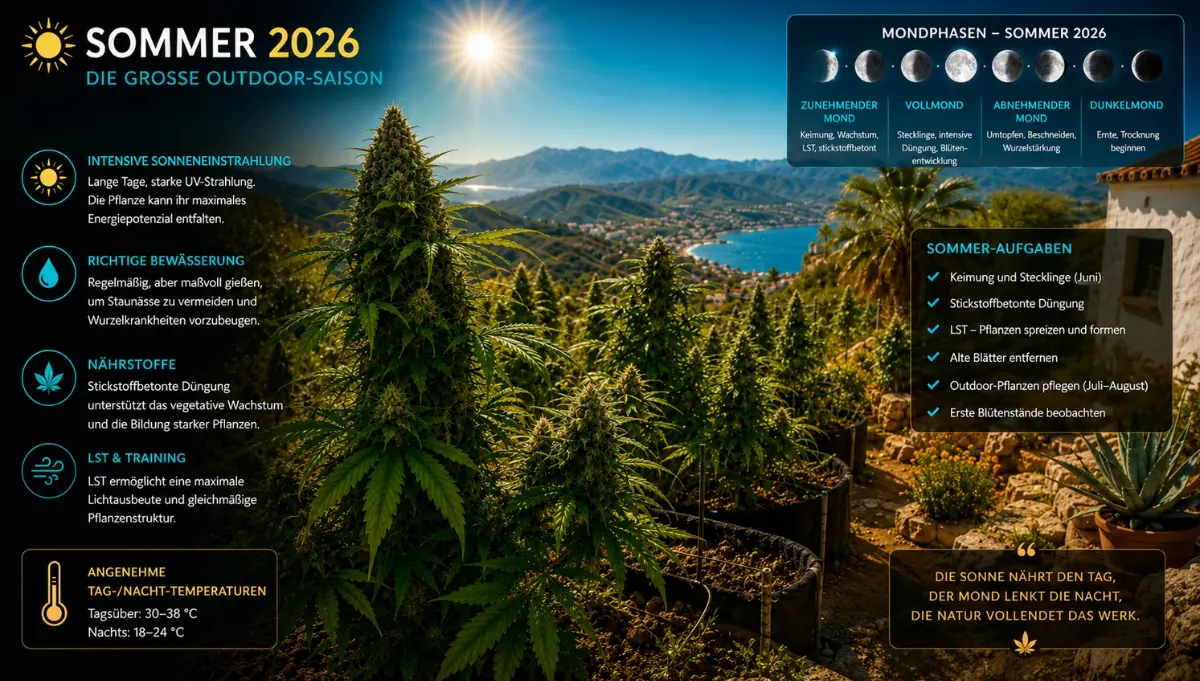
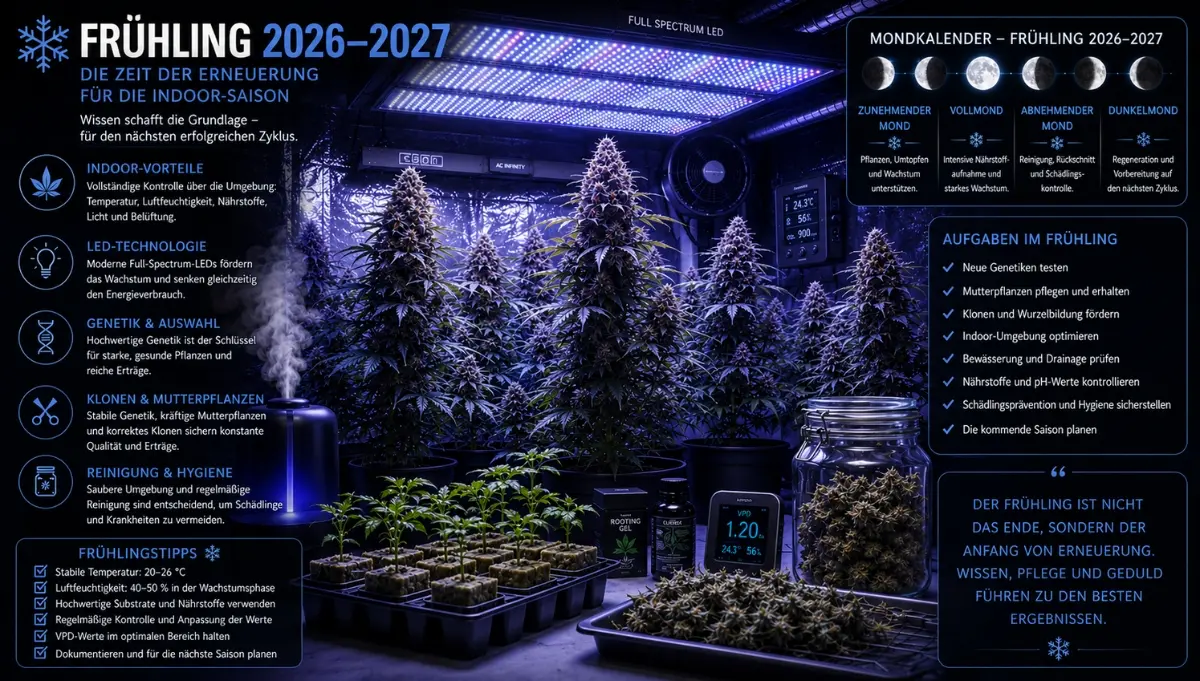
This cannabis lunar calendar is based on traditional and biodynamic principles of moon gardening. It is intended as a reference for growers who want to coordinate cultivation tasks with the Moon’s natural rhythms. The recommendations draw on long-term observations and the experience of gardeners around the world.
| Period | Lunar Phase | Recommended Tasks |
|---|---|---|
| June 15–29, 2026 | Waxing Moon | Germination, raising seedlings, LST and vegetative feeding |
| June 30, 2026 | Full Moon | Inspect mother plants, take cuttings and apply microbial products |
| July 1–13, 2026 | Waning Moon | Transplant, strengthen roots and apply compost and mycorrhizae |
| July 14, 2026 | New Moon | Planning, disinfection and tool cleaning |
| July 15–28, 2026 | Waxing Moon | Vegetative growth, LST and nitrogen-rich nutrients |
| July 29, 2026 | Full Moon | Take cuttings and care for mother plants |
| July 30–August 11, 2026 | Waning Moon | Support soil life, work on roots and transplant |
| August 12, 2026 | New Moon | Clean and disinfect tools |
| August 13–27, 2026 | Waxing Moon | Prepare for flowering and switch to a 12/12 light cycle |
| August 28, 2026 | Full Moon | Support flowering and apply PK nutrients |
| August 29–September 10, 2026 | Waning Moon | Begin flushing and support the root zone |
| September 11, 2026 | New Moon | Harvest early outdoor strains according to biodynamic tradition |
| September 12–October 9, 2026 | Lunar Cycle | Start new indoor cycles, vegetative growth, training and flowering preparation |
| October 10, 2026 | New Moon | Beginning of the main outdoor harvest season |
| October 11–December 8, 2026 | Autumn and Winter Cycles | Flowering, drying, curing and indoor cultivation |
| December 9, 2026 | New Moon | Winter harvest and the beginning of curing |
| December 10, 2026–March 8, 2027 | Winter Lunar Cycles | New indoor generations, vegetation, flowering and clone production |
| March 8, 2027 | New Moon | Prepare for the spring season |
| March 9–May 31, 2027 | Spring Lunar Cycles | Germination, seedlings, outdoor planting, LST and soil preparation |
| June 1–15, 2027 | Waxing Moon | Explosive summer growth and the first autoflower blooms |
How to Use the Lunar Calendar
Moon gardening is based on traditional and biodynamic cultivation principles. Many growers and biodynamic farmers consider lunar phases when planning their work and report positive practical experiences.
At the same time, scientific studies have not yet provided conclusive evidence that lunar phases directly affect plant growth, development or yield. This calendar should therefore be understood primarily as a practical reference, a traditional recommendation and an experience-based guide.
The most important factors for successful cannabis harvests remain high-quality genetics, healthy roots, optimal environmental conditions, balanced nutrition, proper watering and regular trichome inspection.







Comments