The Reality Behind Aloha: How Cannabis Shaped Hawaii
Hawaii cannabis legalization – on the brink of a new era
One of the world’s most iconic tropical paradises, Hawaii, has taken a step that goes far beyond local politics. The Senate’s decision is not just part of an administrative process, but a global message: the future of cannabis is no longer a question, but a direction.
The official call for federal legalization shows that the market, society, and policymakers are increasingly moving in the same direction. This step won’t change everything overnight, but it clearly sets the course for the years ahead.
What does this actually mean?
In the United States, a dual system currently exists: while cannabis is already legal in several states, it remains illegal at the federal level. This situation creates significant challenges:
- banking and financial restrictions
- logistical and transportation issues
- legal uncertainty for businesses
Hawaii’s move aims to break this system. It does not bring immediate change, but instead applies political pressure toward a unified and transparent regulatory framework.
Why is Hawaii unique in the cannabis world?
Hawaii is not just another emerging market. It is a genetic and cultivation hotspot, where nature provides nearly ideal conditions.
The impact of the tropical climate is clear:
- year-round growing potential
- strong outdoor growth
- intense terpene profiles
This environment has led to the creation of legendary genetics that are now known worldwide.
Iconic Hawaiian genetics
The name Hawaii is almost synonymous with certain classic sativa lines that still shape the market today.
Maui Wowie – a true tropical sativa, known for its energetic, creative effects and its pineapple-citrus profile. A perfect example of how environment shapes terpene expression.
Kona Gold – a clean, focused genetic that reveals its full potential outdoors. Characterized by strong growth and pronounced stretch.
Hawaiian Snow – a more modern, high-THC hybrid combining classic lines with European breeding. High yields and powerful effects.
Puna Budder – less widely known but locally appreciated, this strain stands out with creamy terpene profiles and balanced effects.
Growing reality in Hawaii
Even though the conditions seem almost perfect, cultivation is not without its challenges. Experienced growers know that adaptability is the key to success.
Advantages:
- stable 12/12 light cycle year-round
- rapid vegetative growth
- high THC potential due to strong sunlight
Challenges:
- high humidity → risk of mold
- insects and pests
- impact of salty ocean air in certain areas
Therefore, success depends on selecting the right genetics and optimizing airflow.
Cannabis tourism – illusion vs. reality
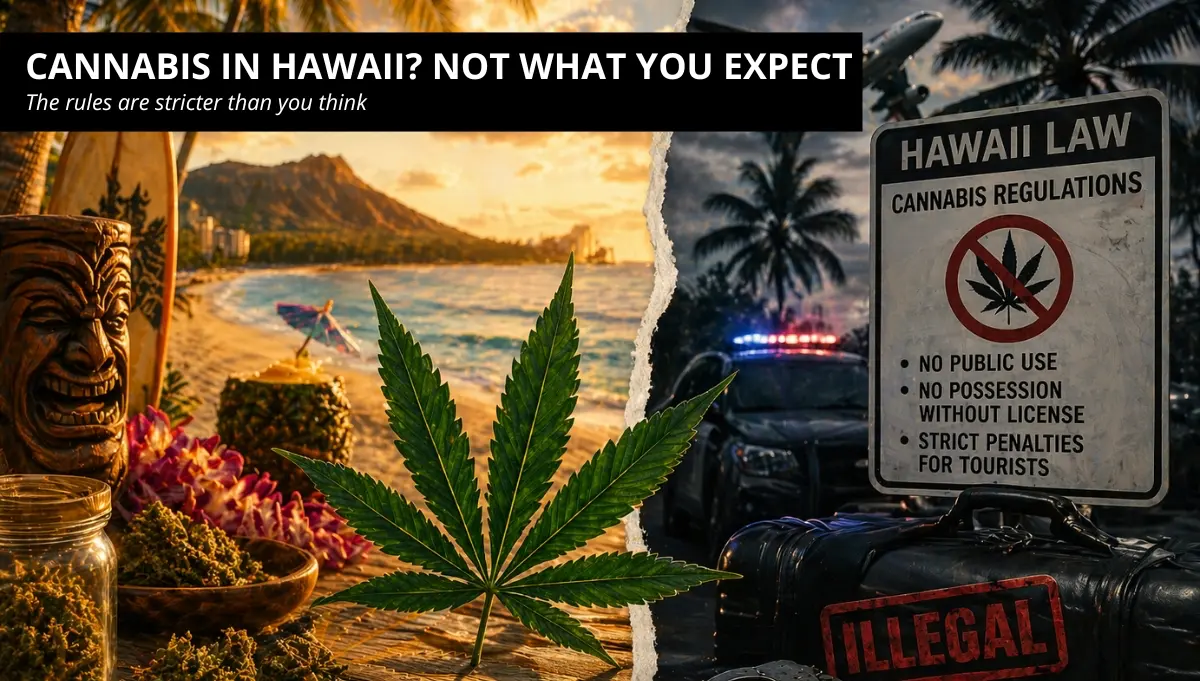
Many people imagine Hawaii as a kind of “tropical Amsterdam,” but the reality is far more nuanced.
Current situation:
- medical cannabis is legal
- recreational use is limited
- public consumption is prohibited
This means that access is not necessarily easy for tourists, and breaking the rules can have serious consequences.
Cannabis-friendly travel – strategy, not coincidence
With proper planning, Hawaii can still offer a unique experience.
Location choice
- Oahu – more options, urban environment
- Maui – quieter, closer to nature
- Big Island – strong outdoor grow culture
Accommodation
Privacy is key. Instead of large hotel chains, it’s better to choose a secluded accommodation or villa.
Discretion
The most important rule: stay low-key. Despite the relaxed atmosphere, the laws are real and enforced.
- consume only in private spaces
- avoid public visibility
- don’t act irresponsibly online
Alternative: CBD
If you want to stay on the safe side, CBD products are a much safer option for tourists.
The future – what comes next?
If federal legalization becomes a reality, Hawaii’s position could change dramatically.
- boom in cannabis tourism
- opening of export opportunities
- emergence of a new premium genetics hub
This will not only impact the U.S. market but also have global effects—especially for European grow shops and seed banks.
Hawaii is currently at a turning point. What is now a political initiative could soon become a new industry standard.
Those who recognize this shift early—whether growers, travelers, or investors—will have a clear advantage.
Because the future of cannabis is not tied to a single place—it is a global movement, and Hawaii could become one of its next epicenters.
Hawaii and cannabis – history, culture, and spiritual connection
The relationship between Hawaii and cannabis goes far beyond a modern trend or economic opportunity. In the history of the islands, the plant has not only played a recreational or medicinal role, but has also carried cultural and spiritual significance.
The beginnings – immigrants and plant knowledge
Cannabis did not arrive in Hawaii with the original Polynesian culture, but later in the 19th century, when Asian workers – mainly Chinese and Indian immigrants – came to the islands.
They brought with them:
- knowledge of the medicinal use of cannabis
- traditional plant-based healing practices
- spiritual and ritual forms of use
The Indian influence was particularly significant, as cannabis has long been regarded in Hindu culture as a sacred plant, associated with expanding consciousness and spiritual connection.
The Rastafari influence and the spiritual dimension
Throughout the 20th century, Hawaii’s cultural landscape was further enriched, especially through the influence of the Rastafari movement, which originated in the Caribbean.
Followers of this movement use cannabis—often referred to as “ganja”—as a sacred plant.
For them, cannabis is:
- a tool for meditation
- a means of communal connection
- a path to spiritual cleansing and expanded awareness
This perspective also found its place in Hawaii, particularly within nature-oriented alternative communities, where the use of the plant is understood not as consumption, but as ritual.
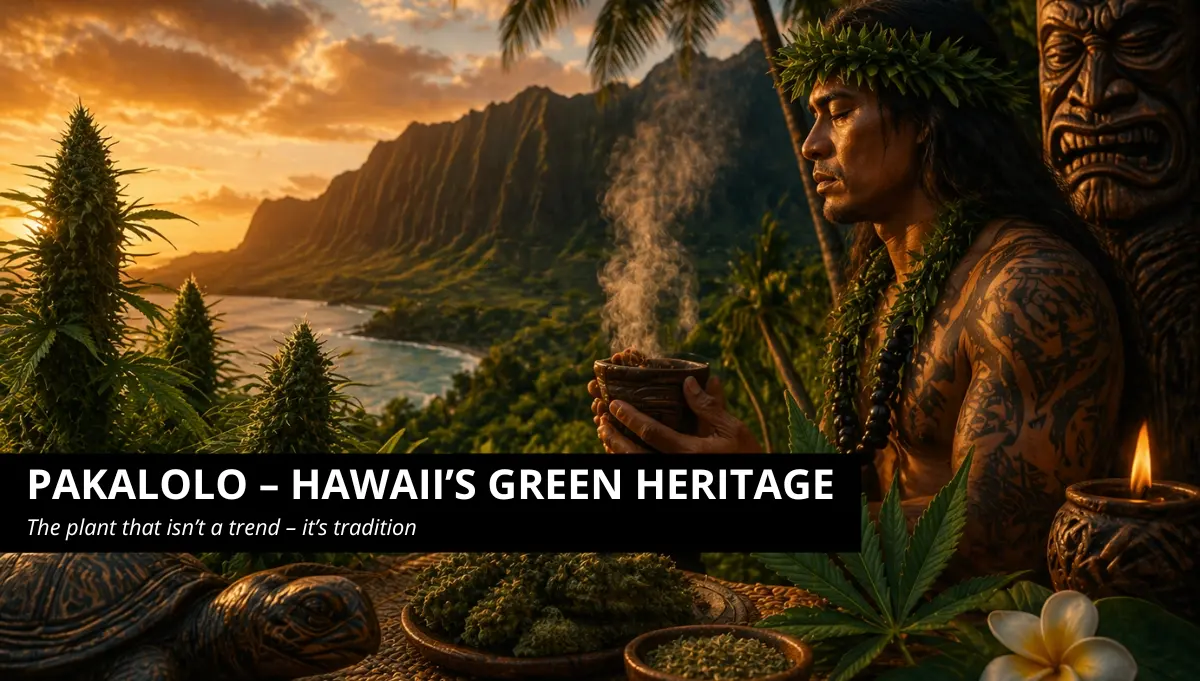
“Pakalolo” – part of local identity
In Hawaii, cannabis is often referred to as “pakalolo”, a term deeply embedded in everyday language and culture.
Pakalolo is more than just a plant:
- it is part of local identity
- it is connected to respect for nature
- it reflects the “slow life” mindset and the Aloha philosophy
The Aloha principle—representing respect, harmony, and connection—is seen by many as aligned with a conscious and mindful use of cannabis.
Alternative communities and a “green” lifestyle
In the 1960s and 1970s, several Hawaiian islands—especially Maui and the Big Island—attracted communities seeking a nature-based, alternative lifestyle.
These communities:
- adopted organic and later vegan cultivation methods
- experimented with different genetics
- practiced conscious and spiritual use
This period contributed significantly to Hawaii becoming a center of experimentation and innovation in the cannabis world.
The meeting of past and future
Today’s legalization efforts did not emerge out of nowhere. They are built on a historical and cultural foundation where cannabis:
- served as a medicinal tool
- held spiritual significance
- created shared community experiences
This past forms the basis for Hawaii viewing cannabis today not only as an economic opportunity, but also as part of its cultural heritage.
The relationship between Hawaii and cannabis is more than cultivation or consumption. It is a connection shaped by historical, spiritual, and cultural layers, now re-emerging in a new form through legalization movements.
If you understand this, you don’t just see the market—you see the deeper meaning behind the plant.
Back to the posts








Comments