Cannabis VPD Chart: Ideal Values & Calculator for Veg and Flower

Written by: Bartholomew Alen
aTemperature and humidity are among the first climate parameters growers keep an eye on. Nevertheless, two rooms with the same relative humidity can have completely different effects on plants. The reason is simple: 60% humidity at 22°C produces a different evaporation power than 60% at 28°C. This is exactly where it will be VPD for cannabis interesting.
VPD stands for Vapor Pressure Deficit , in German vapor pressure deficit. In simple terms, the value describes how big the difference is between the maximum possible amount of water vapor and the actual moisture in the air. For the plant, this difference is an essential part of the driving force behind transpiration: the flow of water from the roots through the plant to the leaves.
A sensibly set VPD can help to control the growing climate in a more stable and understandable way. However, it is not a magical yield regulator. Genetics, root health, light, irrigation, nutrient supply, air movement and plant age remain just as important. This guide therefore not only shows target areas, but also how to correctly classify measured values, avoid typical mistakes and... VPD table for cannabis practically used.
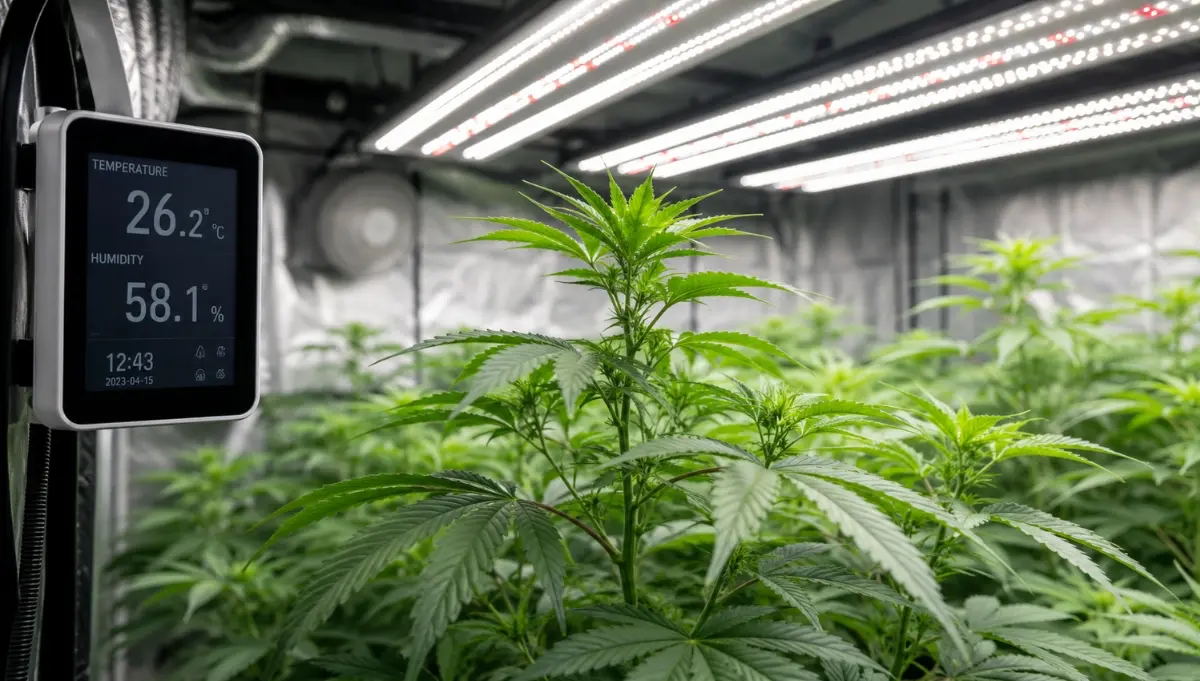
In short: The most important thing about cannabis VPD
- VPD combines temperature and relative humidity to create a more meaningful climate value.
- A low VPD means low evaporative demand; a high VPD means strong evaporative demand.
- A practical guideline is approximately 0.4–0.8 kPa for seedlings and cuttings, 0.8–1.2 kPa for the vegetative phase and 1.2–1.5 kPa for flowering.
- For a more accurate calculation, leaf temperature should be taken into account, especially under LED lighting.
- VPD is a target corridor, not a single perfect point. Plant response and trend are more important than short-term fluctuations.
What exactly does VPD mean in cannabis?
Warm air can hold more water vapor than cold air. The relative humidity shows to what extent the air is saturated with water vapor at the measured temperature. However, it alone does not say how much the atmosphere can absorb water from a leaf. The VPD closes this gap.
In plant physiology, VPD refers to the difference between the saturation vapor pressure and the actual water vapor pressure. The greater this difference, the greater the atmospheric demand for water. Plants react to this through their stomata, the so-called stomata. Under favorable conditions, open stomata allow both the absorption of CO₂ and the release of water vapor. If the air becomes too dry, the stomata can partially close, which changes water loss, CO₂ uptake and photosynthesis. [1]
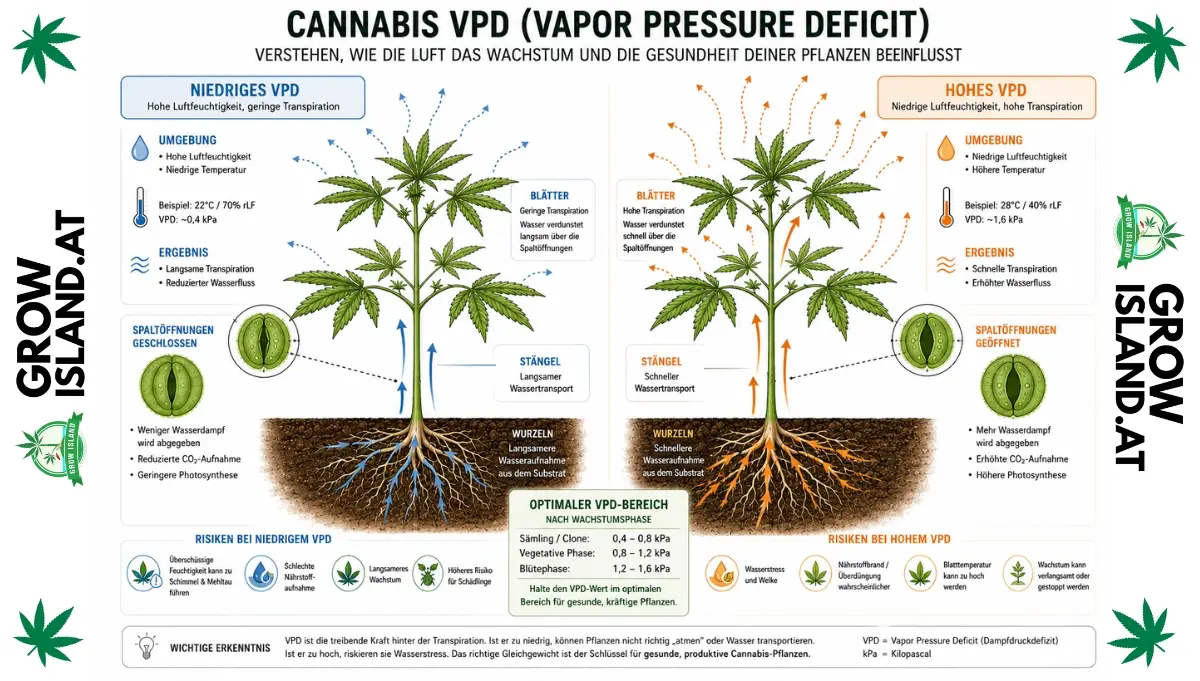
A picture for understanding
Imagine the leaf as a wet sponge. It dries only slowly in almost saturated air. In warm, dry air it loses water much more quickly. VPD does not describe the water content of the sponge, but rather the “pull” of the environment. However, the plant is not a passive sponge: it can regulate its stomata and thus respond to this pull.
Why temperature and humidity alone are not enough
A blanket recommendation like “always keep humidity at 55%” ignores temperature. At 22°C and 55% relative humidity, the air-based VPD is approximately 1.19 kPa. At 28 °C and the same humidity it is already around 1.70 kPa. The air may feel similar to us, but presents a significantly higher evaporation requirement for the plant.
This explains why a grow can show dry leaf edges, high water consumption or slowed development despite seemingly “correct” humidity. Conversely, an acceptable temperature combined with very high humidity can lead to sluggish transpiration and a humid microclimate in the crown.
VPD helps to read both values together. However, it does not replace direct plant observation. A healthy target value is of little use if the substrate is permanently waterlogged, the roots do not receive enough oxygen or strong lamps locally overheat the leaf surface. The Grow Island article also explains how climate, light and plant stress interact Cannabis Stress Guide .
Cannabis VPD table: practical target areas by phase
The following areas are not universal constants of nature. They are practical guidelines that must be adapted to genetics, rooting, light intensity, irrigation and cultivation system. Recent cannabis literature identifies similar corridors while emphasizing that direct research on humidity in cannabis is still limited. [2]
| Development phase | VPD target area | Typical temperature | Typical relative humidity |
|---|---|---|---|
| seedling | 0.4–0.8 kPa | 23-26°C | 70-80% |
| Unrooted or young cuttings | 0.4–0.8 kPa | 23-26°C | 70-85% |
| Early vegetation phase | 0.8–1.0 kPa | 24-27°C | 65-75% |
| Late vegetation phase | 1.0–1.2 kPa | 24-28°C | 55-70% |
| Early flowering | 1.1–1.3 kPa | 23-27°C | 50-60% |
| Medium bloom | 1.2-1.4 kPa | 22-26°C | 45-55% |
| Late flowering | 1.3-1.5 kPa | 21-25°C | 40-50% |
In the seedling and cutting phase, a lower VPD is preferred because the roots are still poorly developed. With unrooted cuttings, water absorption via the root system is initially severely limited. As root mass increases, the demand for evaporation is allowed to increase gradually.
During the vegetation phase, a medium VPD can support active water and mineral flow. During flowering, the relative humidity is usually reduced in a controlled manner in order to keep the microclimate in increasingly dense inflorescences less humid. This is no guarantee against fungal infestation, but together with air movement, hygiene and a crown that is not too dense, it reduces an important risk factor. You can find out more about this in the guide Recognize, avoid and properly treat mold in cannabis .
Grower Tip 1: Make transitions slow
Do not abruptly lower the humidity from 75% to 50%. Change the target value over several days and monitor leaf position, water consumption and substrate drying time. A slow transition gives the plant time to adapt its stomata, root performance and water uptake to the new climate.
Cannabis VPD table by temperature and humidity
This table shows the air-based VPD in kPa. To simplify, it assumes that leaf and air temperatures are the same. In practice, the blade surface may be warmer or cooler, so the values are intended as a quick guide rather than a high-precision blade VPD calculation.
| Temperature | 40% RH | 50% RH | 60% RH | 70% RH | 80% RH |
|---|---|---|---|---|---|
| 20°C | 1.40 | 1.17 | 0.94 | 0.70 | 0.47 |
| 22°C | 1.59 | 1.32 | 1.06 | 0.79 | 0.53 |
| 24°C | 1.79 | 1.49 | 1.19 | 0.90 | 0.60 |
| 26°C | 2.02 | 1.68 | 1.34 | 1.01 | 0.67 |
| 28°C | 2.27 | 1.89 | 1.51 | 1.13 | 0.76 |
| 30°C | 2.55 | 2.12 | 1.70 | 1.27 | 0.85 |
Example: At 26°C and 60% RH, the air-based VPD is around 1.34 kPa. This can be good for the flowers, but would usually be too dry for a freshly cut cutting. At 24°C and 70% RH the value is approximately 0.90 kPa, which is more suitable for an established young plant or early vegetation period.
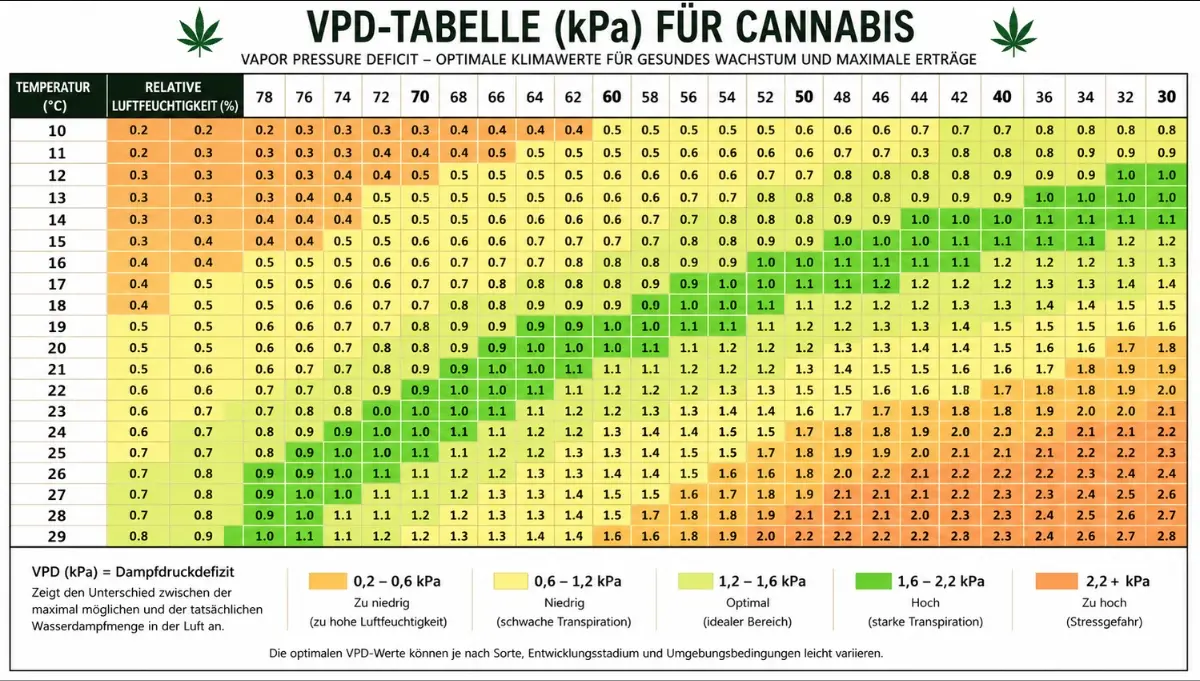
A VPD calculator uses the saturation vapor pressure at a specific temperature and subtracts the actual vapor pressure of the air. For a simplified calculation with the same leaf and air temperatures:
Interactive cannabis VPD calculator
Calculate leaf VPD from air temperature, relative humidity, and leaf temperature difference.
Calculated using 26.0°C air, 60% RH and 24.0°C leaf temperature.
What does this value mean?
The calculated value is in a balanced range for vegetative development.
Possible risks: With stable irrigation and good air movement, there are usually no particular climatic risks.
Recommended action: Keep the climate stable and monitor leaf position and water consumption.
Interactive VPD chart
Temperature 18-32°C, humidity 40-85%, all values in kPa.
| Air °C Sheet °C |
85% RH | 80% RH | 75% RH | 70% RH | 65% RH | 60% RH | 55% RH | 50% RH | 45% RH | 40% RH |
|---|---|---|---|---|---|---|---|---|---|---|
| 18° 16° |
0.06 | 0.17 | 0.27 | 0.37 | 0.48 | 0.58 | 0.68 | 0.79 | 0.89 | 0.99 |
| 20° 18° |
0.08 | 0.19 | 0.31 | 0.43 | 0.54 | 0.66 | 0.78 | 0.89 | 1.01 | 1.13 |
| 22° 20° |
0.09 | 0.22 | 0.36 | 0.49 | 0.62 | 0.75 | 0.88 | 1.02 | 1.15 | 1.28 |
| 24° 22° |
0.11 | 0.26 | 0.41 | 0.56 | 0.70 | 0.85 | 1.00 | 1.15 | 1.30 | 1.45 |
| 26° 24° |
0.13 | 0.29 | 0.46 | 0.63 | 0.80 | 0.97 | 1.14 | 1.30 | 1.47 | 1.64 |
| 28° 26° |
0.15 | 0.34 | 0.53 | 0.72 | 0.90 | 1.09 | 1.28 | 1.47 | 1.66 | 1.85 |
| 30° 28° |
0.17 | 0.39 | 0.60 | 0.81 | 1.02 | 1.23 | 1.45 | 1.66 | 1.87 | 2.08 |
| 32° 30° |
0.20 | 0.44 | 0.68 | 0.91 | 1.15 | 1.39 | 1.63 | 1.87 | 2.10 | 2.34 |
Detailed assessment of VPD areas
| VPD area | Classification | Possible consequences | What should be done? |
|---|---|---|---|
| 0 kPa or less | Risk of condensation and dew point | The leaf surface can reach the dew point. Water film, botrytis, mildew and other fungal problems become more likely. | Immediately reduce the humidity, check the temperature drop, improve exhaust and circulating air and check flowers for moisture. |
| 0-0.4 kPa | Very low drying power | The humidity is usually too high. Transpiration can become very slow, the substrate dries slowly and the risk of mold increases, especially in dense flowers. | Use dehumidifiers or exhaust air more intensively, avoid stagnant, moist air and increase the value gradually. |
| 0.4-0.8 kPa | Cuttings and seedlings | Low evaporation protects small or weak roots. However, this area may be too wet for established plants and dense blooms. | Keep young plants stable. For older plants, slowly reduce humidity and control air movement. |
| 0.8-1.2 kPa | Vegetative target zone | Often balanced range for transpiration, water uptake and vegetative growth with healthy roots. | Keep the climate stable. Continue to monitor water consumption, leaf position and substrate drying time. |
| 1.2-1.6 kPa | Bloom Target Zone | Higher drying power can reduce the humid microclimate in the flower. Young plants can lose too much water here. | Sufficiently supply the root zone, avoid strong fluctuations and check leaf tips for drought stress. |
| Over 1.6 kPa | High drying power | High water consumption, curled leaf edges, dry tips, salt concentration and stomatal stress are possible. | Lower the temperature or carefully increase the humidity. Control irrigation and root health. |
Note: Target areas are orientation values. Genetics, root health, light, irrigation and measurement position influence plant response.
VPD = saturation vapor pressure × (1 − relative humidity / 100)
A more accurate leaf VPD calculator uses measured leaf temperature for saturation vapor pressure, while actual vapor pressure is determined from air temperature and relative humidity. From this it follows:
Blade VPD = saturation vapor pressure at the blade − actual vapor pressure of the room air
This sounds theoretical, but it is simple in everyday life: Measure the air temperature and RH at the height of the plant crown, determine the leaf temperature with a suitable infrared thermometer and enter all values into a leaf VPD calculator. It is important not to measure on shiny reflections or directly on wet leaf surfaces.
Leaf temperature, LED and the difference between room VPD and leaf VPD
Many simple tables equate leaf and air temperatures. In fact, leaf temperature depends on radiation, transpiration, air movement, plant water status and lamp technology. Under some LED setups, leaves remain cooler than the surrounding air, while high light intensity and low air movement can also warm individual leaf zones.
For example, if the leaf is 2°C cooler than the air, its saturation vapor pressure will be lower. The real leaf VPD can therefore deviate significantly from the table value. That's why a measured leaf difference is more helpful than the general assumption that "LED always means minus two degrees".
Light intensity should not be viewed in isolation either. In a controlled investigation Cannabis sativa favorable photosynthesis conditions were 25–30 °C and high PPFD; at the same time, transpiration increased with temperature and light, while very high temperature and light intensity could affect photosynthesis and water use efficiency. [3] You can find information on suitable lighting control in the article How far should the LED grow light be from cannabis?

Grower Tip 2: Place sensors where the climate counts
A hygrometer on the ground or directly under the tent ceiling does not measure the climate of the leaves. Place a calibrated sensor level with the top crown, but not directly in the air stream of the humidifier, dehumidifier, or fan. In larger areas, several measuring points make sense because warm and moist zones can form.
What happens if the VPD is too low?
A low VPD means that the air can only hold a small amount of additional water. The demand for perspiration decreases. This is helpful in the short term for seedlings and unrooted cuttings, but in the long term a very low value can become problematic for established plants.
Possible signs and consequences
- slow drying of the substrate and low water absorption;
- sluggish perspiration and altered mineral transport;
- soft or excessively lush growth;
- condensation on cool surfaces;
- humid microclimate in a dense plant crown;
- Increased risk of certain fungal diseases, especially if there is poor air movement.
A recent controlled study on a CBD-dominant cannabis chemotype compared high and low humidity. Extremely high RH with very low VPD was associated with delayed flower development and lower cannabinoid concentrations in this specific experimental setup. [2] One should not derive a universal percentage rule for every genetic from this; However, the study shows that long-term extreme humidity is physiologically relevant.
What happens if the VPD is too high?
When VPD is high, the air demands a lot of water from the plant. As long as roots and conducting tissue can supply enough, transpiration often increases. If demand exceeds supply capacity, the plant becomes water-stressed. She can partially close her stomata to conserve water. This means that less CO₂ can be absorbed at the same time.
Possible signs and consequences
- unusually rapid water consumption;
- hanging leaves despite sufficiently moist substrate;
- leaf edges rolled up or dry leaf tips;
- strong salt concentration in the root area due to rapid water removal;
- apparent calcium or magnesium problems even though fertilizer is present;
- slowed growth with prolonged drought stress.
General plant research shows that increasing VPD affects stomatal conductance, transpiration and carbon uptake. However, the reaction is species-specific and depends, among other things, on soil water, acclimatization and duration of exposure. [1] [4]
Common misconception: More transpiration does not automatically mean more growth
A higher VPD can increase water flow, but “more” is not infinitely better. If the air becomes too dry, the plant can close its stomata and limit photosynthesis. The best area is therefore a controlled corridor in which water supply, light, root performance and climate fit together.
Correctly control day, night and light changes
When the lights are turned off, the temperature often drops faster than the moisture is removed from the room. Because cold air can hold less water vapor, the relative humidity increases. In the worst case scenario, the dew point is reached and water condenses on leaves, tent walls or flowers.
Stable night control therefore begins before the light changes. Dehumidification and exhaust air should not only react when RH has already risen significantly. At the same time, an extremely dry night time value is not automatically better: the goal is a controlled climate without condensation and without unnecessarily large jumps.
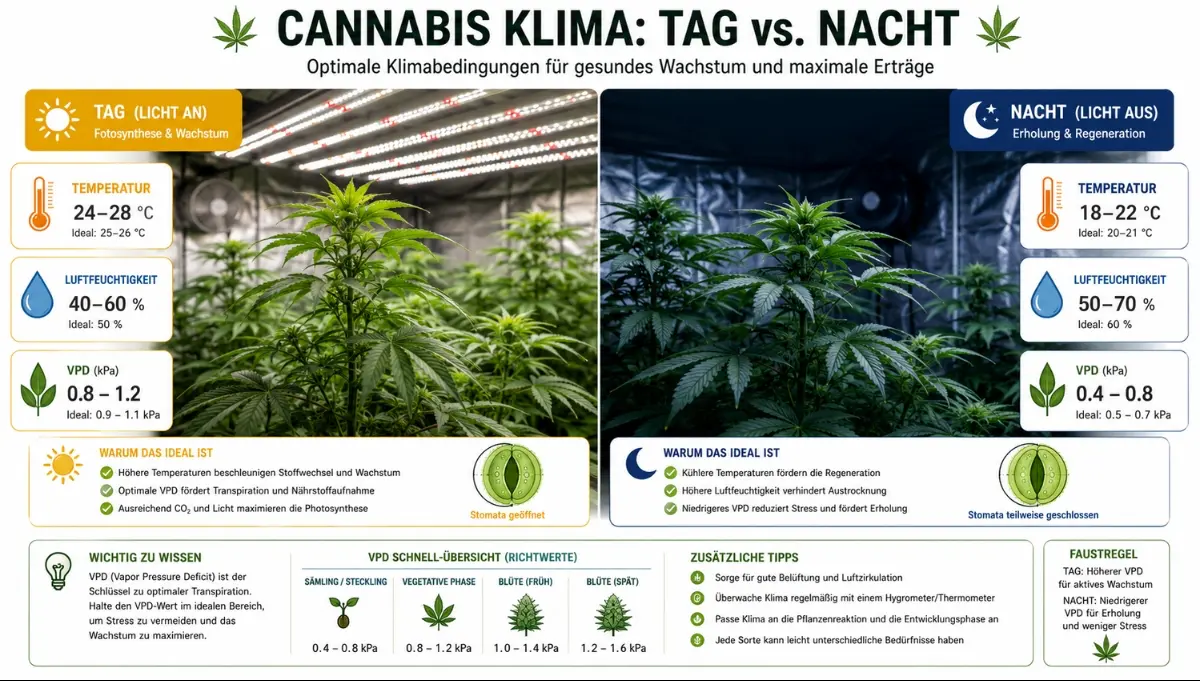
- Log temperature and RH for at least one full day-night cycle.
- Check particularly carefully the first 30-60 minutes after the light change.
- Reduce large temperature drops if the setup allows.
- Let the circulating air continue to run moderately at night, without constantly blowing heavily on plants.
- Control dense flowers and the interior of the crown, not just the indoor air.
This is how you optimize the growing climate step by step
1. Check measuring devices
Two cheap hygrometers can differ from each other by several percentage points. Compare sensors side by side and calibrate them if the model allows this. A small measurement error can produce a noticeable difference in the calculated VPD in warm temperatures.
2. Choose a realistic target corridor
First choose a range to suit the development phase instead of an exact value. For example, an established plant in the vegetation can be targeted to 0.9–1.1 kPa. Then observe for several days before optimizing further.
3. Change only one factor at a time
If you change temperature, humidity, lamp power and watering at the same time, the plant reaction is difficult to determine. If possible, only adjust one variable and document the effect.
4. Think about irrigation
A higher VPD can increase water consumption. This does not mean that watering should be carried out more frequently according to a rigid calendar. Check pot weight, substrate moisture and drainage. The detailed Grow Island guide Water hemp plants properly explains the connections between the root zone and water balance.
5. Document plant reactions
Record daily minimum, maximum, light phase, dark phase, watering amount and visible changes. A weekly trend is more meaningful than a single momentary value. Good climate control is created through trends, not through constant readjustments every minute.
Advantages, limitations and risks of VPD control
Possible benefits
- Temperature and humidity are evaluated together rather than in isolation.
- Climate changes can be planned comprehensibly between development phases.
- Irrigation and transpiration trends become easier to interpret.
- Problematic day-night transitions and humid microclimates are identified more quickly.
- In controlled indoor systems, the control of humidification, dehumidification and exhaust air can be carried out more precisely.
Boundaries
- Many common VPD target values come from horticultural practice and general plant physiology; Cannabis-specific comparative studies are still limited.
- Different genetics, substrates and root systems do not respond identically.
- A spatial value does not fully represent the microclimate within dense flowers or under the canopy.
- A mathematically perfect value cannot compensate for problems with light, roots, salinity or disease.
Risks if used incorrectly
- Dehumidifying too aggressively can dry out young plants.
- Excessive humidification can increase condensation and microbial risks.
- A misplaced or uncalibrated sensor can misdirect the entire climate control system.
- If you only follow a table, you can miss clear stress signals from the plant.
Cannabis VPD FAQs
Which VPD is optimal during flowering?
About 1.1–1.5 kPa is used as a rough guide, with early bloom near the lower end and late bloom near the upper end. Leaf temperature, genetics, water supply and avoiding a humid microclimate are crucial.
Is a VPD of 1.5 kPa too high?
For cuttings and small young plants, usually yes. For a healthy, well-rooted plant in later flowering, 1.5 kPa may be appropriate at times. Permanently higher values should only be achieved with good control of leaf reaction, root zone and water consumption.
Do I absolutely need a VPD calculator?
No. For a simple grow, reliable temperature and RH measurements as well as a suitable table are sufficient. A calculator becomes particularly useful if you want to include leaf temperature, use automation, or compare climate data more accurately.
Can a perfect VPD prevent mold?
No. It can help to avoid permanently too humid conditions, but is only part of the prevention. Air exchange, hygiene, plant spacing, canopy structure, genetics and regular monitoring remain crucial. If the crown is very dense, well thought-out thinning can improve air movement; However, unnecessary stress should be avoided. See this Cannabis defoliation .
Why does my sensor show good values, but the plant shows stress?
Possible causes include incorrect sensor position, different leaf temperature, local wind stress, root problems, incorrect watering, salt accumulation or too high light intensity. Check the system as a whole instead of automatically changing the VPD further.
Related Grow Island guides
VPD is only one part of a complete cultivation system. These related guides help place climate data in the wider context of plant development, watering, nutrition and disease prevention:
- What cannabis anatomy reveals about plant health
- Cannabis seedling care in three practical steps
- Cannabis clones and a strong start
- Proper cannabis watering
- Diagnosing slow-growing cannabis plants
- Feeding schedules for cannabis cultivation
- Recognizing nutrient-related problems
- Identify, prevent and treat mold on cannabis
- Protecting cannabis from pests and mold
- Cannabis stress guide
- Cannabis foxtailing causes and solutions
- Cannabis defoliation and airflow
- The 10 most common cannabis cultivation mistakes
- Protecting cannabis plants during a power outage
- Hop Latent Viroid and cannabis plant health
Conclusion: VPD for cannabis as a compass, not a dogma
The VPD for cannabis makes temperature and humidity understandable together. Instead of tracking two isolated numbers, you get an indication of how much the indoor air is driving perspiration. In practice, around 0.4–0.8 kPa for seedlings and cuttings, 0.8–1.2 kPa in the vegetation phase and 1.1–1.5 kPa in flowering are sensible starting points.
However, the best VPD table is only as good as the measurement behind it. Measure at crown height, take leaf temperature into account if possible and pay particular attention to the change in light. Adjust the climate gradually and read the plant at the same time: leaf position, water consumption, growth, substrate drying time and root health provide the necessary context.
VPD is therefore not a replacement for experience, but a tool that makes observations more precise. If you use target corridors instead of supposedly perfect individual values, you can control the growing climate more stably and recognize more quickly whether a change actually helps.
Legal and health notice
This article is intended for general botanical and horticultural information only. Before growing cannabis, find out about the current laws where you live and where you grow cannabis. The contents are not legal, health or therapy recommendations. Use electric air conditioning and irrigation devices only professionally and be aware of the risks of fire, electricity and moisture.
About Grow Island
Grow Island combines practical experience with understandable knowledge about cannabis, plant care, genetics and controlled growing conditions. Our goal is to provide adult readers with comprehensible information, to separate scientific findings from empirical values and to promote responsible use of the plant.
Scientific sources
- Grossiord, C.; Buckley, T.N.; Cernusak, L.A.; Novick, K.A.; Poulter, B.; Siegwolf, R.T.W.; Sperry, J.S.; McDowell, N. G. (2020): Plant responses to rising vapor pressure deficit. New Phytologist , 226(6), 1550–1566. DOI: 10.1111/nph.16485 .
- Corredor-Perilla, D. et al. (2025): Elevated relative humidity significantly decreases cannabinoid concentrations while delaying flowering development in Cannabis sativa L. Frontiers in Plant Science , 16, 1678142. DOI: 10.3389/fpls.2025.1678142 .
- Chandra, S.; Lata, H.; Khan, I.A.; ElSohly, M. A. (2008): Photosynthetic reaction of Cannabis sativa L. to variations in photosynthetic photon flux densities, temperature and CO₂ conditions. Physiology and Molecular Biology of Plants , 14(4), 299–306. DOI: 10.1007/s12298-008-0027-x .
- Yuan, W. et al. (2019): Increased atmospheric vapor pressure deficit reduces global vegetation growth. Science Advances , 5(8), eaax1396. DOI: 10.1126/sciadv.aax1396 .










Comments