Cannabis defoliation
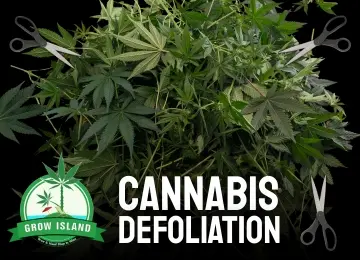
More Light, Better Airflow… or Just Unnecessary Stress?
In the world of cannabis cultivation, few topics divide growers as much as defoliation. Some cultivators swear by it, claiming it dramatically improves yield and flower quality. Others see it as completely unnecessary stress that causes more harm than benefit.
The truth, however, is far more complex than the simple idea that “less leaves = more yield”.
Thanks to modern research and advanced indoor canopy management systems, we now understand much more clearly what actually happens inside a plant during defoliation. The real question is not whether cannabis “likes” defoliation, but rather how light distribution, microclimate, and airflow within the canopy influence plant development, flower quality, and total biomass production.
And this is where the topic starts becoming truly interesting.
What Is Cannabis Defoliation?
During defoliation, the grower selectively removes certain leaves from the plant in order to:
- allow more light to reach lower flowering sites,
- improve airflow,
- reduce moisture buildup,
- lower the risk of mold,
- create a more even canopy structure.
The technique became especially popular in indoor cultivation, where plants grow in limited spaces under artificial lighting. Indoors, cannabis often develops a much denser canopy than the available light source can effectively penetrate.
The issue became even more noticeable with modern LED grow systems. High-intensity LEDs, elevated PPFD levels, CO₂ supplementation, and short-internode hybrids can create extremely dense canopies. In these situations, upper fan leaves can literally block light from reaching the lower zones of the plant.
Many growers automatically turn to defoliation at this point.
But leaves are not useless decorations.
Leaves are the photosynthetic engines of the plant. They generate the energy used to develop flowers. Every removed leaf can therefore represent both an advantage and a loss at the same time.
This is exactly why defoliation has become one of the most controversial tools in modern canopy management.
The Real Problem of an Overcrowded Canopy
Most growers begin defoliating primarily in pursuit of bigger yields. In reality, however, an overly dense canopy can create far more problems than simple shading alone.
Modern studies show that significant differences can develop between the upper and lower parts of the canopy in terms of:
- light intensity,
- temperature,
- humidity,
- terpene production,
- cannabinoid concentration.
For example, a 2022 study found that lower flowers sometimes contained up to 90% lower cannabinoid concentrations compared to the top colas. This clearly demonstrates that canopy uniformity is not only an aesthetic concern, but also a matter of quality and production consistency.
A dense canopy can also create ideal conditions for:
- Botrytis,
- powdery mildew,
- various mold species,
- as well as certain pests.
The situation becomes especially dangerous during flowering, when large and compact buds can trap extremely high levels of humidity inside their structure.
The Real Problem Is Often Not the Leaves — but the Microclimate
Experienced indoor growers today increasingly view defoliation less as a “leaf problem” and more as a microclimate management issue.
Because in many cases, the real issue is the canopy microclimate itself.
Inside dense canopies, so-called RH pockets can easily form — localized high-humidity zones where:
- air movement is weaker,
- air becomes stagnant,
- temperature rises,
- evaporation slows down.
This is especially common in modern LED grows, where the upper canopy develops aggressively while lower sections receive minimal air exchange.
When it comes to bud rot and fungal diseases, the overall room humidity is not always the main factor. In many cases, the deciding factor is the microclimate forming deep inside the canopy itself.
This is where it becomes easier to understand why many growers use defoliation.
Not necessarily for bigger yields.
But to create a more stable, safer, and better-controlled canopy environment.
What Does Research Say About Defoliation?
Modern scientific literature approaches cannabis defoliation far more carefully and with much greater nuance than old grow forums or earlier “bro science” cultivation advice. While many growers once viewed defoliation almost as a universal solution, current research increasingly shows that its effects are highly complex and strongly dependent on the growing environment, genetics, and canopy structure.
Scientific studies suggest that under certain conditions, defoliation can indeed positively influence plant development and flower quality. Properly executed leaf removal may improve light penetration into the lower canopy, create more even light distribution, and increase airflow within dense plant structures. This can be especially beneficial in modern indoor grow environments where high-powered LED systems and aggressive vegetative growth often create extremely compact canopies.
Research also indicates that in some situations, defoliation may contribute to higher concentrations of certain cannabinoids. Because of this, some growers feel that defoliated plants appear “stronger” or more aromatic at harvest. However, modern studies emphasize that higher cannabinoid concentration does not always translate into larger overall yields or greater total cannabinoid production.
And this is exactly where the topic of defoliation becomes truly interesting.
Leaves are not simply shading elements. Fan leaves are the plant’s photosynthetic engines, producing the energy required for growth and flower development. Every removed leaf also means lost photosynthetic surface area. Because of this, overly aggressive defoliation can easily backfire, especially when a plant is already experiencing environmental stress.
According to current research, defoliation can produce not only positive but also negative effects. In some cases, it may reduce total biomass, slow down development, and trigger stress responses within the plant. Certain genetics respond extremely well to a more open canopy structure, while other phenotypes react very sensitively to leaf removal.
For example, a 2021 study found that defoliation increased the average concentration of several cannabinoids, yet the best overall flower yield and cannabinoid yield were achieved not through defoliation itself, but through double pruning. This clearly demonstrates that “better quality” and “higher quantity” are not necessarily the same thing in cannabis cultivation.
A 2025 indoor study further complicated the picture. During the research, defoliation reduced total flower biomass in certain genotypes while simultaneously increasing concentrations of specific cannabinoids. In other words, the plant may produce stronger or more concentrated flowers, but overall produce less material.
So the answer is far from black and white.
The outcome of defoliation depends on numerous factors:
- genetics and phenotype,
- canopy structure and density,
- plant density,
- lighting intensity,
- PPFD levels,
- microclimate,
- air movement,
- as well as the timing and intensity of defoliation.
When Can Defoliation Be Useful?
In certain grow environments, defoliation can genuinely serve as an effective canopy management tool, especially when the goal is not exclusively maximum biomass production, but rather creating a more stable and controllable grow environment.
It can be particularly useful in:
- dense indica hybrids,
- SCROG systems,
- extremely compact canopies,
- high-humidity grow rooms,
- environments with weak airflow,
- high-powered LED grow systems.
In these situations, the primary purpose of defoliation is often not “bigger yields”, but rather establishing a more stable microclimate within the canopy itself. Improved air exchange and more efficient airflow may reduce the risk of mold and bud rot while also creating more even light distribution for lower flowering sites.
Many experienced indoor growers today no longer view defoliation as a classic “yield boosting” technique, but instead as a microclimate management tool that can help maintain greater control over canopy conditions.
When Should You NOT Defoliate?
This is the part that most grow articles completely ignore, even though it may be the most important aspect of the entire topic.
Defoliation always creates stress for the plant. A stable, healthy, aggressively growing plant may recover quickly after leaf removal. An unstable or already struggling plant, however, can easily suffer setbacks from it.
Aggressive defoliation is generally not recommended for:
- recently transplanted plants,
- heat-stressed canopies,
- plants suffering from nutrient lockout,
- overwatered growing media,
- genetics with slow vegetative growth,
- diseased or pest-infested plants,
- plants with weak root systems,
- as well as autoflowering strains when performed aggressively.
Many growers make the mistake of using defoliation as a universal solution for every problem. In reality, opening the canopy too aggressively can create additional stress, especially when the plant is already struggling with environmental conditions.
Excessive defoliation may slow photosynthesis, reduce energy production, and temporarily suppress flower development. This can be especially problematic for autoflowering plants, since these genetics have much shorter life cycles and less time available for recovery.
Modern canopy management philosophy therefore increasingly favors targeted and moderate interventions over excessive “stripping” of plants.
Well-timed and careful defoliation can absolutely be beneficial in certain grow environments. But excessive leaf removal can easily create more problems than it actually solves.
Defoliation, Pruning, and Lollipopping — They Are Not the Same Thing
In the world of cannabis cultivation, many growers use the terms defoliation, pruning, and lollipopping interchangeably, as if they all mean the same thing. In reality, however, these are completely different canopy management techniques that serve different purposes and influence plant development, energy allocation, and structure in very different ways.
In modern indoor cultivation, understanding the differences between these techniques is especially important because poorly executed interventions can easily lead to excessive stress, slowed development, or even reduced yields.
Experienced cultivators today no longer simply “cut leaves”. Instead, they intentionally manage canopy structure in order to help the plant use available light, energy, and airflow as efficiently as possible.
What Is the Difference Between Defoliation and Pruning?
Defoliation primarily involves removing leaves. In most cases, the grower removes large fan leaves or heavily shading foliage to allow more light to reach lower flowering sites while improving airflow within the canopy.
The goal of defoliation is therefore usually not to alter the structure of the plant itself, but rather to optimize the microclimate and improve light distribution. It is especially common in dense canopies where the upper foliage completely blocks lower zones from receiving adequate light.
Pruning, on the other hand, is a far more structural intervention. During pruning, not only leaves are removed, but also entire shoots, side branches, or weak growth sites. At this point, the goal is no longer simply improving airflow or light penetration, but consciously directing the plant’s energy distribution.
Through pruning, the grower can determine which parts of the plant receive more energy, which branches become dominant, and which sections should be removed in order to create a more even and controllable canopy structure.
In modern indoor grows, pruning is often combined with topping, mainlining, or other training techniques to ensure the canopy receives the most even light distribution possible throughout the flowering cycle.
What Is Lollipopping?
Lollipopping is another separate canopy management technique focused on cleaning up weak lower growth zones. During this process, the grower removes lower branches and smaller flowering sites that will likely never receive enough light to produce dense, high-quality flowers.
The technique gets its name from the final appearance of the plant, which resembles a lollipop: a clean lower stem with a dense upper canopy and concentrated flowering zone.
The goal of lollipopping is not necessarily increasing total biomass, but rather preventing the plant from wasting energy on lower regions that would likely only produce small, airy, and lower-quality flowers under poor lighting conditions.
This technique is especially common in high-density indoor grows and SCROG systems where the upper canopy dominates the majority of light absorption.
Modern canopy management often combines defoliation, pruning, and lollipopping. However, these techniques do not serve the same purpose. While defoliation is mainly a microclimate and light-management tool, pruning focuses on structural optimization, and lollipopping redirects energy toward the upper canopy regions.
Modern Canopy Management Is About Much More Than Just Cutting Leaves
Over the last few years, technological advances in indoor cultivation have completely changed the way growers approach canopy optimization. In the past, many cultivators automatically relied on aggressive defoliation to manage dense canopies. Today, however, more growers are turning toward technical and environmental control-based solutions instead.
Modern grow rooms now include numerous tools and strategies capable of improving lower canopy lighting and microclimate conditions without requiring extreme leaf removal.
Increasingly, growers are using:
- side lighting to support lower canopy regions,
- under-canopy LED systems,
- stronger and more intelligent ventilation systems,
- VPD optimization,
- more precise plant-density management,
- as well as advanced training techniques.
According to modern research, technically optimizing light distribution can sometimes be far more effective than aggressive defoliation. If the canopy microclimate is properly controlled, airflow remains stable, and lower regions receive sufficient light, there may be little need for extreme leaf stripping at all.
This is why professional indoor growers today are no longer simply “cutting leaves”.
They are managing canopies.
This approach represents a far more system-based mindset, where light, airflow, VPD, plant density, and microclimate work together as part of one optimized environment.
Defoliation Is Not a Miracle Technique — It Is a Compromise
Modern research and professional indoor cultivation experience clearly show that defoliation is not a universal yield-enhancing technique. While it can certainly be beneficial in some grow environments, it is better viewed as a compromise rather than a guaranteed success factor.
Not every genetic responds the same way to defoliation. Not every canopy benefits from it. And not every grow room truly requires it.
In certain situations, defoliation may improve:
- light distribution,
- microclimate stability,
- airflow,
- canopy uniformity,
- as well as mold-risk management.
In other cases, however, it may simply cause unnecessary biomass loss while placing additional stress on the plant. Overly aggressive defoliation can reduce photosynthetic surface area, weaken energy production, and temporarily slow overall development.
Experienced growers increasingly understand that canopy optimization is not about removing as many leaves as possible. It is about creating an environment where light distribution, airflow, and microclimate function in proper balance.
Perhaps this is the most important lesson of the entire topic.
Professional growers today no longer blindly follow internet “yield boosting tricks”. Instead, they understand how canopy systems function, how plants respond to stress, and when intervention is actually necessary.
And that is exactly what transforms defoliation into a true professional cultivation decision — rather than simply cutting leaves off a plant.











Comments