Author: Bartholomew Alen
If your neighbor suddenly seems unusually interested in gardening, it does not automatically mean your carbon filter has failed. Cannabis odor escaping from a closed, legally operated grow area is often caused by incorrect system sizing, insufficient negative pressure, leaking connections, or saturated activated carbon. This guide explains how the filter, fan, and ducting should be planned, checked, and maintained as one complete system.
The short answer
Odor problems are not solved with fragrance sprays, ozone, or simply installing the most powerful fan possible. What matters is an activated carbon filter matched to the real airflow, slight negative pressure, short and airtight air paths, and replacing the filter at the right time. The goal is considerate, controlled ventilation within the laws that apply in your location.
1. Why does cannabis smell so strong?
The characteristic smell comes mainly from volatile aromatic compounds, including terpenes. Their composition varies depending on genetics and the stage of plant development. Citrus, earthy, fruity, or fuel-like notes can become noticeable even at low concentrations. For more background, read our article about cannabis terpenes and their functions.
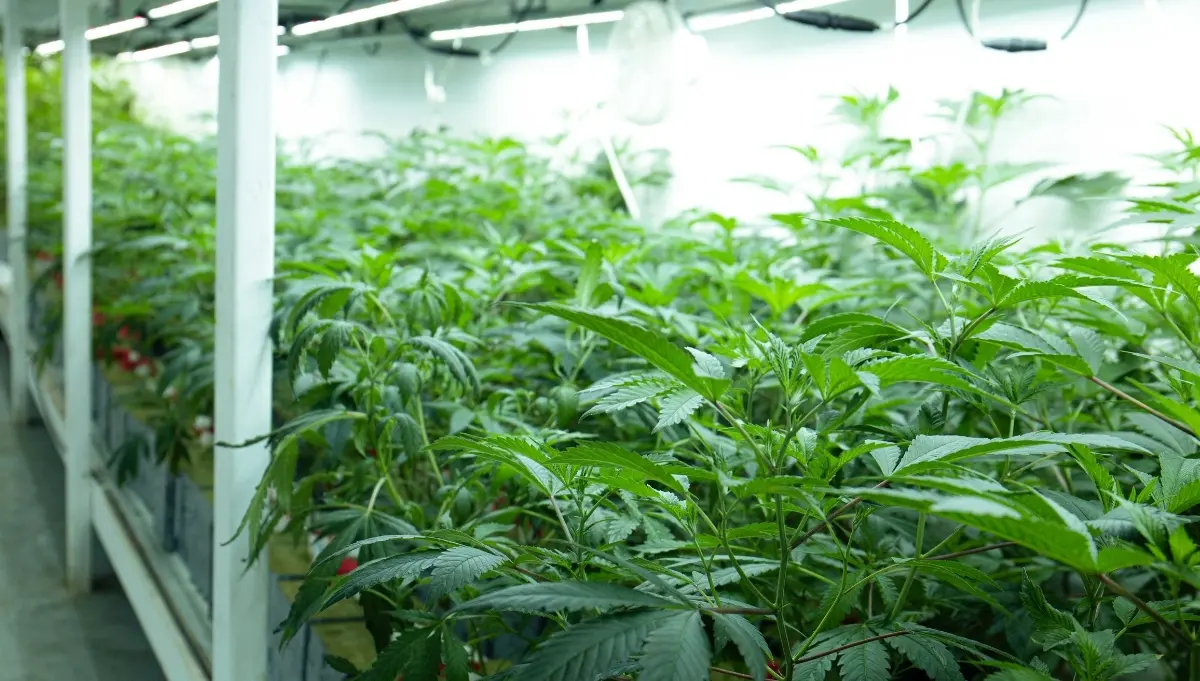
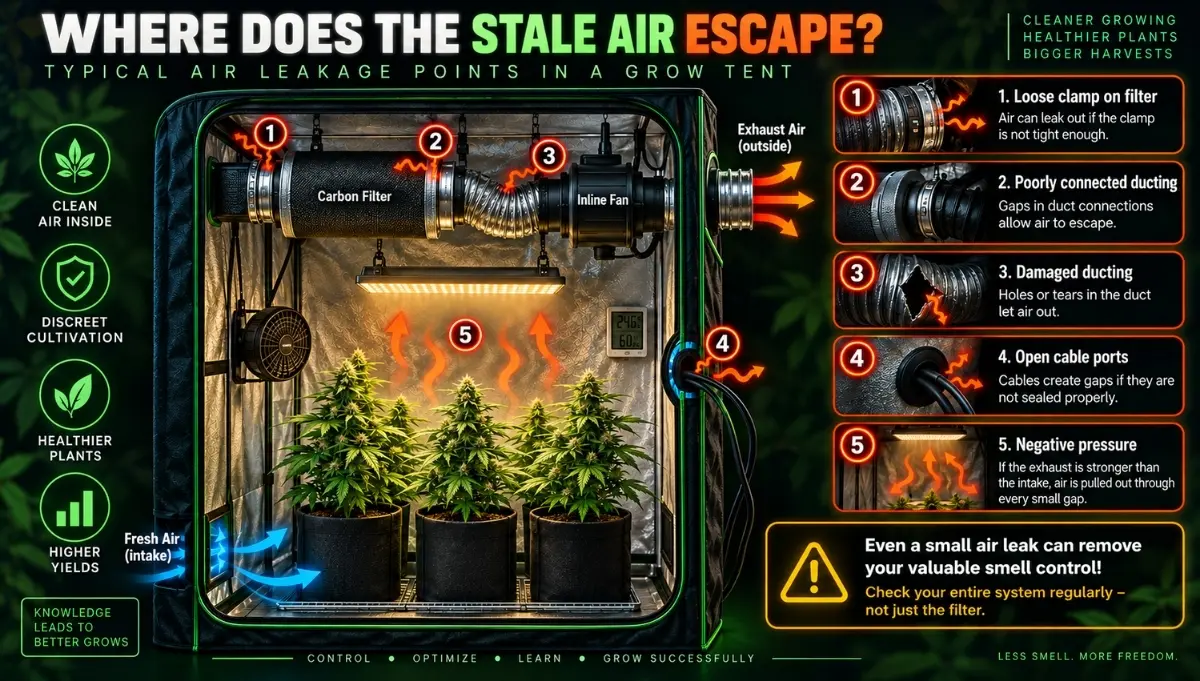
Odor levels are usually highest during advanced flowering, shortly before harvest, while trimming, and during drying. Higher temperatures and strong air movement can also accelerate the distribution of volatile compounds. A closed tent door alone is not enough: air can escape through zippers, cable openings, and poorly sealed duct connections.
2. How an activated carbon filter reduces odor
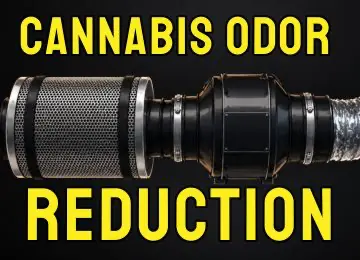
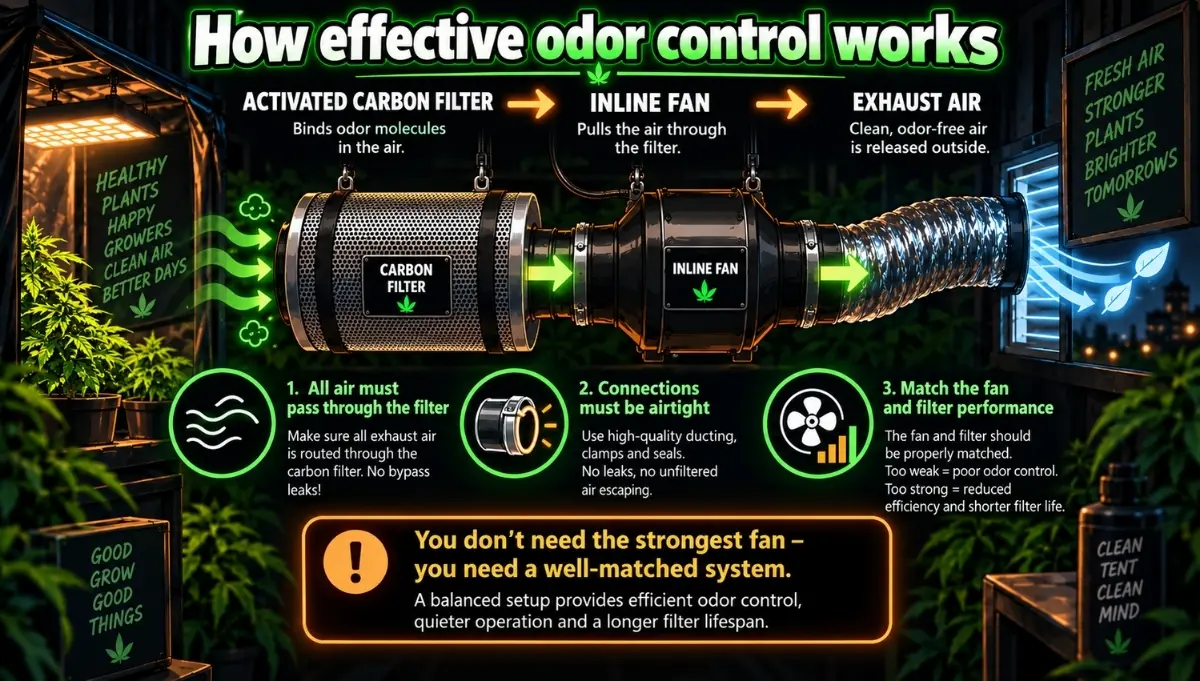
An activated carbon filter traps many gaseous odor molecules on the extremely large internal surface of the carbon. This process is called adsorption. For reliable performance, all exhaust air must pass through the carbon bed. Unfiltered bypass air, an overloaded filter, or unsuitable humidity can reduce filtration efficiency.
Important: rated airflow is not real-world airflow
The airflow stated on a fan is usually measured under defined conditions. Filters, long ducts, tight bends, reducers, and silencers all increase resistance. Do not compare only two numbers printed on product packaging; plan the complete airflow path.
3. How to size the filter and fan correctly
Start with the room volume: width × depth × height gives the volume in cubic meters. Multiply this value by the desired number of air changes per hour. In small indoor systems, approximately 30 to 60 air changes per hour is often used as a rough planning range. Heat load, humidity, and surrounding conditions may require additional capacity.
Example: A 1 × 1 × 2 meter tent has a volume of 2 cubic meters. At 45 air changes per hour, the theoretical airflow requirement is 90 m³/h. This is only a theoretical starting point and does not automatically mean that a 90 m³/h fan is sufficient. Additional capacity must then be allowed for the filter and duct resistance. Final component selection should match the manufacturer's performance curve, filter airflow range, temperature conditions, and noise requirements.
Scroll horizontally to view the table
| Check point |
Good planning |
Typical mistake |
Result |
| Filter capacity |
Matched to real airflow |
Fan maximum exceeds the filter range |
Odor may break through |
| Ducting |
Short, correctly sized, few bends |
Long, compressed, many tight bends |
Lower airflow, more noise |
| Negative pressure |
Slight and stable |
Intake stronger than exhaust |
Unfiltered air can escape |
| Humidity |
Within manufacturer limits |
Persistently very high |
Adsorption efficiency may decrease |
Common misconception
An extremely powerful fan is not automatically safer or more effective. If the actual airflow exceeds the recommended filter range, contact time with the activated carbon may become too short. On the other hand, a fan that is too weak may not control temperature and humidity properly. The fan and filter must be matched as a system.

Prima Klima K1603, 360 m³/h, 125 mm
A 125 mm activated carbon filter for correctly sized exhaust systems. Before purchasing, check the maximum and recommended airflow as well as the available space for safe mounting.
View product

Can-Fan RK 125, 310 m³/h
The 125 mm design makes it easier to combine with a compatible filter and duct. Real airflow is reduced by system resistance; adjustable operation can help balance airflow performance and noise.
View product
4. Negative pressure: the invisible safety line
With slight negative pressure, air enters through the intended intake openings and leaves the space through the filter and exhaust system. Tent walls may pull inward slightly, but they should not deform heavily. Excessive negative pressure puts unnecessary strain on zippers, reduces usable volume, and is not a substitute for correct system sizing.
Check critical areas with a thin strip of paper. If it is pushed outward at a closed seam, unfiltered air may be escaping there. Avoid open flames or smoke tests. Climate management is covered in more detail in our VPD guide and our guide to watering cannabis correctly.
5. How to find leaks systematically
- With the system switched off, check that all duct clamps are secure.
- Inspect the filter flange, fan connection, and any reducers.
- Check the duct for tears, crushing, and sharp bends.
- Seal cable openings and unused ports correctly.
- Switch the exhaust system on and check negative pressure at several points.
- Evaluate odor from some distance away rather than directly at the exhaust outlet, and allow a few minutes before judging.
Aluminum duct tape can help seal suitable ventilation connections, but it does not replace a clamp or mechanically secure mounting. Filters and fans can be heavy and require strong, independent attachment points.

Aluminum Duct Tape, 45 m × 50 mm
Suitable for clean, properly prepared ventilation connections. Surfaces should be dry and free from dust; load-bearing connections should always be secured mechanically as well.
View product
6. Humidity, temperature, and filter lifespan
Activated carbon is a consumable material. How long it remains effective depends on the amount of carbon, odor load, operating hours, airflow, dust, and humidity. A universal lifespan is therefore misleading. Persistently high relative humidity can reduce the ability of the carbon to adsorb odor molecules. Always follow the limits specified by the filter manufacturer.
A pre-filter protects the carbon bed from dust, but it must also be inspected, cleaned, or replaced according to the manufacturer's instructions. A heavily clogged pre-filter increases resistance. High humidity also increases the risk of mold on cannabis, so growers should also be familiar with early warning signs of mold.
Do not cover the smell with fragrance or ozone
Fragrance sprays do not remove the cause and may affect both plant aroma and indoor air quality. Ozone generators should not be used in occupied spaces because of potential health risks. A sealed, correctly sized filtration system is the controllable solution.
7. Duct routing affects both performance and noise
Every tight bend increases pressure loss. Keep the airflow path as short and straight as possible and use properly sized ducting throughout. A larger duct diameter combined with a slower, adjustable fan can be quieter than a smaller system running near its limit. Structural noise can also be reduced by mounting the fan with vibration isolation instead of allowing it to resonate directly against the tent frame or wall.

Sonoconnect 127 mm, 10 m
Insulated flexible ducting can help reduce airflow noise. Use only the length that is actually required and avoid compressing the duct.
View product
8. Drying: the often forgotten odor peak
The filter's job does not end at harvest. Odor levels can be especially high during cutting, trimming, and drying. A drying area should therefore also have controlled, filtered exhaust ventilation. Airflow that is too strong and direct can dry the outside of the flowers too quickly, while stagnant humid air increases the risk of mold.
If the same grow tent is used for drying, the filtration system should remain in operation. If a separate room is used, its airflow path must be planned independently. Our guide to the cannabis calyx can help explain dense flower structures that may hold more moisture. For broader plant problems, the Cannabis Stress Guide provides a wider diagnostic overview.
9. When should an activated carbon filter be replaced?
Smelling cannabis outside the tent does not automatically prove that the filter is saturated. First check negative pressure, connections, bypass leaks, airflow, and humidity. If filtration performance remains clearly worse than before despite a correctly functioning system, replacement should be considered. Record the installation date and operating conditions instead of relying on memory or a universal number of months.
Odor troubleshooting order
- Close the door and all openings.
- Confirm slight negative pressure.
- Check ducts and connections for leaks.
- Compare fan speed with the filter's airflow range.
- Check humidity and the condition of the pre-filter.
- Only then decide whether the filter should be replaced.
10. Three practical system classes
Scroll horizontally to view the table
| Class |
Typical connection |
Planning goal |
What to watch for |
| Compact |
100 mm |
Small volume, low heat load |
Noise and filter headroom |
| Medium |
125 mm |
Balanced standard system |
Fan curve and duct routing |
| Performance reserve |
160 mm |
More airflow at lower fan speed |
Space, weight, and safe mounting |

Prima Klima K1607, 460 m³/h, 160 mm
The larger connection size provides more performance reserve and may allow operation at lower fan speed in a properly matched system. Check dimensions and weight before installation.
View product

Prima Klima PK160EC-TC
An adjustable EC radial fan for systems where performance reserve and temperature-dependent control are desired. Settings must always remain compatible with the connected filter's airflow range.
View product
11. Air movement inside the grow tent
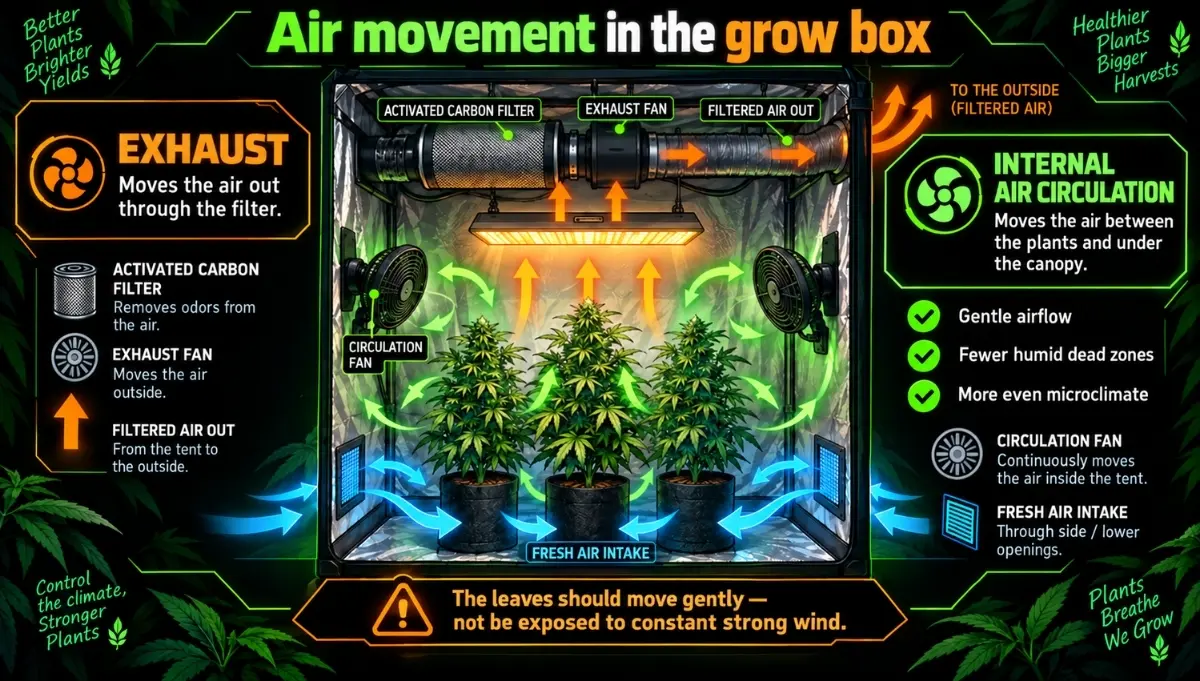
Circulation and exhaust serve different purposes. Exhaust ventilation replaces air and routes it through the filter, while circulation fans move air between leaves and help prevent local pockets of high humidity. A strong continuous stream of air directed at a plant can cause wind stress. Leaves should move gently, not remain permanently pushed to one side.
If the canopy becomes very dense, careful structural management can improve airflow. Our guide to cannabis defoliation explains the potential benefits and limitations. To help determine whether unusual leaf symptoms are related to climate or other causes, see our guide to cannabis anatomy.
12. Incense, air freshener, and panic: what actually helps?
When an unusual smell becomes noticeable in a hallway, many people immediately reach for incense, scented candles, or air freshener. These products may temporarily cover the odor, but they do not remove the molecules responsible for it. In many cases, they simply create an even more noticeable mixture of smells. A better response is calm, systematic troubleshooting.
Scroll horizontally to view the table
| Method |
What it actually does |
Assessment |
| Incense and scented candles |
Adds smoke and fragrance but does not remove the source. |
Not a technical solution; consider fire risk and indoor air quality. |
| Air freshener or fragrance block |
Temporarily masks odor and may itself become very noticeable. |
Do not use around plants or drying flowers. |
| HEPA air purifier |
Primarily filters particles; gaseous odors are only partly addressed unless suitable activated carbon is included. |
Useful as additional room-air filtration, but not a replacement for exhaust filtration. |
| Odor neutralizer |
Depending on the product, may reduce or mask certain odor components. |
Use only outside the plant area and strictly according to product instructions. |
| Opening the window wide |
Dilutes indoor air but may carry odor directly outside and toward neighbors. |
Use thoughtfully and without bypassing the controlled filtration route. |
| Correctly sized activated carbon filter |
Adsorbs odor molecules from the controlled exhaust airflow. |
The central technical measure when correctly sized and installed. |
How to use ONA correctly
ONA products are odor neutralizers available in several forms, including blocks, gels, and sprays. They can act as a useful secondary layer of odor control in areas outside the plant and drying room, such as an entrance area. However, they do not replace an activated carbon filter and will not fix missing negative pressure or leaking duct connections.
The most important rule: do not place ONA products inside the grow tent, inside the drying room, or near an air intake where treated air could reach plants or flowers. Aromatic ingredients may affect the plant's natural smell. Always follow the label, recommended dosage, room size, and safety instructions for the specific product.
Suitable placement
A grow tent with an activated carbon filter and negative pressure should be the first stage. A closed entrance area or another critical transition zone may be a suitable secondary ONA location. Air treated with ONA should not be drawn back into the plant area. Avoid placing it directly at the exhaust outlet if this would distribute the product uncontrollably outdoors.

ONA Gel PRO
A continuously evaporating odor-control supplement for suitable areas outside the grow tent and drying room. Choose container size and opening according to room size and manufacturer instructions.
View ONA Gel

ONA Block PRO, 170 g
A compact option for small, suitable transition areas. Do not place it among plants or store it together with food or harvested plant material.
View ONA Block

ONA Breeze Fan for 1 and 4 L ONA Gel
The fan increases the distribution of ONA Gel, making it suitable for more active treatment of separate areas outside the plant room. Because dispersion is stronger, adequate distance from air intakes, plants, and drying material is particularly important.
View ONA Breeze
Reduce paranoia: check first, act second
After spending a long time in the same room, your nose becomes partly accustomed to the smell, making objective assessment more difficult. At the same time, anxiety can make every noise in the hallway feel like a reaction. Replace assumptions with a short, documented check.
- Check that the exhaust fan and filter are actually running.
- Check for negative pressure with the grow tent closed.
- After a few minutes, go to an area with neutral air and only then reassess the hallway or exhaust outlet.
- If legally and personally appropriate, ask a trusted adult for an independent assessment.
- Record the time, humidity, fan setting, and result. Change only one factor at a time.
- If everything checks out but concern remains intense, take a break and speak to someone you trust. Persistent anxiety is not a ventilation problem.
Immediate steps for a genuine odor problem
- Do not add more fragrance or smoke sources.
- Keep the grow area closed and maintain the filtered exhaust path.
- Close open doors, inspection windows, and cable openings.
- Check connections, ducts, and the filter flange for bypass leaks.
- Check whether the fan is operating outside the recommended filter range.
- Replace a saturated or damaged filter with a compatible unit.
Safety limit
Do not burn incense or candles near grow tents, fabrics, filters, electrical wiring, or dry plant material. Never use ozone for odor treatment in occupied rooms. If you experience breathing difficulties, dizziness, severe anxiety, or other acute symptoms, leave the area, get fresh air, and seek medical help if necessary.
13. Common mistakes
- Choosing a fan only by its maximum m³/h rating.
- Ignoring filter airflow limits, pressure loss, and real fan speed.
- Increasing active intake without checking negative pressure.
- Routing ducting through several tight 90-degree bends.
- Checking connections visually but not while the system is running.
- Leaving the pre-filter uncleaned or unchanged for years.
- Trying to cover odor with perfume, fragrance blocks, or ozone.
- Switching off filtered exhaust immediately after harvest.
- Hanging heavy equipment from a single insecure mounting point.
- Buying a used carbon filter without knowing its condition or storage history.
More avoidable planning mistakes are covered in our article The 10 Most Common Cannabis Growing Mistakes. Odor and neighbor considerations are particularly important for balcony and terrace grows, so also see our guide to growing cannabis on balconies and terraces.
14. Plant selection and odor planning
Genetics influence the aroma profile, but strain names alone cannot reliably predict how strong the smell will be in your own grow area. Phenotype, developmental stage, temperature, and total plant mass also play major roles. Do not size your filtration system only around a supposedly low-odor strain; build in sensible capacity for the entire grow area.
When starting with a young plant, transport stress and environmental changes should also be taken into account. Useful basics can be found in our guide to cannabis seedlings. Order and cultivate plants only where doing so is legally permitted.

AK420 Seedlings
A classic hybrid option from Seed Stockers. When planning the room, take later plant mass into account and monitor the microclimate regularly rather than relying only on a calendar.
View seedling

Blue Zushi Seedlings
A modern genetic option for growers who plan climate, space, and airflow carefully. Individual plant development may vary.
View seedling

Banana Purple Punch Auto Seedlings
An autoflower option from Fast Buds. Because autoflower genetics follow a more predetermined development timeline, the exhaust, filter, lighting, and final container should already be prepared before the plant is placed in the grow area.
View seedling
Check before ordering
Always check current stock, delivery area, product description, and local law directly on the relevant product page. A plant recommendation is not a guarantee of yield, aroma, or cultivation success.
15. FAQ about cannabis odor and activated carbon filters
Why can I still smell cannabis with a new filter?
Common causes include bypass leaks, insufficient negative pressure, excessive airflow, or incorrect airflow direction. Check the complete system before assuming the filter is defective.
Does the exhaust fan need to run continuously?
If odor, humidity, or heat are being produced continuously, the required air treatment must also be maintained continuously. Exact control should be based on measurements and manufacturer instructions.
Is more negative pressure always better?
No. Slight negative pressure helps prevent unfiltered air from escaping. Heavily collapsed tent walls are more likely to indicate an unbalanced intake or unnecessary system resistance.
Can I use a larger filter?
Often yes, provided the connection size, recommended airflow, weight, and available space are suitable. A larger filter does not fix leaks or incorrect installation.
Where should the filter be installed?
Warm, odor-heavy air is typically drawn from the upper part of the enclosed grow area through the filter. The permitted installation position and airflow direction are specified in the product instructions.
Why is my ventilation system so loud?
Common causes include high fan speed, narrow ducting, compressed ducts, sharp bends, and vibration transferred into walls or frames. Each cause should be checked separately.
Does a circulation fan help with odor?
A circulation fan moves air inside the tent but does not filter odor molecules. Odor reduction depends on routing air through activated carbon in a controlled exhaust system.
How can I check for a leaking connection?
With the system running, inspect clamps, tape, and duct connections using a light strip of paper. Do not use an open flame or smoke.
Conclusion
Reliable odor reduction does not start with buying the strongest possible fan. It starts with a properly balanced system. Calculate the room volume, account for pressure losses, keep the filter within its intended airflow range, and maintain slight negative pressure. Seal every connection carefully and treat activated carbon as a consumable material that needs regular inspection.
Planning odor control in advance is not only more considerate toward housemates and neighbors, it also improves control over temperature and humidity. The system should be fully assembled and tested empty before use, then checked and documented regularly during operation.
Legal and safety notice from Grow Island
This article is provided solely for general information about indoor ventilation, odor reduction, and product selection. It does not constitute legal advice and is not intended as guidance for concealing unlawful activity. Laws regarding cannabis cultivation, possession, and processing vary between jurisdictions and may change over time. Before use, check the laws, age restrictions, tenancy rules, fire-safety requirements, and neighbor-related regulations that apply where you live. For Austria, our article Cannabis Laws in Austria 2026 provides a starting point; only current law and information from the relevant authorities are legally authoritative.
Electrical equipment, heavy filters, and fans must be operated in dry conditions, securely mounted, and used according to manufacturer instructions. Do not use open flames, overloaded electrical outlets, or ozone generators in occupied spaces. For electrical installation work or structural exhaust penetrations, consult qualified professionals where appropriate.
Product references may have a commercial purpose and may link to Grow Island offers. Availability, technical specifications, and prices are determined by the current product page. Example calculations are non-binding starting values; manufacturer data and real measurements from the actual system always take priority.













Comments