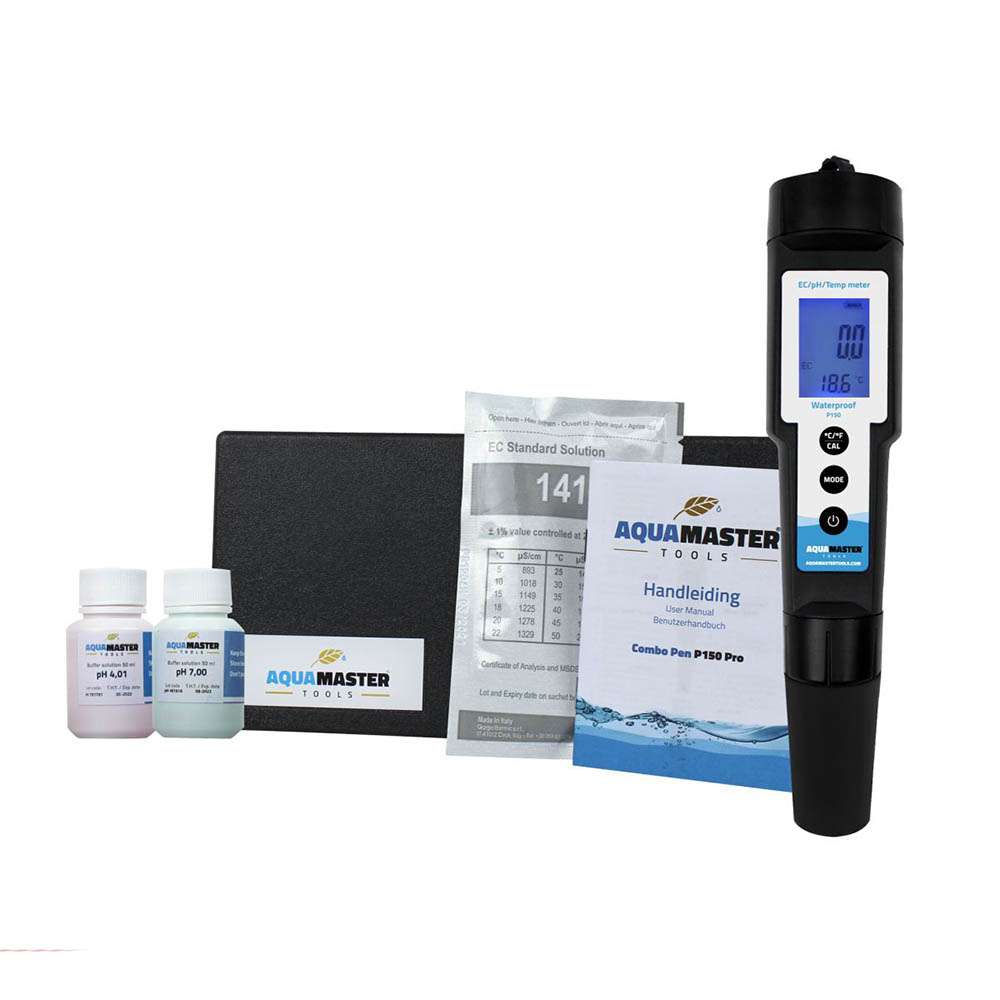
Aqua Master Tools Combo Pen P160 Pro
Portable combination meter for EC, pH and temperature—useful when both key values should be logged with one instrument.
View product
Author: Bartholomew Alen
Reliable cannabis feeding requires more than a fixed millilitre schedule. Two nutrient solutions can look identical and have the same pH while containing completely different amounts of dissolved ions. This is where the EC value in cannabis cultivation becomes important. EC shows how well a solution conducts electricity and therefore provides a practical indication of its total ionic load.
EC does not reveal which individual nutrients are present. It cannot distinguish calcium from sodium or nitrate from chloride. Even so, it is one of the most useful tools in a grow room: it helps identify solutions that are too weak or too concentrated, assess tap water, track salt build-up in the root zone and adapt feeding schedules to the plant's actual response.
This comprehensive guide connects EC, water quality, growing medium and nutrition as one system. It includes target ranges for soil, coco and hydro, a detailed flowering table, diagnostic paths for overfeeding and underfeeding, measurement and calibration instructions, and dedicated sections on tap water, reverse-osmosis water, rainwater, condensate, filter jugs, well water and runoff. To understand the chemical availability of nutrients, always evaluate EC together with pH.
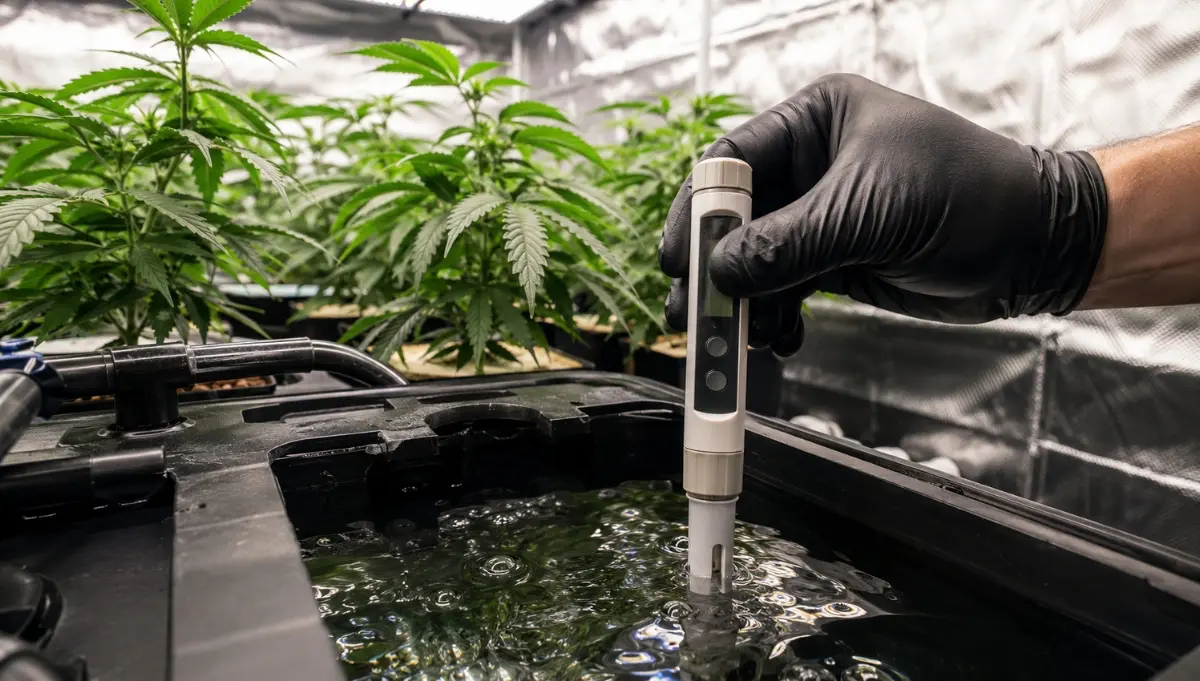
EC stands for electrical conductivity . Pure water conducts electricity only very weakly. Conductivity rises as charged particles dissolve in it. These ions include desirable plant nutrients such as nitrate, potassium, calcium, magnesium, sulphate and phosphate, but also ions that can be undesirable or problematic at high concentrations, including sodium and chloride.
In horticulture, EC is usually expressed in millisiemens per centimetre: mS/cm . Some water reports use microsiemens per centimetre. Conversion is simple: 1.0 mS/cm equals 1,000 µS/cm, so a reading of 650 µS/cm equals 0.65 mS/cm.
An EC meter applies a small voltage between two electrodes and measures how well the liquid conducts it. Conductivity changes with temperature, so many meters include automatic temperature compensation. This improves comparability but does not replace calibration or clean electrodes.
PPM means parts per million , while TDS means total dissolved solids . Many so-called TDS meters do not directly measure every dissolved particle. They measure conductivity and convert it to ppm using a factor. This creates confusion because devices commonly use conversion factors of 500, 640 or 700.
| EC | 500 scale | 640 scale | 700 scale |
|---|---|---|---|
| 0.5 mS/cm | 250 ppm | 320 ppm | 350 ppm |
| 1.0 mS/cm | 500 ppm | 640 ppm | 700 ppm |
| 1.5 mS/cm | 750 ppm | 960 ppm | 1,050 ppm |
| 2.0 mS/cm | 1,000 ppm | 1,280 ppm | 1,400 ppm |
When two growers talk about 1,000 ppm, they may therefore mean two different concentrations. EC is usually clearer for international comparisons and reproducible records. If you use ppm, always record the scale.
pH describes how acidic or alkaline a solution is and influences the availability of individual nutrients. EC describes the total load of conductive ions. A solution can have perfect pH and still have an excessively high EC. Conversely, a weak solution may show the correct pH but provide too little nutrition.
pH asks: Are the nutrients chemically available? EC asks: How high is the total ionic load? Only the two readings together provide a useful picture.
Roots absorb water along a water-potential gradient. When the salt concentration around the roots rises sharply, water uptake becomes more difficult. A plant may then experience physiological drought stress despite a moist growing medium. At extreme concentrations, ions may also become directly toxic or disrupt the balance of other nutrients.
A low EC may mean that nutrition is not keeping pace with growth, light intensity and plant mass. The plant then mobilises mobile elements from older leaves. However, a low reading is only an indication: a cold, wet or oxygen-poor root zone can also restrict uptake even when sufficient fertiliser is present.
Salt build-up is not caused only by one large overdose. More often it results from many smaller factors: hard source water, repeated top-ups with fertiliser, excessive drying, little runoff, high evaporation and boosters added on top of the base schedule. Responding to every symptom with more fertiliser can make lockout worse.
Visible signs overlap with pH problems, root damage and environmental stress. Always compare the EC trend with the guide to nutrient-related problems , the proper cannabis watering guide and the cannabis stress guide .
The following figures are starting ranges for the finished nutrient solution , not a universal recipe. Genetics, light, temperature, humidity, CO₂, pot size, irrigation frequency, water quality and fertiliser system all affect demand. In organically pre-fertilised soil, measuring the liquid input is less informative than in coco or hydro because some nutrients are released biologically over time.
Important: The values include the source-water EC. If your tap water already reads EC 0.7, a target of 1.2 leaves only about 0.5 mS/cm of visible room for fertiliser. This calculation does not tell you whether the ions in the tap water have a favourable horticultural composition.
| Stage | Soil | Coco | Hydro | What to observe |
|---|---|---|---|---|
| Unrooted cutting | 0.3–0.6 | 0.3–0.6 | 0.3–0.6 | Very low demand; protect tissue hydration and root formation |
| Rooted cutting | 0.5–0.8 | 0.5–0.9 | 0.5–0.8 | Increase slowly and observe new roots |
| Seedling | 0.4–0.8 | 0.5–0.9 | 0.4–0.8 | Account for pre-fertilised soil |
| Early vegetative growth | 0.7–1.1 | 0.8–1.2 | 0.7–1.1 | Check leaf colour and daily development |
| Vigorous vegetative growth | 1.0–1.4 | 1.1–1.5 | 1.0–1.4 | Increase according to uptake, not size alone |
| Pre-flower / stretch | 1.2–1.6 | 1.3–1.7 | 1.2–1.6 | Do not confuse transition with an abrupt PK jump |
| Flower week 1 | 1.3–1.6 | 1.4–1.7 | 1.3–1.6 | Nitrogen remains relevant during stretch |
| Flower week 2 | 1.4–1.7 | 1.5–1.8 | 1.4–1.7 | Increase only if tips and runoff remain normal |
| Flower week 3 | 1.5–1.8 | 1.6–1.9 | 1.5–1.8 | Compare flower set with water uptake |
| Flower week 4 | 1.5–1.9 | 1.6–2.0 | 1.5–1.9 | Possible peak, but never a compulsory target |
| Flower week 5 | 1.6–2.0 | 1.7–2.1 | 1.6–2.0 | Use high values only with a healthy trend |
| Flower week 6 | 1.5–1.9 | 1.6–2.0 | 1.5–1.9 | Do not increase if tip burn appears early |
| Flower week 7 | 1.4–1.8 | 1.5–1.9 | 1.4–1.8 | Demand may begin to fall with maturity |
| Flower week 8+ | 1.2–1.7 | 1.3–1.8 | 1.2–1.7 | Adjust to genetics and actual time remaining |
| Flush / final stage | No fixed EC | No fixed EC | No fixed EC | Method, fertiliser and medium decide; do not starve blindly |
Cuttings: Unrooted cuttings have almost no uptake capacity through roots. A strong solution draws water from the tissue and slows rooting. After the first visible root growth, increase gradually according to response rather than the calendar. The guide to growing from cuttings explains the process in detail.
Seedlings: Cotyledons and seed reserves support early development. Strongly pre-fertilised soil combined with full-strength liquid feed commonly burns the tips. Water alone may initially be sufficient in light soil, whereas inert coco requires a very mild but complete solution early on. See the cannabis seedling guide .
Vegetative growth: Potential consumption rises with leaf area, light intensity and root mass. Rich but not almost black foliage, vigorous new shoots and a stable runoff trend are better reasons to increase feed than the number of days in vegetation.
Pre-flower and stretch: The plant rapidly builds shoots, leaves and flower sites. An abrupt increase in PK can disturb the ionic balance. The base feed remains the foundation and every supplement counts toward total EC.
Mid-flower: Many cultivars reach their highest nutrient turnover here, but a high chart value is not a performance target. Smaller plants under moderate light may thrive at a much lower EC. Leaf-tip response and runoff are decisive.
Late flower: Demand may fall as the plant matures. It does not need to remain artificially dark green until harvest, but extreme starvation is not proof of quality either. Flushing depends on fertiliser type, medium, salt accumulation and cultivation goal. Read the separate Grow Island guide on how and when to flush cannabis plants .
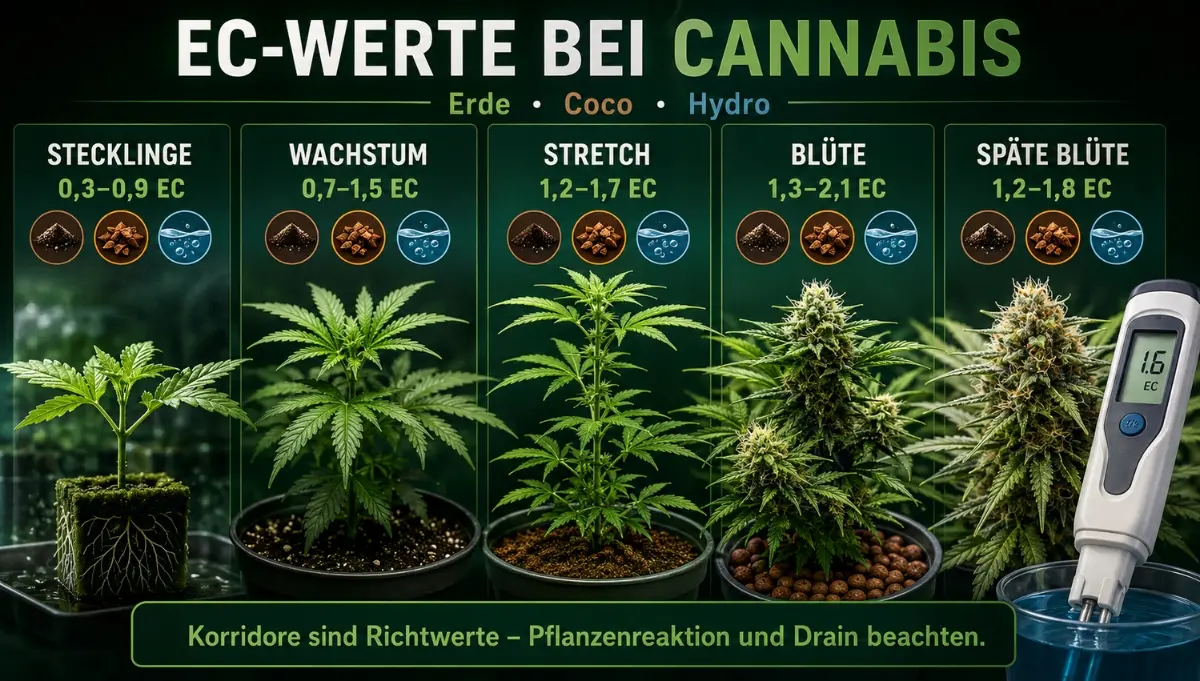
Overfeeding is not merely a high reading in the mixing jug. What matters is the salt concentration directly around the roots. A moderately mixed solution can become problematic in the medium when large amounts of water evaporate between irrigations, little runoff is produced or fertiliser is repeatedly added.
One burnt millimetre on old leaf tips does not automatically justify aggressive flushing. Watch whether the pattern progresses, measure input and runoff, and verify that the solution was mixed correctly. With serious overfeeding, the goal is to return the root zone gradually to a useful range, not create the opposite error.
The base fertiliser is mixed according to the chart, then CalMag, enzymes, PK boosters and flowering additives are added on top. Every conductive additive raises total EC. Add water and genuinely necessary supplements first, then add the base nutrients gradually and stop within the planned total range.
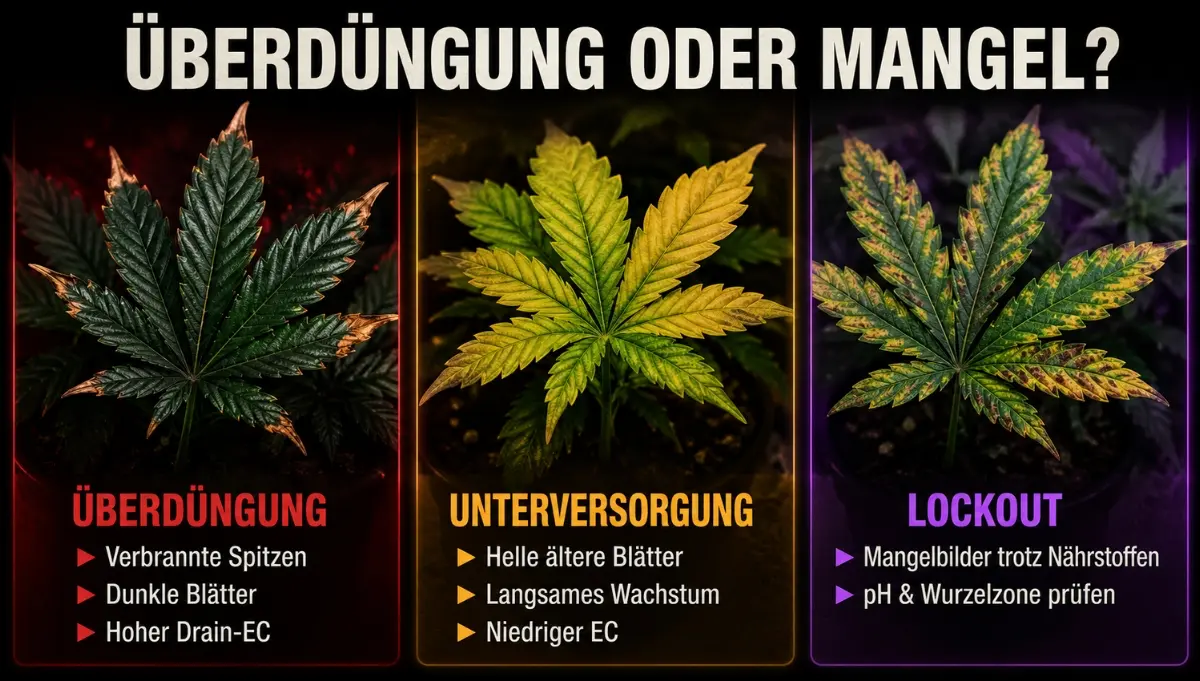
Underfeeding often develops more slowly than an acute overdose. Mobile nutrients are relocated from older leaves into new tissue. The lower plant may therefore become uniformly pale while new growth initially looks acceptable. With a general shortage, growth speed, leaf size and lateral branching decline.
A low input EC alone does not prove underfeeding. In biologically active soil, the liquid feed may be weak while the medium mineralises nutrients. Conversely, a high runoff EC can coincide with visible deficiency when salt stress or incorrect pH blocks uptake. This is the classic point at which extra fertiliser makes matters worse.
If pH and roots appear sound, input and runoff remain low, and the plant is clearly becoming paler and slower, an increase of about 0.1 to 0.2 mS/cm is usually more sensible than a large jump. Record the response over several days.
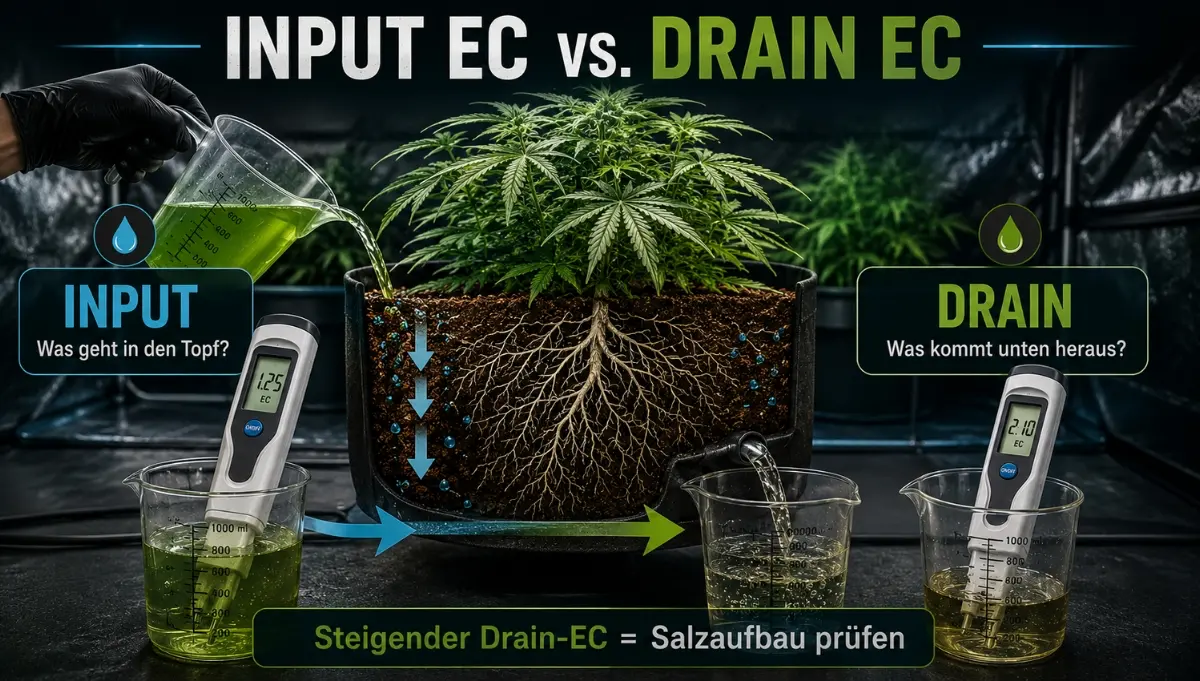
Good EC data comes not from an expensive meter alone but from a repeatable routine. Use the same container where possible, a similar solution temperature and a clean probe. Record source water, finished solution, pH, date and runoff when relevant.
Use the calibration solution specified by the manufacturer, commonly 1.413 mS/cm or 1,413 µS/cm. Never pour used reference solution back into the bottle. Rinse the probe with clean water, prevent deposits and follow the meter's storage instructions. Combined pH/EC meters contain sensors with different care requirements.
Calibrate more often when the meter is used daily, has been dropped, shows unusual readings or has been stored for a long time. A quick check in reference solution before an important correction costs far less than acting on a false reading.
Portable combination meter for EC, pH and temperature—useful when both key values should be logged with one instrument.
View product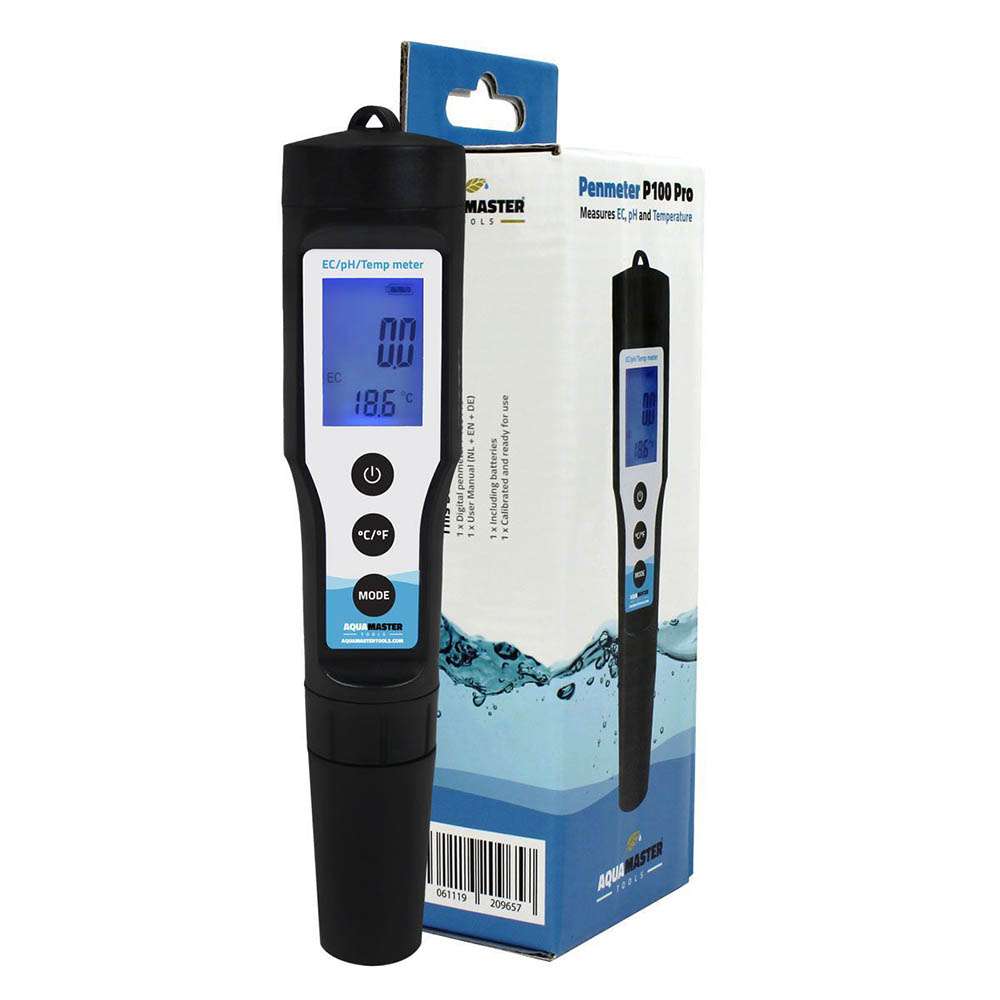
Compact multi-parameter meter for routine pH, EC and temperature checks in nutrient solutions.
View product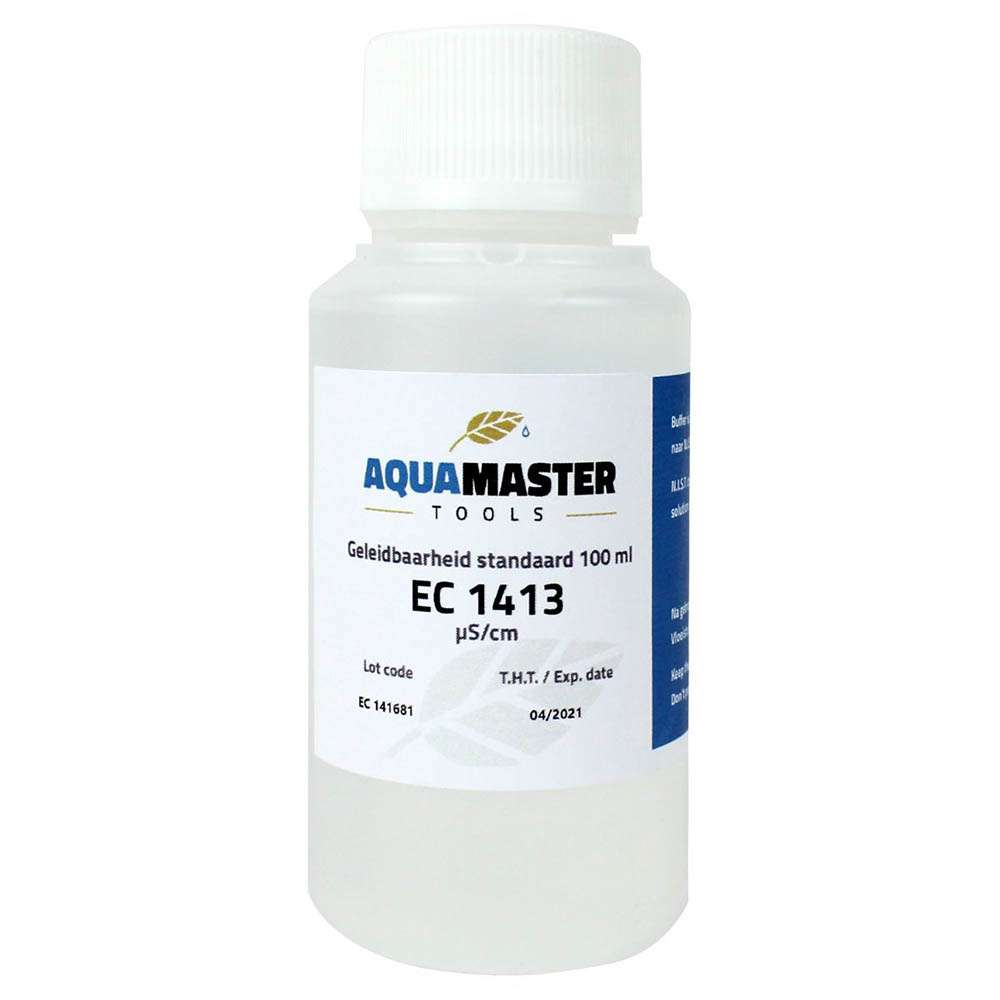
Reference solution for traceable calibration and a quick plausibility check of the meter.
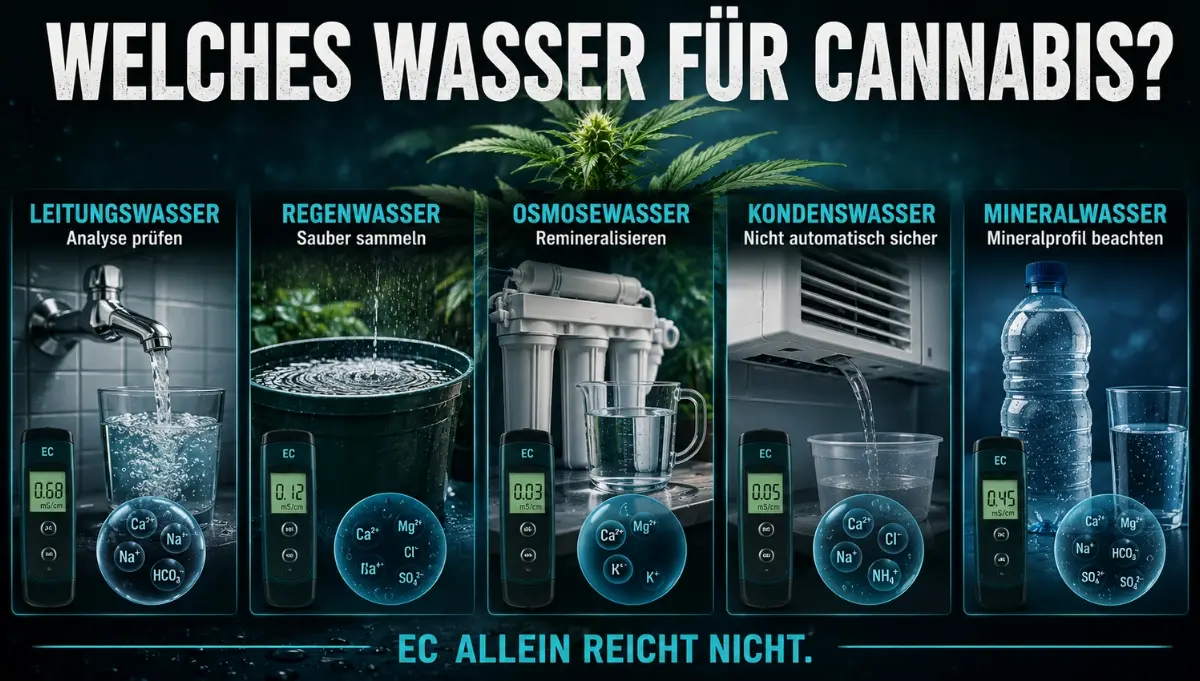
View productTap water is controlled as drinking water, but it is not automatically ideal for every growing system. Its EC may come from calcium, magnesium, bicarbonate, sodium, chloride and sulphate. Two water samples with EC 0.6 can therefore behave very differently in cultivation.
Water hardness mainly describes calcium and magnesium compounds, whereas EC includes every conductive ion. Hard water often has higher EC, but hardness and EC are not interchangeable. Ideally, obtain the latest supplier analysis for conductivity, total hardness, calcium, magnesium, sodium, chloride, bicarbonate or alkalinity, and sulphate.
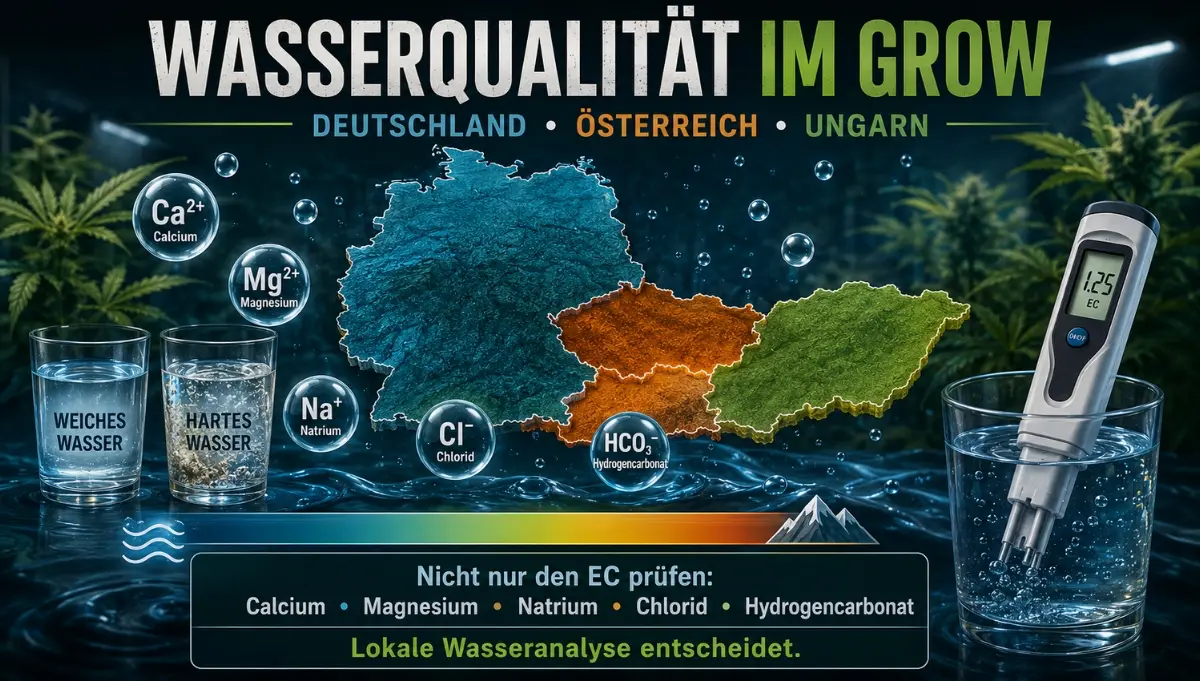
Germany has no single hardness value for an entire city. Geology, wells, reservoirs, interconnected waterworks and temporary blending create local variation. The following figures are only an orientation based on published supplier data and never replace a check for your own address.
| Region | Typical orientation | Practical check |
|---|---|---|
| Berlin | Average about 14 °dH; locally much higher values are possible | Use the Berliner Wasserbetriebe postcode analysis |
| Hamburg | Predominantly medium; central example around 11.8 °dH | Check waterworks by street or postcode |
| Munich | 13.9–17.9 °dH, average around 15.8 °dH | Hard source water; examine the complete analysis |
| Cologne / Rhine region | Often medium to hard depending on supply zone | Retrieve the RheinEnergie analysis for the address |
| Frankfurt / Rhine-Main | Supply areas may differ considerably | Check the Mainova zone and current report |
| Bavaria generally | Many calcareous areas, but no meaningful state-wide value | The local supplier is decisive |
Austria also ranges from soft spring water to hard groundwater. Vienna typically reports 6–12 °dH, while individual districts and supply conditions can occasionally reach about 20 °dH. Much of Salzburg city is around 9–11 °dH, with peripheral zones reaching 18 °dH. Graz, Tyrol and Vorarlberg must be assessed by municipality and supply zone.
| Region | Typical orientation | What should you check? |
|---|---|---|
| Vienna | Usually 6–12 °dH, temporarily higher in some areas | District and mountain-spring or groundwater supply |
| Salzburg | Usually 9–11 °dH, outer areas 9–18 °dH | Salzburg AG hardness map |
| Graz | Zone-dependent; southern districts may differ | Current Holding Graz analysis |
| Tyrol | Strong local differences due to alpine springs and geology | Municipality or utility, not a state average |
| Vorarlberg | Varies by source and municipality | Retrieve the local test report |
Budapest, Debrecen, Győr, Szeged, Pécs and settlements around Lake Balaton draw from different water sources. Mineral-rich, harder water is common in many Hungarian regions, but a single city-wide value would also be misleading. Supply zones and blends can change in Budapest, while the specific municipality matters around Lake Balaton.
Request the latest drinking-water report from the regional supplier and also measure at your own tap. Domestic softeners, old pipes, filters or a private well can mean that the water in the grow room differs from the published network analysis.
The best measure does not depend on hardness alone. Water rich in calcium and magnesium may be useful when sodium and chloride are low and the fertiliser is designed for it. Problems become more likely when source EC leaves too little room for a balanced nutrient solution or alkalinity repeatedly pushes pH upwards.
With moderate EC and a favourable analysis, tap water may be the simplest solution. Do not reduce fertiliser by an arbitrary number of millilitres; mix to total EC and monitor calcium and magnesium supply as well as runoff. A hard-water fertiliser can account for minerals already present.
A 1:1 blend lowers source EC approximately toward the average. For example, tap water at EC 0.8 plus RO water at EC 0.05 theoretically produces about EC 0.43 when equal volumes and temperatures are used. Remineralise or feed appropriately afterwards.
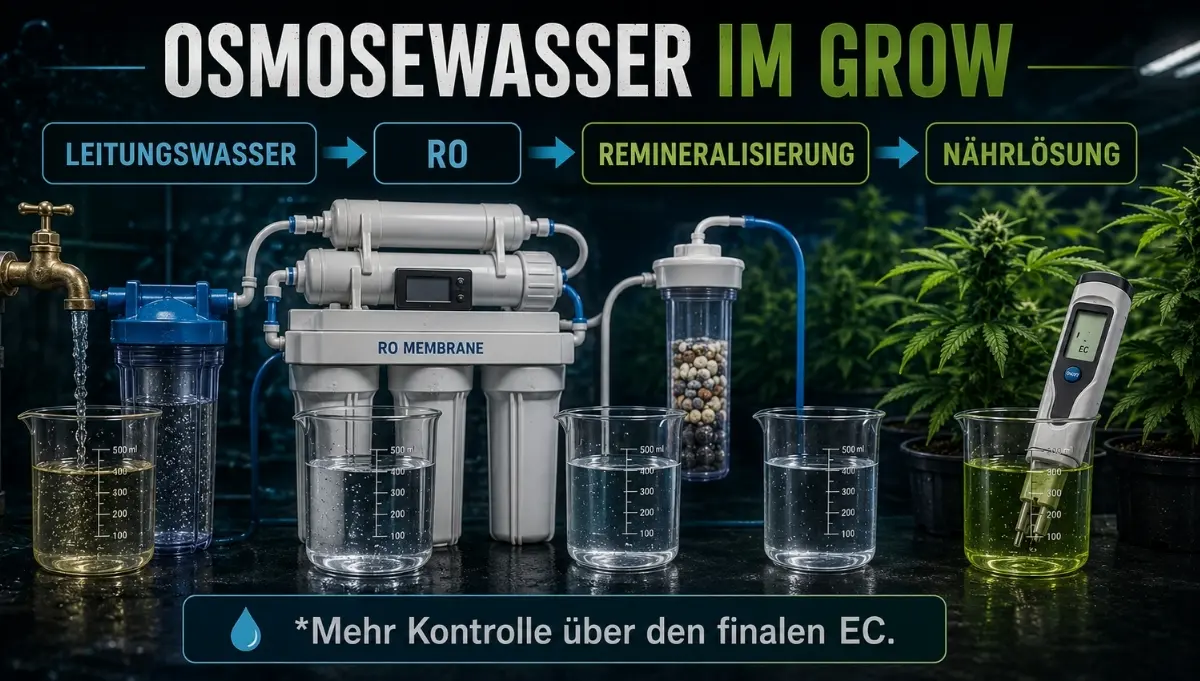
This offers maximum control but creates reject water, consumes energy and filters, and removes desirable minerals as well. Pure RO water is not a complete nutrient solution. Coco and hydro require deliberate base nutrition and often a coordinated calcium-magnesium strategy.
Hard water does not automatically contain the ideal calcium-to-magnesium ratio. Conversely, very hard water does not automatically need additional CalMag. Analysis, fertiliser formula, medium and visible demand are decisive. Cation exchange is especially relevant in coco.
Target EC minus source EC shows only the numerical room available. It does not assess ion quality. EC 0.6 coming from calcium and magnesium is different from EC 0.6 containing a lot of sodium and chloride. Read the water analysis, not only the display.
A reverse-osmosis system forces water through a semipermeable membrane. A large proportion of the dissolved salts remains in the concentrate stream, while the permeate has a very low EC. This creates a controllable starting medium.
RO water is useful when tap water has permanently high EC, excessive sodium or chloride, problematic alkalinity or strong seasonal fluctuations. It is not essential when the local analysis is favourable and plants grow consistently with the existing feeding system.

Rainwater often has a low EC, but it is not automatically clean. Roofing material, bird droppings, dust, pollen, industrial emissions and the storage vessel all affect quality. The first runoff after a dry period is generally more contaminated than the water that follows.
Responsible use requires a clean collection surface, a first-flush diverter, light-proof storage, closed containers that exclude animals and regular cleaning. Odour, cloudiness or biofilm are warning signs. Microbiologically uncertain rainwater should not be used untested in recirculating hydro systems.
A low rainwater EC also means calcium, magnesium and buffering may be absent. After filtration, build the water deliberately as you would RO water, then add nutrients to the desired total EC.
Distilled water contains very few dissolved salts and is useful for cleaning meters, laboratory work or small blending volumes. For a large grow it is generally expensive and environmentally inefficient. Like RO water, it is not a complete mineral supply and has little buffering capacity before salts are dissolved in it.
Do not treat it as a magical cure for every problem. If the root zone is saline, the appropriate correction in the medium matters. If the source water is already suitable, distilled water may offer no practical benefit.
Condensate forms when moisture in the air meets a cold surface. It may show very low EC, but it is not sterile distilled water. The collection tray, heat exchanger, dust, biofilm, cleaning products and metal components can introduce microorganisms or contaminants.
Do not plan condensate as the primary irrigation source. Low EC proves neither microbiological safety nor the absence of metals. Sensible use would require suitable analysis, hygienic collection, treatment and stable remineralisation. For most home growers, controlled tap/RO blended water is safer and more reproducible.
Household filter jugs are designed mainly for taste and domestic use. Depending on the cartridge, they reduce part of the carbonate hardness or certain metals but do not reliably remove all dissolved ions. EC may fall only moderately, and performance changes with use and cartridge age.
A filter jug is therefore neither a replacement for reverse osmosis nor a predictable tool for large nutrient reservoirs. Water left standing in a poorly maintained jug can also become microbiologically problematic. If you test a jug, measure before and after filtration and replace the cartridge exactly as instructed.
Well water may be excellent or unsuitable. Without analysis, you do not know whether iron, manganese, sodium, nitrate, chloride, hardness or microorganisms are problematic. EC alone is insufficient. High iron may cause deposits, sodium may accumulate in the medium, and microbial contamination matters for both people and system hygiene.
Have a private well tested regularly by a suitable laboratory. At minimum, the report should include conductivity, pH, hardness, calcium, magnesium, sodium, chloride, sulphate, nitrate, iron, manganese and microbiological parameters. Select treatment according to evidence, not guesswork.
Mineral water is usually unnecessarily expensive for plants. Still mineral water may contain high bicarbonate, sodium, calcium or magnesium; carbonated water temporarily changes pH because of dissolved carbon dioxide. The printed mineral analysis is useful, but the product was formulated for human consumption, not as a balanced nutrient base.
In an emergency, low-sodium still water can be used when its analysis and EC are suitable. For ongoing use, tap water, correctly blended RO water or tested rainwater are normally more logical.
Growers often leave water standing so chlorine can dissipate. Whether this helps depends on the disinfectant used. Free chlorine can decrease through aeration and time, while chloramine is much more persistent. In Germany, according to the Federal Environment Agency, drinking water is not routinely chlorinated everywhere; chlorine is used where treatment or network safety requires it. A universal 24-hour rule is therefore not useful.
Standing does not remove calcium, magnesium, sodium, chloride or source EC. CO₂ exchange can alter pH, and uncovered water can collect dust. Ask the supplier about treatment. Where chlorine is genuinely an issue, appropriate activated-carbon filtration or controlled treatment is more reliable than a fixed waiting time.
Runoff is the water that leaves the bottom of the container after irrigation. In coco and mineral-fed systems, its EC is a useful trend indicator. Interpretation is more difficult in organic soil because dissolved organic matter and uneven flow paths affect the sample.
When runoff repeatedly sits well above input and continues to rise, accumulation or excessive dry-back is likely. Slightly higher runoff may be normal in coco. No single maximum gap applies to every system. What matters is whether the trend coincides with tip burn, falling water uptake or pH drift.
Very low runoff EC after heavy irrigation may reflect dilution or strong nutrient uptake. One sample cannot support a firm conclusion. Compare several irrigations under similar conditions.
The same EC value does not have the same practical meaning in every root environment. In soil, nutrients may bind to clay minerals and organic matter, undergo microbial transformation and be released later. Coco is inert but has cation-exchange properties. In hydro, roots sit directly in or beside a mineral nutrient solution. The measuring strategy must therefore match the medium.
Good soil can absorb short-term fluctuations. In organically pre-fertilised mixes, irrigation EC shows only part of the nutrition system. Microorganisms mineralise organic compounds, root exudates alter the rhizosphere, and cation-exchange capacity stores certain ions. It therefore makes little sense to force organic soil to an exact EC as though it were a hydro reservoir.
Measurements become more direct when mineral liquid fertilisers are used in soil, but the pot should still not be flooded simply to obtain runoff every time. Permanently wet medium lowers oxygen availability and creates symptoms that resemble nutrient deficiency. The detailed cannabis watering guide explains how pot weight, irrigation volume and dry-back work together.
A practical soil routine is to begin with moderate input, observe the colour and growth rate of new leaves, track pot weight and collect comparable runoff only occasionally. If the plant is healthy, runoff is not climbing and tips are not burning, there is no reason to chase a higher chart value.
Coco can hold substantial water while remaining airy. It is generally irrigated more frequently with a complete nutrient solution, so it responds quickly to both adjustments and mistakes. Watering too rarely or with insufficient runoff raises ion concentration between events. Severe dry-back concentrates the salts even further.
Cation exchange primarily affects calcium, magnesium and potassium. Quality coco is sold buffered, but a coco-specific nutrient should still be used. Pure coco and coco-perlite can both work. Perlite increases air-filled porosity and may accelerate drying, while pure coco provides a more uniform water reservoir. The correct irrigation rhythm matters more than claims that one blend is universally superior.
In a stable coco grow, input and runoff are compared regularly. When runoff rises over several days, first improve irrigation uniformity. Simply reducing input further can also be wrong when the actual problem is uneven wetting. The Grow Island coco guide explains the medium in greater depth.
In DWC, NFT and recirculating systems, the direction of EC together with reservoir level matters as much as the absolute value. When water level falls and EC rises, the plant is taking proportionally more water than ions. The solution may be too strong, transpiration may be high, or root conditions may be unfavourable. When both water level and EC fall, the plant is taking up proportionally many ions and cautious replenishment may be needed.
If water level hardly changes while EC drifts sharply, rule out measurement error, evaporation, dosing mistakes and technical faults. Water temperature and dissolved oxygen are central. Warm nutrient solution holds less oxygen and encourages root problems. A mathematically perfect EC cannot compensate for damaged roots.
Do not top reservoirs up indefinitely with only water or concentrate. Composition changes even when EC appears correct. Plan complete solution changes according to reservoir size, plant mass and system hygiene. Clean sensors and lines without leaving cleaning residues in the root zone.
Nutrient demand cannot be separated from the environment. Light drives photosynthesis and growth, temperature affects metabolism and evaporation, and humidity alters transpiration. If stronger light accelerates growth, nutrient turnover may rise. But increasing light without matching water supply, root space and climate creates stress and concentrated salts.
In hot, dry air, plants may absorb large amounts of water. More ions remain in the root zone, runoff EC rises and leaf tips burn even though the recipe has not changed. In very humid air, movement of water and minerals may slow. An EC schedule that works in spring is therefore not automatically suitable during a heatwave.
Light that is too close or intense creates another diagnostic trap. Rolled leaf margins, pale tips and dry areas may be mistaken for nutrient burn. Check distance with the Grow Island LED distance guide . If development remains slow despite apparently suitable readings, the article about slow-growing cannabis plants helps separate other causes.
The same input EC can behave differently on two days. If a plant loses twice as much water on a hot day, the root zone concentrates more quickly. Irrigation volume, climate and EC therefore belong in the same log.
A plant in coco receives input EC 1.7. Within one week, runoff rises from 1.9 to 2.4. Leaves become dark, tips curl downwards and the first margins burn. Accumulation is more likely than deficiency. The grower checks calibration, improves irrigation uniformity and frequency, produces controlled runoff and lowers input moderately. New damage stops; old damage remains visible.
A vigorously growing plant receives EC 0.8, while runoff repeatedly reads 0.7–0.8. pH is suitable, roots smell fresh and pots dry normally, but older leaves become uniformly pale. True underfeeding is plausible. Input is raised by 0.1–0.2. What matters is whether new growth becomes stronger during the following days.
A soil-grown plant shows rust spots and yellow areas. The grower assumes calcium and magnesium deficiency and adds CalMag. Runoff is already very high, however, the medium stays wet for too long and pH is displaced. Extra CalMag only increases the salt load. Correct the root zone, pH and watering first. A visible deficiency pattern does not prove that the element is absent from the pot.
The reservoir starts at EC 1.6. The next morning it reads 1.9 while water level has fallen markedly. The plant has absorbed proportionally more water than ions. The grower does not immediately add concentrated fertiliser but tops up with suitable water, returns the reservoir to the target range, and checks temperature, humidity and root condition. The next 24-hour trend determines the new concentration.
A good log does not need to be complicated. It should contain the values that explain a decision: date, plant stage, source EC, EC after supplements, final EC, pH, irrigation volume, runoff volume and runoff EC. Add temperature, relative humidity, pot weight or reservoir level, plus a short observation of new growth.
Take photographs under comparable light and from a similar angle. Mark affected leaves so old damage is not mistaken for new damage. A weekly trend line is more informative than many unstructured individual readings.
When using a feeding chart, record not only millilitres per litre but also the resulting EC. Water and product batches may differ. Grow Island's feeding schedules provide a starting structure; the plant and your measurements determine the fine-tuning.
Many mistakes happen because several variables are changed at once. If fertiliser, pH, light, irrigation frequency and climate are all altered on the same day, the plant's response can no longer be attributed to a cause. The guide to the ten most common cannabis cultivation mistakes helps you assess the whole system methodically.









Comments