The Secret of Flow: Does Cannabis Bring You Closer to It or Pull You Away?

Cannabis and Flow: Does It Enhance Deep Focus or Pull You Away from It?
By Bartholomew Alen
Flow is the state in which we become completely immersed in an activity. The noise of the outside world fades into the background, our perception of time changes, and thoughts, movements, and decisions seem to unfold effortlessly. Many people describe it as a moment when “everything just works.” Athletes, artists, musicians, programmers, gardeners, and creative professionals often know this feeling from personal experience.
When it comes to cannabis, one question is asked repeatedly: Can it help people enter this state more easily? Or does it interfere with concentration, memory, and performance?
The answer is not black and white. For some people and in certain situations, cannabis may enhance feelings of immersion, perception, and creative association. In other cases, however, it can reduce attention, slow cognitive processing, impair working memory, and increase distractibility. For this reason, cannabis itself is not the determining factor behind flow. What matters most is the interaction between mental state, task demands, environment, and individual neurological responses.
In Short
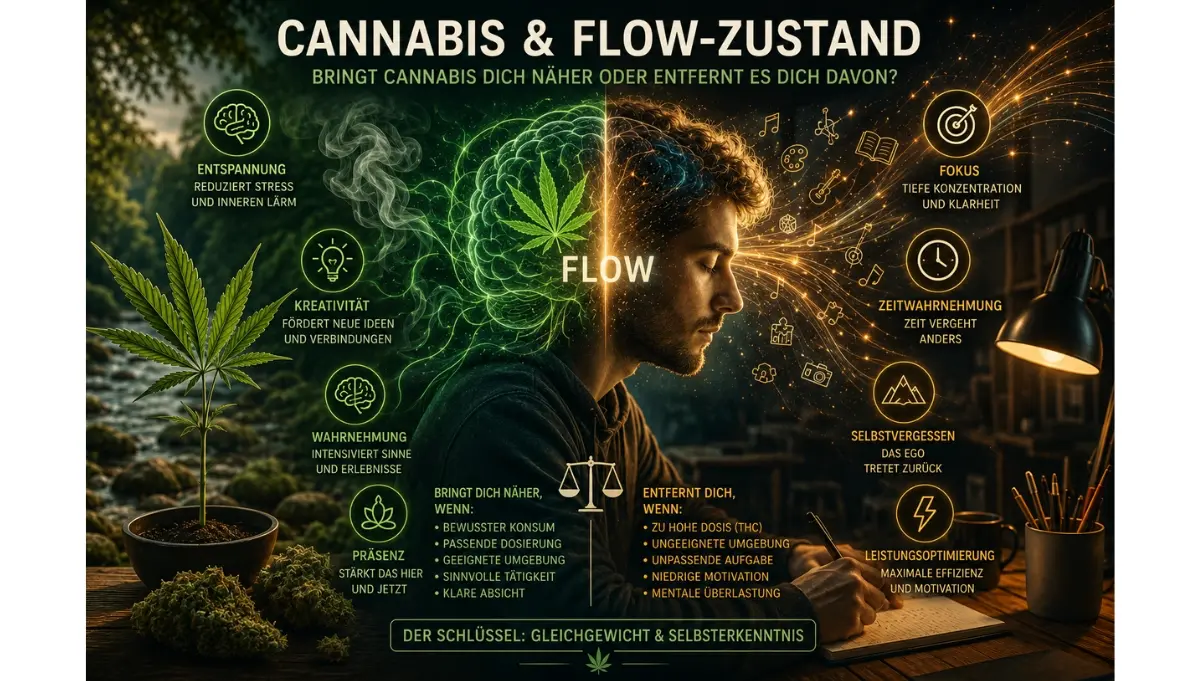
Flow is not the same as relaxation or intoxication. It is a highly active mental state in which attention, motivation, and performance align. The real question is not whether cannabis automatically creates flow, but whether it can help some individuals move closer to it.
What Is Flow?
The concept of flow became widely known through the work of psychologist Mihály Csíkszentmihályi. His research describes flow as an optimal state of consciousness in which all attention becomes focused on a specific activity.
The task is challenging enough to be engaging, but not so difficult that it causes stress or overwhelm. The individual remains in control while becoming fully absorbed in the activity.
Flow commonly occurs during:
- sports,
- playing music,
- drawing and painting,
- programming,
- writing and content creation,
- gardening,
- technical and hands-on work.
Key Characteristics of Flow
- Deep concentration
- Strong presence in the moment
- Reduced self-criticism
- Altered perception of time
- Intrinsic motivation
- Smooth and effortless action
- A sense of control and natural performance
Flow is not passive relaxation. It is not about “switching off the brain.” Quite the opposite—the mind is working at a very high level, but without unnecessary distractions. Attention becomes focused on a single objective.

What Happens in the Brain During Flow?
Modern neuroscience suggests that flow is associated with changes in activity across multiple brain networks. Some regions become less active while others become more engaged. Researchers often refer to this phenomenon as transient hypofrontality.
In simple terms, brain regions involved in constant self-evaluation, worry, and self-criticism may temporarily become less dominant.
As a result:
- feelings of self-doubt may decrease,
- overthinking may be reduced,
- focus on the present moment may increase,
- decision-making can become more fluid.
Interesting Observation
Many athletes, artists, and entrepreneurs report achieving levels of performance in flow that would be significantly more difficult to reach under ordinary circumstances.
Why Do Many People Associate Cannabis with Flow?
Many cannabis users report that they can immerse themselves more easily in certain activities. Commonly mentioned experiences include heightened perception, increased creative thinking, and a stronger ability to tune into a task.
There may be several reasons for this. For some individuals, cannabis may temporarily reduce internal mental noise, excessive self-criticism, or constant rumination. This can create conditions that make it easier to become absorbed in an activity.
For others, however, the exact opposite may happen.
| Possible Positive Experiences | Possible Negative Experiences |
|---|---|
| Feeling of increased creativity | Difficulty concentrating |
| Enhanced sensory perception | Slower thinking |
| Reduced self-criticism | Weaker memory performance |
| Greater sense of immersion | Increased distractibility |
The Relationship Between Flow and Cannabis Is Highly Individual
One of the most important factors is the uniqueness of each person's nervous system. No two people respond in exactly the same way. What feels inspiring and productive for one individual may feel distracting or uncomfortable for another.
The experience can be influenced by:
- individual neurological differences,
- current mood,
- stress levels,
- the surrounding environment,
- the nature of the task,
- previous experiences.
For this reason, it is impossible to make a universal claim that cannabis either promotes or prevents the development of a flow state.

A Common Misconception
Many people confuse flow with pleasant relaxation or intoxication. They are not the same thing. Flow requires active attention and continuous engagement, whereas relaxation is usually associated with a reduction in mental effort and stimulation.
Which Activities Most Commonly Trigger Flow?
Flow is most likely to occur during activities that provide a clear goal, immediate feedback, and a level of challenge that matches the individual's abilities.
- playing music,
- drawing and painting,
- writing,
- programming,
- photography,
- video editing,
- gardening,
- sports,
- cooking,
- hands-on craftsmanship.
Grower's Tip
Many growers report experiencing flow while caring for plants, pruning, transplanting, or simply observing their garden. Repetitive tasks that still require attention can naturally encourage immersion in a focused and productive rhythm of work.
Why Do Many People Associate Cannabis with the Flow State?
Discussions about the connection between cannabis and flow often begin with personal experiences. Many cannabis users report that their perception changes in certain situations, time seems to pass more slowly, music feels more immersive, or creative activities become easier to engage with.
At first glance, these experiences can resemble some elements of the flow state. Attention becomes more focused on a particular activity, external distractions seem less important, and the feeling of being fully present in the moment may increase.
This is most commonly reported during activities that naturally involve perception, self-expression, or repetitive movements.

In Which Situations Is This Most Commonly Described?
- While listening to music, details and rhythms may feel more vivid
- During drawing or painting, associations may arise more easily
- While writing, thinking can feel more open and unrestricted
- During gardening, the sense of presence may increase
- During meditation or breathing exercises, immersion can feel deeper
- In repetitive tasks, the perception of time often changes more noticeably
However, it is important to distinguish between flow and an altered state of consciousness. While the two may share certain characteristics, they are not the same thing.
One of the defining features of flow is high performance. A person does not simply feel good; they are also performing the task efficiently and purposefully. Attention becomes sharper rather than scattered.
If someone frequently loses track of what they are doing, becomes distracted, struggles to follow their thoughts, or works less accurately, they are likely experiencing a different state rather than classic flow.
A Common Misconception
A pleasant experience alone is not flow. One of the most important characteristics of flow is the combination of well-being and high performance occurring at the same time. It is this balance that forms the core of the flow experience.
The Endocannabinoid System and Natural Flow Experiences
When discussing cannabis, the role of the endocannabinoid system is frequently mentioned. This is one of the body's natural regulatory systems and is involved in numerous physiological processes.
The endocannabinoid system works through naturally produced molecules known as endocannabinoids. These compounds are created by the body itself and help fine-tune a variety of biological functions.
Research suggests that the endocannabinoid system may be linked to:
- mood regulation,
- stress responses,
- motivation,
- reward mechanisms,
- pain perception,
- learning and memory.
This is particularly interesting because some of the same systems may also play a role in certain natural flow-like experiences.

What Is a Runner's High?
After long-distance running or intense endurance exercise, some people report entering a unique state. Their mood improves, pain feels less noticeable, a sense of inner calm develops, and occasionally even a mild euphoric feeling is described.
This phenomenon is known as the Runner's High. For many years, it was mainly explained through the release of endorphins. More recent research, however, suggests that the endocannabinoid system may also play an important role.
What Does This Mean in Practice?
Under certain conditions, the human body can naturally create biochemical states that influence mood, motivation, pain perception, and the feeling of becoming deeply immersed in an activity.
This does not mean that exercise, flow, and cannabis trigger exactly the same process. Rather, it suggests that certain neurological systems may be involved in multiple types of experiences.
Cannabis and Creativity: The Effect Is Not Always Positive
The relationship between cannabis and creativity has been debated for decades. Many artists, musicians, and creative professionals report feeling more open-minded, noticing new connections, or generating ideas more easily while using cannabis.
This may partly be explained by changes in thinking and association patterns. Some individuals perceive links between concepts that seem less obvious when sober.
However, subjective experience does not necessarily reflect objectively measurable performance.
Scientific studies paint a far more nuanced picture than many popular assumptions suggest.
| Subjective Experience | Objective Performance |
|---|---|
| I feel more creative | Creative performance does not necessarily improve |
| I generate more ideas | The quality of ideas can vary greatly |
| My thinking feels more free-flowing | Organization and evaluation may become more difficult |
| Thoughts seem more interesting | Not every idea later proves useful |
In some controlled studies, high-THC cannabis did not improve creative problem-solving. In certain cases, it even reduced performance in tasks involving divergent thinking.
Divergent thinking is considered one of the foundations of creativity. It refers to the ability to generate multiple different solutions to a single problem.
This does not mean that people cannot experience inspiring or creative moments while using cannabis. Rather, it highlights that the feeling of inspiration and actual creative performance are not always the same thing.
An Important Distinction
Someone may feel more creative even when objective measurements show no improvement in performance. At the same time, unusual perspectives or unexpected associations can sometimes contribute to valuable new ideas.
However, creativity is not only about inspiration. Implementation, refinement, critical thinking, and the ability to turn ideas into reality are equally important parts of the creative process.
The Enemy of Flow: Too Much THC
One of the most important requirements for flow is the ability to maintain stable attention over an extended period of time. To become fully immersed in an activity, the brain must be capable of filtering out distractions, sustaining concentration, and remaining continuously engaged with the task at hand.
For many people, a high dose of THC can interfere with this process. While cannabis may intensify perception or enhance the feeling of immersion in certain situations, larger amounts often produce effects that work against the conditions needed for a genuine flow state.
Potential effects of excessive THC consumption may include:
- more scattered attention,
- short-term memory impairment,
- increased internal dialogue,
- heightened feelings of anxiety,
- slower information processing,
- altered perception of time,
- reduced motivation,
- difficulty making decisions.
These effects are not necessarily unpleasant, but they often conflict with the very mental abilities required to maintain a stable flow state.

Why Can Too Much THC Be Problematic?
Flow is not merely a pleasant feeling. It is also a state of efficient performance. If attention is constantly interrupted, thoughts repeatedly drift away, or memory can no longer reliably support the task, maintaining flow becomes significantly more difficult.
Which Types of Tasks Are Most Affected?
Certain activities are particularly sensitive to changes in concentration and memory. Even minor reductions in attention can lead to noticeable declines in performance.
| Mental Ability | Why Is It Important? |
|---|---|
| Logical thinking | Solving complex problems |
| Precision | Minimizing errors |
| Working memory | Short-term information processing |
| Rapid decision-making | Responding to dynamic situations |
| Coordination | Performing precise movements |
While some individuals may benefit from mild changes in consciousness during creative brainstorming or open-ended artistic work, the same effects can quickly become disadvantages in complex programming, financial analysis, engineering, or other precision-dependent tasks.
An Important Difference
During flow, attention becomes increasingly focused on the task itself. Under the influence of excessive THC, the opposite often occurs: attention begins to drift in multiple directions at the same time.
When Can a Cannabis Experience Feel Like Flow?
Although cannabis does not create flow, the subjective experience can sometimes resemble certain elements of it. This is most likely to occur during activities that naturally encourage deep immersion and engagement.
These activities are often:
- creative,
- low-risk,
- not dependent on constant precision,
- associated with limited responsibility,
- guided by a natural rhythm,
- interesting enough to sustain attention,
- neither too difficult,
- nor too boring.
One of the key requirements for flow is a balance between challenge and skill. If a task is too easy, boredom develops. If it is too difficult, frustration and stress emerge.

Which Activities Are Most Commonly Mentioned?
According to personal reports, flow-like experiences are most frequently associated with activities such as:
- listening to music,
- playing musical instruments and practicing music,
- drawing and painting,
- free-form writing,
- gardening,
- plant care,
- cooking,
- photography,
- spending time in nature,
- visual idea development.
What these activities have in common is that they create relatively little external pressure while still requiring enough attention to allow complete immersion.
Grower's Tip
For many growers, caring for plants is a natural source of flow experiences. Watering, pruning, transplanting, or regularly observing plants are repetitive activities that demand attention and can encourage deep engagement with the task, regardless of cannabis use.
Flow Is Not Created by Cannabis
One of the most common misconceptions about flow is the belief that it can be produced by an external substance or tool. In reality, flow is primarily a psychological and neurological process.
Several factors must come together for flow to occur:
- an appropriate level of skill,
- a clear goal,
- immediate feedback,
- motivation,
- an environment with minimal distractions,
- sustained attention over time.
Cannabis can only influence the state of consciousness in which these processes take place. For some individuals, under specific circumstances, it may contribute to a flow-like experience. For others, it may move them further away from it.
From the perspective of flow itself, the critical factor is not whether cannabis is present. What truly matters is whether the delicate balance between challenge, skill, motivation, and attention is achieved.
The Most Important Takeaway
Flow is not the effect of a substance—it is a state. Cannabis may influence the path toward that state under certain circumstances, but flow itself continues to emerge from the connection between a person and the activity to which they are fully devoted.
CBD, THC, and Flow: Not the Same Story
When discussing the relationship between cannabis and flow, it is important to distinguish between the plant's most well-known compounds. In everyday conversation, people often speak simply about the “effects of cannabis,” even though those effects are actually the result of a complex interaction between hundreds of different plant compounds.
In discussions about flow, THC and CBD are usually at the center of attention. These two well-known cannabinoids may interact with attention, perception, and subjective experiences in different ways.

The Role of THC
THC, or tetrahydrocannabinol, is the best-known psychoactive compound found in cannabis. It is responsible for many of the classic experiences most people associate with cannabis use.
The effects of THC can vary considerably from person to person. Commonly reported experiences include:
- altered perception of time,
- heightened sensory experiences,
- feelings of euphoria,
- changes in thought associations,
- mood fluctuations.
At higher doses, however, THC may also contribute to:
- anxiety,
- confusion,
- impaired attention,
- memory difficulties,
- excessive self-monitoring.
This contrast is what makes THC particularly interesting in the context of flow. For some individuals, it may reduce internal barriers and self-consciousness, while for others it can make sustained concentration more difficult.
A Common Misconception
Many people equate flow with euphoria. In reality, a pleasant or intense experience alone is not a flow state. Core elements of flow still include focus, control, and purposeful action.
The Role of CBD
CBD, or cannabidiol, tells a different story. Unlike THC, CBD does not produce a classic intoxicating effect and is not associated with what is commonly described as being “high.”
Research over the past decade suggests that CBD may influence several neural networks, particularly those involved in:
- stress responses,
- emotional regulation,
- mood-related processes,
- certain cognitive functions.
From the perspective of flow, this is particularly interesting because excessive stress and anxiety are often major obstacles to deep engagement in an activity. People who are constantly overthinking, self-monitoring, or worrying about mistakes often find it more difficult to become fully present in the moment.
However, this does not mean that CBD automatically creates a flow state. At present, a direct scientific connection between CBD and flow has not been clearly established.
Why Is This Interesting?
One of the greatest enemies of flow is often not a lack of attention, but excessive self-criticism and internal tension. For this reason, any factor that may influence these processes attracts significant interest from researchers and practitioners alike.
Cannabis Is Not a Shortcut to Flow
In modern self-improvement culture, many people search for methods that promise better performance, greater creativity, or deeper concentration in less time. When it comes to flow, however, there is no simple shortcut.
Flow is not a trick. Not a tool. Not a strain. Not a playlist. Not an app. And not a single plant compound.
Instead, flow is a delicate state of balance that emerges when multiple factors align in the right way at the same time.
Classic flow typically requires:
- a clear goal,
- immediate feedback,
- an appropriate level of challenge,
- sufficient skill and experience,
- minimal distractions,
- intrinsic motivation,
- a safe environment,
- a stable state of attention.

The Formula for Flow
If a task is too easy, boredom develops. If it is too difficult, stress and frustration emerge. Flow is most often found between these two extremes, where challenge and skill are in balance.
Cannabis may help some people filter out distractions or view a problem from a different perspective. For others, however, the same effects may result in reduced concentration and increased distraction.
For this reason, flow cannot be reduced to the influence of a single substance. It continues to arise primarily from the interaction between the individual, the environment, and the task itself.
Creative Work and Cannabis: Idea Generation Is Different from Execution
In creative professions, the question of whether cannabis can support creativity has been debated for decades. As with many aspects of cannabis, the answer is more complex than a simple yes or no.
Creative work generally consists of two distinct phases:
- idea generation,
- execution and refinement.
During idea generation, free associations, unusual connections, and intuitive thinking often take center stage.
At this stage, some individuals report that new ideas or creative insights come to them more easily.

Grower's Tip
Many creative people consciously separate inspiration from execution. Gathering ideas and later developing them into finished work often require entirely different mental states.
When the Idea Is No Longer the Main Challenge
The second phase of creative work is often less exciting, yet this is where the final result is actually created. The quality of a marketing campaign, music project, video, or article is often determined not by the original idea, but by how effectively it is developed.
During the execution phase, the following become especially important:
- editing and revision,
- review and quality control,
- structural development,
- strategic thinking,
- linguistic precision,
- attention to detail,
- meeting deadlines and schedules.
These are precisely the areas where excessive THC effects may create difficulties. Reduced concentration, memory issues, or slower decision-making can directly affect the quality of the final work.
| Idea Generation | Execution |
|---|---|
| Associations | Precision |
| Inspiration | Structure |
| New perspectives | Revision |
| Experimentation | Quality control |
A Common Realization Among Creative Professionals
For many creatives, separating inspiration from execution leads to better long-term results. The birth of an idea and the process of transforming it into a finished product often require completely different states of attention, focus, and work.
Flow Naturally: Achievable Without Cannabis
One of the most fascinating aspects of the flow state is that it does not require special tools or external influences. While many people search for shortcuts to deeper focus, studies suggest that flow most often emerges from the combination of a suitable environment, intentional attention, and a well-matched task.
Most people have experienced flow multiple times throughout their lives without fully realizing what was happening. It can occur while writing a long article, engaging in sports, working on a creative project, or even spending a peaceful afternoon in the garden.
Flow is therefore neither mystical nor rare. Instead, it is a natural human capability that can be consciously developed and strengthened over time.

What Can Encourage the Development of Flow?
- 60 to 90 minutes of uninterrupted work
- Turning off phones and notifications
- Focusing on one clear task at a time
- Breaking large projects into smaller steps
- Creating a consistent start-up ritual
- Using suitable music or complete silence
- Taking advantage of natural daylight
- A brief exercise session before work
- Handwritten notes
- Consciously avoiding multitasking
Flow is often less dramatic than many people expect. It does not need to be accompanied by euphoria or extraordinary experiences. In many cases, it simply means that internal resistance disappears and a person becomes aligned with the task they are performing.
During these moments, motivation no longer feels forced. Attention no longer feels like a struggle. Procrastination fades into the background. You are simply immersed in the process itself.
Grower's Tip
Many growers discover that observing their plants, pruning, transplanting, or improving the growing environment becomes a natural source of flow. Repetitive activities that still require attention often encourage deep immersion almost automatically.
The Most Important Question: Does It Truly Help, or Does Everything Just Seem More Interesting?
To understand the relationship between cannabis and flow, this may be the most important question of all. Many experiences can feel extraordinarily intense, inspiring, or meaningful in the moment.
The real question, however, is not how interesting something feels while it is happening, but what remains after the experience is over.
An idea may initially seem brilliant yet prove unstructured or impractical the next day. On the other hand, an unusual perspective may genuinely help someone overcome a creative block and produce valuable long-term results.
For this reason, it is useful to distinguish between two different things when evaluating flow:
- the immediate experience,
- the long-term outcome.

| Immediate Experience | Actual Outcome |
|---|---|
| An exciting idea | A practical solution |
| A strong feeling of inspiration | An executable project |
| Interesting thoughts | Real-world value |
| An altered state of consciousness | Sustainable performance |
The Most Objective Perspective
From the perspective of flow, cannabis is neither automatically beneficial nor automatically harmful. A more accurate statement would be that it can alter the mental conditions under which flow develops—while at the same time potentially disrupting those same conditions.
Conclusion
The relationship between cannabis and flow is a fascinating area of study located at the intersection of psychology, neuroscience, creativity research, and human performance. Although growing attention is being paid to the topic, science has not yet provided definitive answers to every question.
What can be stated with greater confidence is that flow generally requires:
- deep concentration,
- intrinsic motivation,
- a balance between challenge and skill,
- a stable state of attention,
- a suitable environment.
During creative, intuitive, or sensory-focused activities, some individuals report flow-like experiences while using cannabis. In other situations, however, the same effects may reduce concentration, impair memory, or make productive work more difficult.
High THC levels, complex tasks, intense performance pressure, or an unsuitable environment may often move a person further away from flow rather than closer to it.
Ultimately, flow is not about cannabis. Flow describes a unique relationship between a person and an activity. It is the state in which attention, motivation, knowledge, and action merge into a single continuous process.
Cannabis may sometimes deepen that connection and sometimes distort it. The difference is not measured by the intensity of the experience itself, but by what remains afterward: clearer thinking, meaningful results, and genuine creative achievement—or simply an interesting memory.
Legal and Health Disclaimer
This article is intended solely for educational and informational purposes. Laws regarding the possession, use, cultivation, and distribution of cannabis vary significantly between countries and regions. Always follow the laws and regulations applicable in your local jurisdiction.
Individuals with mental health conditions, anxiety disorders, panic disorders, bipolar disorder, those taking prescription medications, or people with an elevated risk of substance dependence may face additional risks associated with cannabis use. In such cases, consultation with a qualified healthcare professional is recommended.
Author
Bartholomew Alen
CMO – Grow Island
The goal of the Grow Island blog is to provide accessible, science-informed, and practical information about cannabis culture, botany, cultivation, history, and related fields of research.
Scientific Sources and Further Reading
The preparation of this article was informed by scientific publications and review papers covering the neuroscience of flow states, the cognitive effects of cannabis, the endocannabinoid system, and the relationships between creativity, attention, and performance.
1. Gold, J. & Ciorciari, J.
A Review on the Role of the Neuroscience of Flow States in the Modern World
A comprehensive literature review examining the neuroscientific foundations of flow states. The authors discuss the relationships between flow, attention, performance, cognitive control, motivation, and optimal mental functioning.
2. van der Linden et al.
Go with the Flow: A Neuroscientific View on Being Fully Engaged
This paper connects the flow state with dopaminergic and noradrenergic systems as well as large-scale attentional networks in the brain. It provides valuable insights into focus, immersion, engagement, and high-level performance.
3. Kowal et al.
Cannabis and Creativity: Highly Potent Cannabis Impairs Divergent Thinking
A study exploring the relationship between cannabis and creativity. The findings suggest that high-THC cannabis does not necessarily enhance creativity and may, in certain situations, impair divergent thinking—a key component of creative problem-solving.
4. Sewell et al.
Acute Effects of THC on Time Perception in Frequent and Infrequent Cannabis Users
This study investigates the relationship between THC and time perception. The subjective slowing or distortion of time is one of the most commonly reported cannabis experiences and shares certain similarities with the altered perception of time that may occur during flow states.
5. Siebers et al. and Research on Runner's High
The Endocannabinoid System and Natural Euphoria
Research on the endocannabinoid system suggests that naturally occurring cannabinoid-like molecules produced by the body may contribute to feelings of well-being, mild euphoria, and reduced anxiety following prolonged physical activity. These findings provide interesting parallels for the study of naturally occurring flow experiences.
6. Burggren et al.
Cannabis Effects on Brain Structure, Function, and Cognition
A broad scientific review examining the effects of cannabis on brain structure, brain function, and cognitive performance. The paper discusses attention, memory, executive functioning, and information processing—areas closely connected to the development and maintenance of flow states.
Note for Readers
The relationship between flow, creativity, and cannabis remains an active area of scientific research. New findings continue to expand current understanding, which means conclusions should always be considered within the context of the best available evidence at the time. Personal experiences and scientific data do not always align. The goal of this article is therefore not to provide definitive answers, but to present the current state of knowledge in a balanced, accessible, and evidence-informed manner.









Comments