Author: Bartholomew Alen
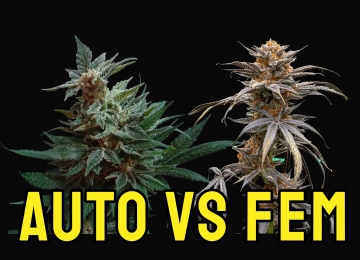
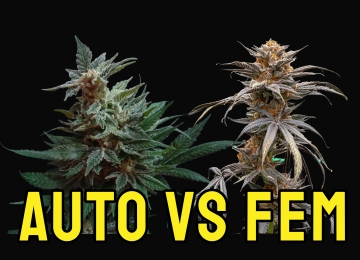
Autoflower or feminized? The question is not entirely accurate, because autoflower seeds are also commonly sold in feminized form. The real decision is therefore: autoflowering or feminized photoperiod? This guide explains the difference, helps you choose the right category through five questions, and introduces several well-known seedbanks whose strains are available from Grow Island.
The most important clarification
Feminized describes the expected sex of the plants. Autoflowering describes a genetically controlled flowering trigger. An autoflower can therefore also be feminized. In this article, we use Photo as shorthand for feminized photoperiod seeds.
1. Autoflowering and photoperiod explained simply
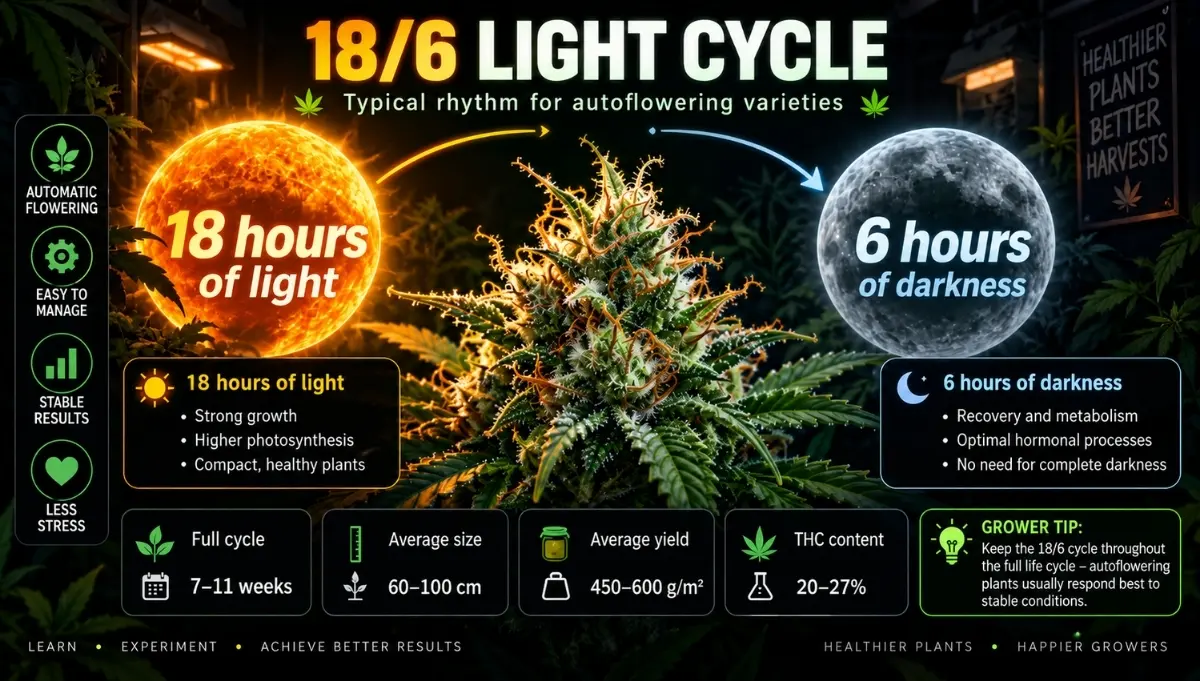
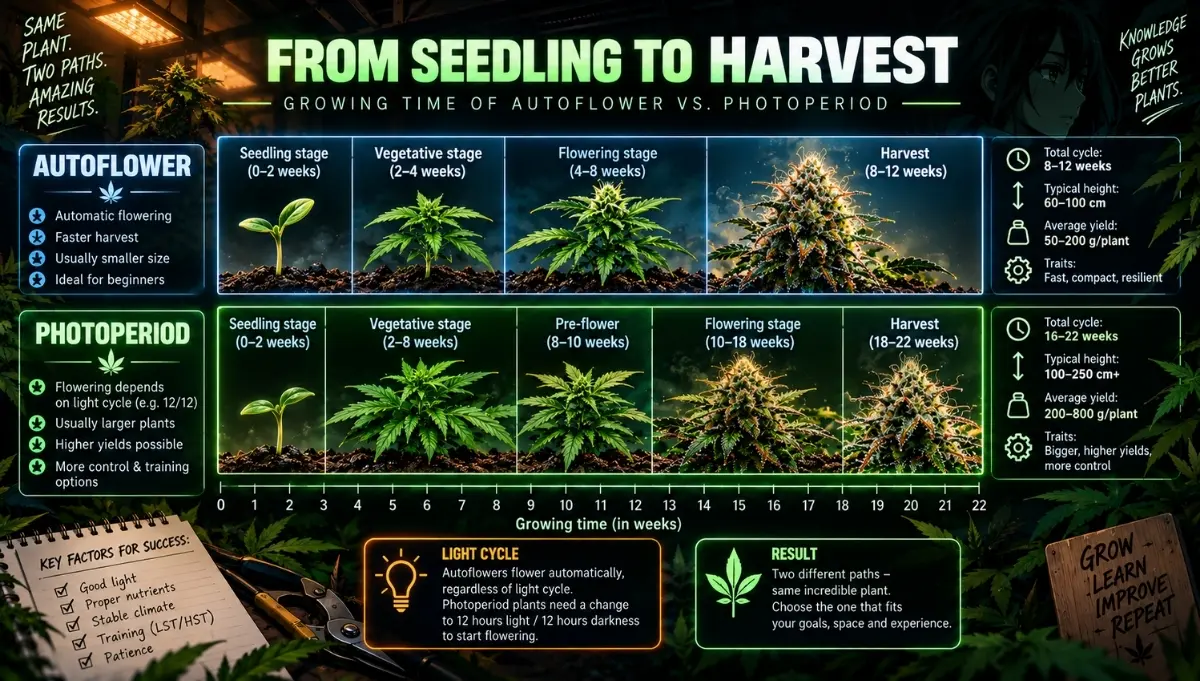
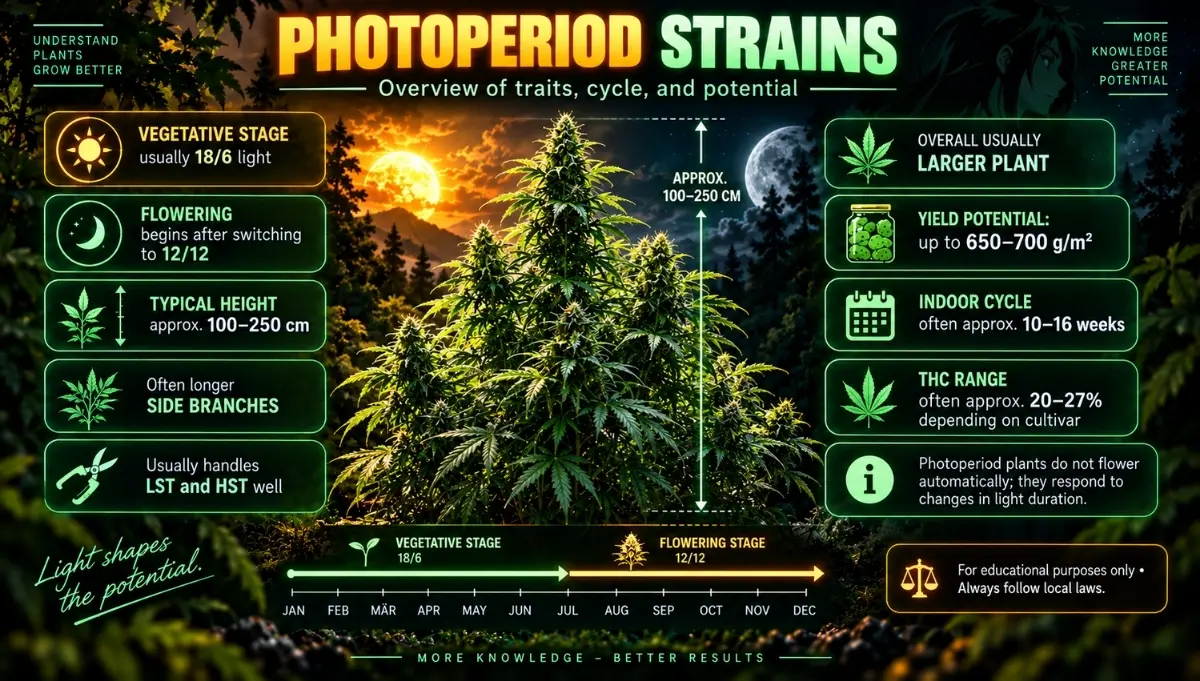
Photoperiod cannabis plants respond to the length of the light and dark periods. Indoors, flowering is typically initiated by significantly extending the dark period. This allows the grower to influence how long the vegetative stage lasts. The additional time creates more room for transplanting, training, and recovery after stress.
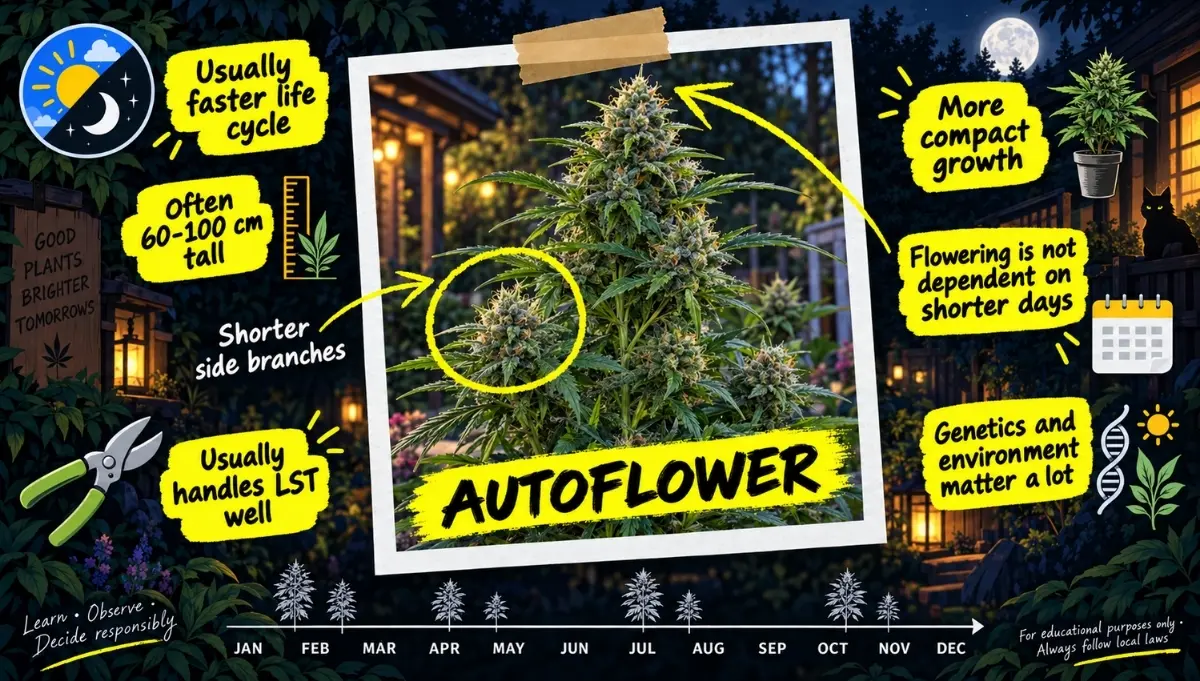
Autoflowering genetics carry traits associated with Cannabis ruderalis. They begin flowering after a genetically influenced developmental period and do not wait for a specific change in light cycle. This makes the overall schedule more compact, but it also removes the option to extend vegetative growth indefinitely. The development of modern autos is covered in The Revolution of Autoflower Genetics.
The botanical basics of different cannabis types are explained in our article Cannabis indica, sativa and ruderalis. If you are completely new to the subject, it is also worth reading our guide to germinating cannabis seeds.
2. Five questions to help you decide
Question 1: Is a short, fixed schedule more important than maximum control?
If a compact and relatively predictable life cycle is the priority, an autoflower may be a good fit. However, the development time listed by the breeder is not a guaranteed harvest date. Phenotype, light, pot size, root health, and climate all influence real development. Photos usually require a longer overall cycle, but in return they offer a freely controllable vegetative stage.
Question 2: How much space is actually available?
Autos do not automatically stay small, and Photos do not necessarily become huge. With photoperiod plants, flowering can be initiated earlier, while with autoflowers final height depends more heavily on genetics and early conditions. Calculate the actual usable height after subtracting the pot, the light fixture, and a safe lamp distance. Our LED distance guide can help with this planning.
Question 3: How much room for error do you need?
A stressed autoflower cannot simply pause its genetically determined development. Overwatering, excessive feeding, or root damage during the first weeks can therefore cost valuable growth time. A Photo can remain in vegetation longer until healthy growth has returned. For this reason, autoflowers are not automatically easier for beginners. For diagnosis support, see the Cannabis Stress Guide.
Question 4: Do you want to use intensive plant training?
Photoperiod plants are generally easier to plan for topping, mainlining, ScrOG, and stronger shaping because more recovery time is available. With autoflowers, early and gentle LST is usually the more cautious approach on a healthy, fast-growing plant. Aggressive interventions without experience can place unnecessary stress on a short life cycle. Even defoliation should not be applied automatically.
Question 5: Indoor, balcony, or seasonal outdoor growing?
Autoflowers can be interesting where the summer window is short or where several staggered cycles are planned. Photoperiod plants can make fuller use of a long season and may become considerably larger outdoors. Location, stray light, weather, and local regulations matter more than a simple Auto or Photo label. For more detail, see our outdoor growing guide and our article about growing on balconies and terraces.
3. Auto vs. Photo: direct comparison
Scroll horizontally to view the table
| Criteria |
Autoflowering |
Feminized photoperiod |
| Start of flowering |
Age- and genetics-dependent |
Responds to the light period |
| Vegetative period |
Cannot be extended freely |
Controllable indoors |
| Error tolerance |
Lost time is difficult to recover |
Recovery before flowering is possible |
| Training |
Preferably early and gentle |
More flexible and intensive planning |
| Cloning |
Generally impractical because development continues |
Well suited to cloning |
| Light cycle |
No light-cycle switch required for flowering |
Flowering cycle must be controlled |
| Typical advantage |
More compact schedule |
Maximum control |
The decision in one sentence
Choose Auto if a compact, more genetically determined schedule fits your space and planning. Choose Photo if you want to control growth, training, and the start of flowering yourself or need more time to correct mistakes.
4. Breeder profiles: origin, philosophy, and distinctive features
Grow Island carries seeds from many international breeders. A broad selection is useful, but it can also make direct comparison more difficult. The following profiles cover long-established seedbanks and modern autoflower specialists. A Cup win can indicate recognition at a specific competition, but it does not guarantee that a strain will suit your space, climate, or experience level. You can find another detailed breeder profile in our article about World of Seeds.
Barney's Farm: Amsterdam, landraces, and many Cup successes
According to its own company history, Barney's Farm was founded in Amsterdam in 1986. The story of the brand is closely associated with Derry and a collection of Asian landrace genetics. Its modern breeding program combines historical lines with contemporary international breeding. The philosophy can be summarized simply as preserving tradition while developing it further through modern selection.
The seedbank refers to numerous Cannabis Cup awards. Historically well-known names include Pineapple Chunk and LSD. Such results relate to specific competitions, categories, and generations and should not be treated as a general performance guarantee for every later seed pack. For more history, see our Grow Island profile of Barney's Farm.

Barney's Farm Pineapple Express Auto
An automatic version from the broad Barney's Farm catalog. It is a good example of how established seedbanks adapt familiar genetics to a more compact autoflower cycle.
View seeds
Dutch Passion: Dutch pioneering work
Dutch Passion was founded in Amsterdam in 1987 by Henk van Dalen. According to the company's own history, its roots go back to the 1970s. The brand places particular emphasis on its role in the commercial development of feminized cannabis seeds in the late 1990s. Its core idea combines long-term selection, innovation, and broader access to high-quality genetics.

Dutch Passion Think Different Auto
A well-known autoflower line from a long-established Dutch seedbank. It may appeal to growers who want modern automatic genetics backed by Dutch Passion's long breeding history.
View seeds
Sensi Seeds: genetic preservation and Dutch classics
Sensi Seeds was founded in 1985 by Ben Dronkers. The brand emphasizes genetic preservation, authenticity, quality, and normalization of the cannabis plant as core values. Lines such as Skunk #1, Hindu Kush, Northern Lights, and Jack Herer have had a major influence on European breeding history.

Sensi Seeds Jack Herer Fem
A traditional photoperiod genetic for growers who want to control the vegetative period and training themselves. Jack Herer remains one of the best-known names in the historic Sensi Seeds catalog.
View seeds
Serious Seeds: smaller catalog, longer selection
Serious Seeds was established in the mid-1990s under biologist Simon. The brand emphasizes that new names are not released simply for marketing reasons, but that lines are tested and selected over a longer period. The principle can be summarized as quality and stability before maximum catalog size.

Serious Seeds AK-47 Fem
One of the historically best-known Serious Seeds lines. As a photoperiod genetic, it offers more time for shaping and recovery than a comparable automatic line.
View seeds
Fast Buds: a clear autoflower focus
Fast Buds is especially known for its broad selection of modern autoflower genetics. The brand's strength lies less in a single historic classic and more in consistently translating modern hybrid, aroma, and flavor directions into automatic lines. This can suit growers who want a wide choice of strains with a compact cycle that does not depend on a flowering light switch.

Fast Buds Gorilla Cookies Auto
A good example of the brand's modern autoflower focus. The compact life cycle makes stable early conditions and careful planning particularly important.
View seeds
Sweet Seeds: Spanish genetics and colorful specialties
Sweet Seeds originates from Spain and is known for feminized, automatic, and fast-flowering lines. The brand became especially visible through genetics capable of developing genetically influenced red and purple tones. Color alone, however, is not a reliable indicator of maturity, potency, or plant health because temperature, phenotype, and environmental conditions also influence appearance.

Sweet Seeds Cream Caramel Fem
A photoperiod strain from the established Sweet Seeds catalog. It may appeal to growers who prefer a Spanish seedbank and a freely controllable vegetative period.
View seeds
Royal Queen Seeds: broad selection and clear categories
Royal Queen Seeds offers a very broad European catalog including autoflowers, feminized photoperiod strains, CBD lines, and modern hybrids. Its strength lies in the large selection and relatively clear categorization. For that reason, it makes sense to filter not only by popularity, but also by available space, cycle length, climate, and experience level.

Royal Queen Seeds Royal Gorilla Fem
A feminized Photo for growers looking for a modern hybrid line with a freely planned vegetative period. Training and the flowering switch can be adapted to the available space.
View seeds
Paradise Seeds: Amsterdam experience since the 1990s
Paradise Seeds is one of the established Dutch seedbanks. The brand combines traditional European breeding work with a relatively focused selection of automatic and photoperiod lines. Wappa is a good example of the same strain name appearing in different flowering types.

Paradise Seeds Auto Wappa
The automatic Wappa version shows how an established Photo family can be further developed for a self-flowering cycle. Product data from the Auto should never be copied directly from the photoperiod version without checking.
View seeds
5. How to interpret Cup winners correctly
Names such as Cannabis Cup, Highlife Cup, or Spannabis Cup do not represent one globally standardized test. Categories, judges, year, and submitted product can all differ. Some awards refer to flowers from a selected phenotype rather than automatically applying to every plant later grown from a seed pack.
Scroll horizontally to view the table
| Breeder or line |
Historical reference |
What an award does not guarantee |
| Barney's Farm |
Numerous Cup awards according to brand statements |
Identical performance in every climate and setup |
| Serious Seeds AK-47 |
Historical competition success since the 1990s |
An identical phenotype from every seed |
| Kali Mist |
Historical Cannabis Cup recognition |
Suitability for low spaces or beginners |
| White Russian |
Historical Cup success according to Serious Seeds |
A specific yield or cannabinoid level |
| Sensi Seeds |
Numerous strain and seedbank awards |
That historical lines remained completely unchanged for decades |
Better than buying based only on trophies
Check flowering type, expected size, development time, climate suitability, and training tolerance first. Lineage, aroma, and awards are useful secondary criteria after that. A Cup title cannot compensate for an unsuitable environment.
6. The same name as Auto and Photo
An Auto version is not simply the same photoperiod strain with a built-in clock. To introduce the self-flowering trait, a new breeding line must be created and selected over several generations. Aroma, structure, development time, and phenotype distribution may therefore differ. Always compare the product description of the exact version.

Tangerine Dream Fem
The photoperiod version gives the grower control over vegetative duration and the flowering switch. It should not be treated as identical to the Auto version simply because they share the same name.
View Photo

Tangerine Dream Auto
The automatic version begins flowering independently of a flowering light-cycle switch. It offers a more compact schedule but gives less time to correct early mistakes.
View Auto
7. Common mistakes when choosing seeds
- Treating Auto and feminized as opposites.
- Choosing only by maximum THC or yield figures.
- Reading breeder week estimates as guaranteed calendar dates.
- Calculating final height without including the pot, light, and safety distance.
- Transplanting an autoflower repeatedly or pruning it heavily late in development.
- Underestimating stretch after the flowering switch with Photos.
- Confusing a Cup award with guaranteed uniformity.
- Starting too many genetics with very different development times at once.
For further planning, see our guide to the 10 most common growing mistakes. Slow growth is not necessarily genetic; for that, use our diagnostic article Slow-growing cannabis plant.
8. Quick test: which genetics suit you?
Do you want to decide when flowering begins?
Then a feminized Photo is usually the better fit. You can adapt the vegetative period to the available space, plant size, and plant health.
Do you only have a short seasonal window?
An Autoflower may be suitable if temperature, natural light, location, and legal conditions are appropriate.
Do you want to top, mainline, or train for a long period?
A Photo usually provides more recovery time and more planning flexibility.
Are you a beginner and expecting small mistakes?
A Photo is often more forgiving because you can delay flowering. Simplicity does not depend only on the light cycle.
Do you want to grow Auto and Photo under the same light?
It is technically possible, but often not ideal. Different light schedules, plant heights, and harvest times make efficient use of the growing area more difficult.
9. Sources and further information
Historical information and breeder self-descriptions should always be checked against official sources. Awards relate to a specific time, category, and competition. Product availability and current strain specifications are determined by the relevant Grow Island product page.
Conclusion
Autoflower is not automatically easier, and Photo is not automatically better. Autos reward good preparation, stable starting conditions, and a compact schedule. Feminized photoperiod strains offer greater control over vegetative time, training, and the start of flowering and can therefore provide more room for error. The right choice starts with your available space, your season, and your experience level.
The breeder is the second decision. Long-established names such as Sensi Seeds, Dutch Passion, Barney's Farm, and Serious Seeds represent decades of breeding history; Fast Buds has a strong autoflower focus; Sweet Seeds, Royal Queen Seeds, and Paradise Seeds expand the choice with their own lines and different breeding philosophies. Always compare the exact strain and its product data rather than relying only on the brand name.
Legal notice from Grow Island
This article is provided solely for general information about cannabis seeds, genetics, and breeders. It does not constitute legal advice and does not encourage unlawful cultivation. Purchase, possession, import, germination, and cultivation may be regulated, restricted, or prohibited differently depending on the jurisdiction. Readers are responsible for checking current laws, age limits, and any permitted plant count where they live.
Strain descriptions, development times, size, yield, and other breeder specifications are guideline values and do not guarantee a specific result. Phenotype, environment, climate, and growing conditions may cause variation. Product links may serve a commercial purpose and may lead to Grow Island offers. Current availability, pack sizes, technical specifications, and prices are determined by the relevant product pages.













Comments