Cannabis Legalization in the Czech Republic in 2026
Czech Cannabis Reform (Effective January 1, 2026): What Changed, What We’ve Seen So Far, and What Comes Next
At the start of 2026, the Czech Republic quietly—but decisively—shifted its approach to cannabis. From January 1, adults gained a clearly defined, nationwide legal framework for limited personal cultivation and possession. The country did notlegalize commercial sales, retail stores, coffeeshops, or a club-based distribution system. On the surface, the reform can look like a short list of numbers. In reality, it signals a broader policy change: less criminalization, more legal clarity, and a more pragmatic use of public resources.
This article summarizes what changed on January 1, 2026, what the first month suggested in practice, the likely economic and tourism implications, how the reform may energize the cultivation scene, and how Czechia’s model fits into Europe’s wider regulatory trend. It also draws a clear line between medical cannabis (highly regulated and prescription-based) and recreational cannabis (now tolerated/allowed within defined limits—but without a legal supply market).
1) What Changed on January 1, 2026?
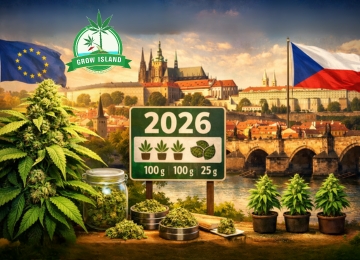
From January 1, 2026, the Czech Republic introduced a limited legalization framework for adult recreational cannabis, focused strictly on personal use. The reform applies to adults aged 21 and over and centers on defined possession and cultivation thresholds.
Key legal thresholds (personal use)
Home cultivation: up to 3 cannabis plants per person
Possession at home: up to 100 grams of dried flower
Possession in public: up to 25 grams
Within these limits, possession and personal consumption do not trigger criminal penalties. The intent is to define what counts as “legal personal use” and reduce the legal ambiguity that previously surrounded small-scale growing.
What did
not
change
Despite the shift, Czechia did not legalize:
Commercial retail sales
Coffeeshops
A nationwide club-based system for distribution
A regulated adult-use market with taxation and licensing
Public consumption also remains restricted: consumption in public places is still prohibited under the legal framework described in the text.
The reform as part of a broader criminal-law overhaul
The cannabis changes took effect as part of a larger criminal justice reform. Czechia had already operated with decriminalization-like practices in the past—since 2010, for example, small amounts (historically referenced as 15 grams) were treated more as an administrative issue than a major crime. However, the rules were not fully unified nationwide for personal cultivation. The 2026 reform aims to create consistent thresholds across the country.
Enforcement remains strict when limits are exceeded
The reform does not eliminate consequences entirely. It draws a hard boundary between “permitted personal use” and “illegal over-limit behavior.” According to the framework described:
Cultivation:
4–5 plants can be treated as an administrative offense
6+ plants can return to criminal offense territory
Possession at home:
101–200 grams may be treated as an administrative offense
over 200 grams can become a criminal offense
Possession in public:
over 25 grams but under 50 grams may be an administrative offense
50 grams and above can be a criminal offense
“Sharing” and distribution: still illegal, with a narrow depenalization detail
Commercial distribution remains illegal, meaning selling or distributing cannabis is prohibited. The text notes a narrow exception: if someone holds cannabis within the permitted quantity limits for another adult, this was reportedly explicitly depenalized (treated as not equivalent to commercial dealing). Practically, however, the message remains: the Czech system is not a legal adult-use marketplace.
Bottom line
Starting in early 2026, Czech adults (21+) can legally engage in limited personal cultivation and possession, but the system is designed as a controlled, cautious model—a partial legalization that increases personal freedom while trying to avoid the risks associated with a fully commercialized free market.
2) First-Month Experiences: A Calm Transition, With Early Signals
January 2026 was the first “legal” month under the new rules, and early reports described a mixed but largely calm transition.
No major incidents reported by police
Authorities and media reported no serious incidents linked directly to the reform. Czech police did not release reports of major disorder caused by the policy change. Prague’s New Year’s Eve was even described by authorities as among the “calmest” in recent years.
This matters because critics of cannabis reform often predict immediate spikes in public disorder. The first month, at least in the narrative presented, did not match that fear.
Continued enforcement focus: especially traffic safety
Officials emphasized that legalization does not equal “anything goes.” One key area was traffic enforcement. Police indicated they would continue strict controls for impaired driving and maintain a zero-tolerance approach to intoxicated driving. In other words: adult-use allowances do not remove road-safety enforcement, and drivers under the influence remain a target of enforcement—just as before.
A spokesperson from the National Investigation Office’s anti-drug division reportedly warned they expect increased cannabis use due to easier access, as seen in other countries. Whether that prediction becomes reality will likely depend on broader social factors and the absence (or future arrival) of a legal supply channel.
Expert and political reactions: progress, but incomplete
Early public debate continued, including contrasting views from well-known figures:
Jindřich Vobořil, former national drug coordinator, described the reform as only a partial step. He acknowledged symbolic progress but highlighted unresolved issues, especially for people who cannot cultivate themselves—such as elderly individuals, people with mobility limitations, or those without adequate space. In such cases, a legal cultivation right does not automatically translate into legal access, which can keep the black market relevant.
Vobořil also suggested that penalties would not disappear entirely, because some individuals will still breach the limits and face consequences. On the positive side, he emphasized that lowering minimum penalties for illegal distribution can make sanctions more proportionate.
Pavel Bém, the new national drug coordinator (and former mayor of Prague), expressed a more optimistic stance. He argued that regulation is more effective than prohibition and expected the reform to reduce burdens on courts and prisons. At the same time, he emphasized he supports a strictly controlled legal market, not unlimited liberalization—suggesting he views controlled regulation as the path with the smallest social and health costs.
Everyday life: little disruption, but “grey-zone” confusion appears
On the ground, daily life did not reportedly become chaotic. Czech society already had a reputation for a relatively tolerant cannabis culture, so many people received the new rules with a calm, pragmatic attitude.
At the same time, a “half-legal” environment can create confusion. One example described is the appearance of “weed cigarettes” in tourist gift shops and small stores in central Prague—products that looked like joints. Police checks reportedly found that these did not violate the law because they contained THC under a 1% threshold or used semi-synthetic cannabinoids that did not fall under the same legal category as banned drugs. Authorities warned that packaging can mislead consumers, giving the impression they are buying legal, high-THC cannabis when they are not.
This phenomenon highlights a key structural issue: when commercial sales remain illegal, market gaps emerge, and questionable products may try to fill them.
Justice system impact: early immediate consequences
The text notes that on January 1, more than 300 prisoners were reportedly released from Czech prisons, including individuals convicted for smaller cannabis-related cases. This is presented as a direct consequence of broader penal code changes linked to the reform.
Bottom line
The first month did not bring large-scale public disorder. The biggest early signals were:
continued focus on impairment enforcement (especially driving),
ongoing debate among experts about the reform’s limitations,
and the emergence of grey-zone products attempting to exploit legal loopholes.
3) Expected Economic, Tourism, and Cultivation Impacts
Partial legalization can bring social and economic changes, but many of the most visible benefits or drawbacks tend to appear over time. In the short term, the text argues that the most tangible impact is cost savings in law enforcement and the justice system.
Economic: savings rather than cannabis tax revenue (for now)
One study referenced from Charles University in Prague estimated the state could save the equivalent of up to €107 million per year by reducing the resources spent pursuing low-level cannabis cases—fewer investigations, trials, and incarcerations.
Those savings could, in theory, be redirected into health and social systems or into prevention and education programs. The government’s logic also suggests that home cultivation might reduce reliance on the black market and reduce demand for new psychoactive substances, including synthetic cannabinoids of uncertain composition.
However, Czechia should not expect direct tax revenue from recreational cannabis yet, because commercial sales remain illegal. Unlike Canada or some U.S. states, Czechia is not opening stores, introducing excise taxes, or building a regulated retail market at this stage.
Indirect economic effects: growth in cultivation-related markets
Even without retail cannabis stores, legalization can stimulate adjacent industries. The rise in home cultivation can boost demand for:
grow lights,
nutrients,
seeds,
small-scale hydroponic equipment,
pots and mini-greenhouses,
and general gardening supplies.
This creates new business opportunities for existing shops and entrepreneurs.
The text also notes that Czechia already had a legitimate cannabis-related economic sector: medical cannabis cultivation and export, with companies operating for years. Greater social acceptance can encourage investment, partnerships, and international interest. One example given: a Ghanaian cannabis industry association planning a visit to Prague in April 2026 to build connections and learn from Czech reforms—suggesting Czechia could become a knowledge hub for cannabis regulation and cultivation technology.
Tourism: perception shifts, but “cannabis tourism” is limited
Prague has long attracted young travelers for nightlife and a relatively tolerant cannabis culture. The reform may strengthen the perception that Czechia is a progressive destination—especially since adults 21+ can legally possess small amounts.
But in practical terms, tourism impacts remain limited because there is no legal supply system for tourists:
No coffeeshops
No clubs
No legal retail purchase option
Tourists cannot lawfully bring cannabis across borders, and obtaining it from the black market remains illegal. Therefore, large-scale cannabis tourism is unlikely under the current framework. Amsterdam became a global cannabis tourism hub largely because it developed tolerated points of sale. Prague has not.
Longer-term, tourism impacts could increase if Czechia later introduces clubs or regulated distribution. That could bring both positive and negative branding effects, depending on public opinion and political framing.
Cultivation culture: a new mainstream wave
The cultivation scene is expected to gain momentum. Thousands of adults can legally grow for the first time, which can increase demand for knowledge:
grow guides,
consulting,
educational media,
expos and events.
The text points to Konopex Expo 2026 in Ostrava as a visible example of a growing public culture around cultivation and knowledge-sharing. Legalization can shift home growing from a marginal, hidden hobby toward a more open, mainstream activity.
4) Medical vs Recreational Cannabis in Czechia: Two Separate Systems
A crucial point is that medical and recreational cannabis operate under entirely different frameworks.
Medical cannabis (legal since 2013)
Medical cannabis has been legal since 2013, with patients gaining access starting in 2014. Since 2020, insurers reportedly cover 90% of the cost for prescription medical cannabis—one of the more generous systems in Europe.
Medical cannabis is:
prescription-only,
dispensed through pharmacies,
tracked and regulated,
quality-controlled and standardized (flower and oils, among other forms),
produced by licensed producers and sometimes imported.
The text also notes a typical monthly dispensing limit: up to 30 grams per patient per month through pharmacies (with possible exceptions for certain low-THC preparations). Eligible conditions can include cancer-related pain and nausea, multiple sclerosis, consequences of spinal injuries, HIV/AIDS symptoms, and certain neurological disorders.
From 2023, general practitioners reportedly gained authority to prescribe in some cases, expanding access. The text references over 41,000 prescriptions filled in the first nine months of 2025, suggesting rapid growth.
Recreational cannabis (limited legalization from 2026)
Recreational cannabis is separated from the medical system:
No pharmacy supply
No quality control
No medical oversight
Adults are responsible for staying within the legal limits
There is also an age difference: recreational legalization applies at 21+, while medical cannabis can apply to adults 18+and, in exceptional cases, even younger patients for certain CBD-dominant treatments.
5) Europe in Context: Where Does Czechia Fit?
Czechia’s approach is not unique, but it is significant—especially in Central and Eastern Europe. Several European jurisdictions have moved toward partial legalization models:
Malta (2021): legal personal possession within limits; home cultivation; access via non-commercial clubs.
Luxembourg (2023): home cultivation allowed; no retail system; public possession restrictions remain tighter.
Germany (2024): home cultivation and personal possession within limits; nonprofit cannabis social clubs introduced; no nationwide retail market.
Spain: no national legalization, but long-standing club culture in some regions and de facto tolerance patterns.
Netherlands: long-tolerated coffeeshop sales despite legal contradictions in production (“backdoor” issues); home cultivation remains officially restricted.
Switzerland: pilot projects and experiments since 2022; developing broader models.
The text suggests Czechia is following a step-by-step strategy: first legalize personal cultivation and possession, then consider pilot projects and clubs later—possibly around 2027–2028—depending on outcomes.
EU and international legal frameworks remain a constraint. The EU currently does not easily support a Canada-style fully commercialized legal market. That’s why many European reforms focus on decriminalization, controlled personal limits, and nonprofit club concepts rather than open retail.
6) Opinion: A Forward Step, But Still a Half-Measure
From a policy perspective, the Czech reform can be seen as progressive and pragmatic. It reduces the stigma and punishment for people who use small amounts for personal consumption. It can reduce burdens on courts and police and redirect attention toward more serious crimes.
Yet it also has real limitations:
1) No legal access pathway for non-growers
If there is no legal supply system, people who cannot grow—due to disability, age, housing limits, or personal choice—may remain dependent on the black market.
2) Loss of potential tax revenue and product quality control
Without legal distribution, the state cannot effectively regulate product quality, safety, or contamination risks, and it also does not capture tax revenue.
3) A built-in contradiction: 3 plants vs 100 grams
One commonly cited issue is the mismatch between allowed cultivation and allowed possession at home. Three healthy plants can easily produce more than 100 grams—sometimes substantially more—so lawful growers can accidentally become lawbreakers unless they destroy “excess” material. That is not always realistic and may require legal fine-tuning.
4) Unresolved adjacent issues
The reform does not fully address practical questions such as:
youth protection beyond the age threshold,
testing standards and fairness in driving enforcement (THC can remain detectable long after impairment),
workplace policies (positive THC tests vs lawful off-duty use).
These likely require additional regulations, guidance, or future reforms.
Bottom line
Czechia’s 2026 cannabis reform is a milestone—particularly in its region. It shows that a pragmatic, humane shift is possible. But it also illustrates that legalization is not a single act; it’s a process. The next years will determine whether Czechia turns this cautious model into a fully workable system—or whether the lack of legal supply keeps the black market and grey-zone products alive.
One thing is already clear: in Czechia—and across Europe—the debate is no longer simply “ban or not ban.” The real question is how to regulate cannabis intelligently.
Back to the posts













Comments