Cali Weed – Why do we love Californian genetics so much?
Cali Weed – Or, Why Do We Love Californian Genetics?
Everyone knows that the mass spread of cannabis in the Western world is linked to the hippie movements of the 1960s, which culminated at the 1969 Woodstock Festival. Today, even the USA admits that the subsequent 'War on Drugs' only served to incarcerate masses of people, while failing to reduce either demand or supply. But there was another, less publicized breakthrough during that era: the emergence of Cali weed—that is, Californian cannabis genetics, which we will explore below.
Sun-Drenched California
California breeders have always had a special reputation among cannabis growers—they were the pioneers who first began experimenting with varieties brought in from Mexico and Colombia and with their crossbreeds. It's no coincidence that California, the heart of the hippie movement, was the first place in the USA to legalize cannabis for medical use and to vote for full legalization.
But as sunny as California summers are, the imported South American Sativas were accustomed to the constant heat of the tropics and only fully matured in California around November–December, which was too late for harvest. Breeders' first mission was to adapt these new genetics to the local climate.
Asian Reinforcements in the Birth of American Strains
The solution was not far off. As cannabis enthusiasts traveled through India, Thailand, Nepal and Pakistan, they collected local cannabis seeds to bring back and cross with the varieties grown in California. This solved their initial problem: these new hybrid cannabis strains could be harvested as early as October. However, they still lacked the potency so prized in the southern Sativas.
So the next goal was to create genetics strong enough for the Californian climate, but maintaining that intensity. According to collective memory, the ancestor of Californian strains was created in 1969 by crossing Columbian Gold with an Afghan male. This became one of the cannabis world's first and most influential hybrids, nicknamed "Skunk" for its pungent aroma. Sounds familiar?
Reports say the Sacred Seeds collective saw their main task as stabilizing this strain for further breeding. Over many years and thousands of cultivation cycles, the group perfected their selection, ultimately creating genetics resistant to local fungi and pests and combining the best traits from two continents.
It was during this time that the Haze strain was also created and stabilized. Original Haze is a pure sativa hybrid: in its first year it was crossed with Colombian and Mexican hybrids, the second year with South Indian males and the third year with a Thai strain.

Final Destination: Europe
After a police raid and nearly a year in prison, Sam the Skunkman, the father of the Skunk and Haze strains, moved to the Netherlands in the early 1980s—ushering in a new era for cannabis breeding. The first big, still-renowned hybrids were born, perfected under the Dutch legal system. The rest is history.
Meanwhile, work in California never stopped. By the 1980s and 1990s, the so-called Emerald Triangle—Mendocino, Humboldt and Trinity counties—became the center of Californian cannabis breeding and cultivation. The use of landrace genetics from around the world continued as breeders crafted ever-newer hybrids. Many still swear by the original California-born strains, but today the genetics are so interwoven that Cali Weed varieties combine the best traits from around the globe.
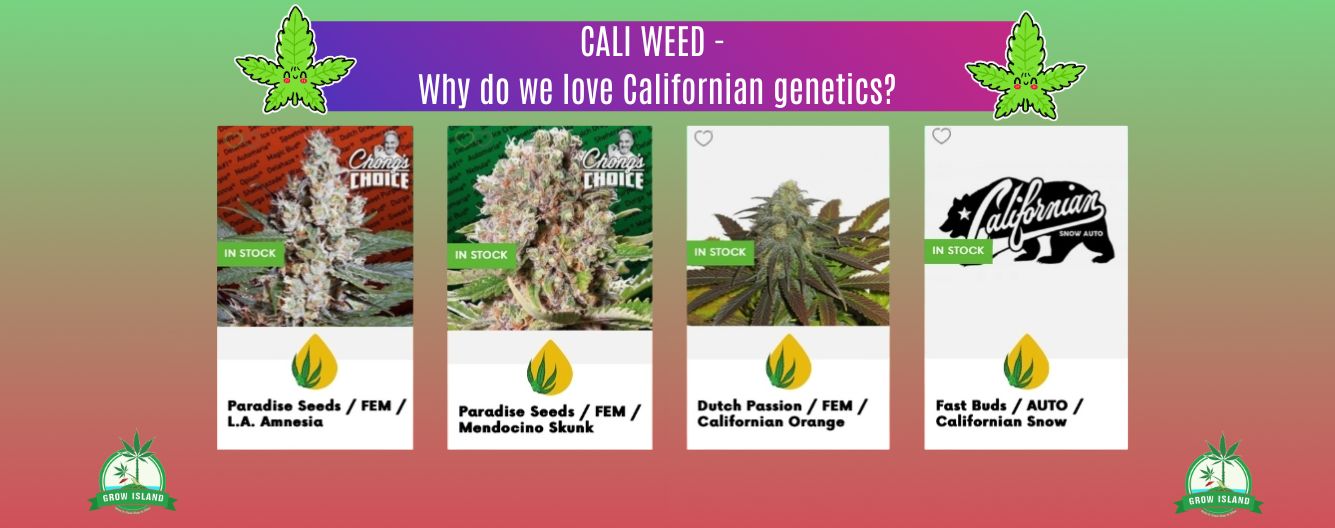
Today, Californian genetics have become synonymous with balanced, high-yielding, potent, and typically hybrid cannabis plants. One of the best-known Cali Weed lines is Paradise Seeds and their collaboration with California actor and cannabis activist Tommy Chong—Tommy Chong’s Collection—which features varieties likeL.A. Amnesia and Mendocino Skunk. Other iconic Californian strains include Gorilla Zkittlez and Runtz X Layer Cake from Barney’s Farm, Californian Snow from Fast Buds and the nostalgic Californian Orange from Dutch Passion—but the list could go on.
Back to the posts


